
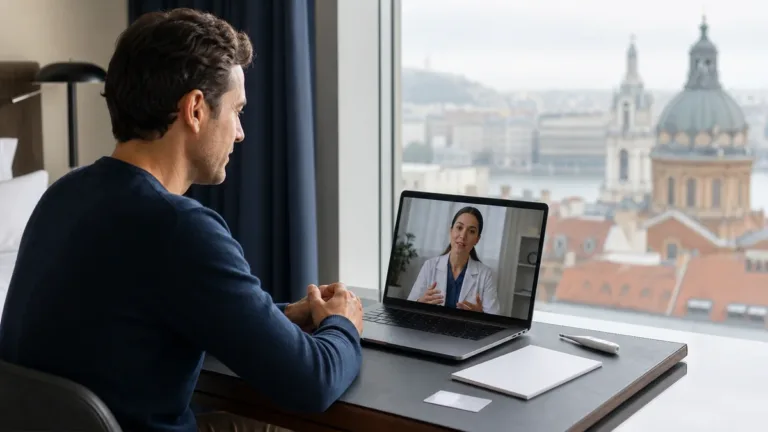
Travel medical insurance telemedicine abroad can mean three different things: an insurer-arranged virtual visit, reimbursement for an independently selected telehealth provider, or remote contact with a traveler’s established U.S. clinician. Access to one does not automatically prove coverage for the others.
This guide helps U.S. travelers compare certificates and prepare for virtual care. It does not diagnose symptoms, decide whether telemedicine is clinically appropriate or replace emergency services.
Key takeaways
- Confirm who provides the visit, where the patient is located and which benefit pays.
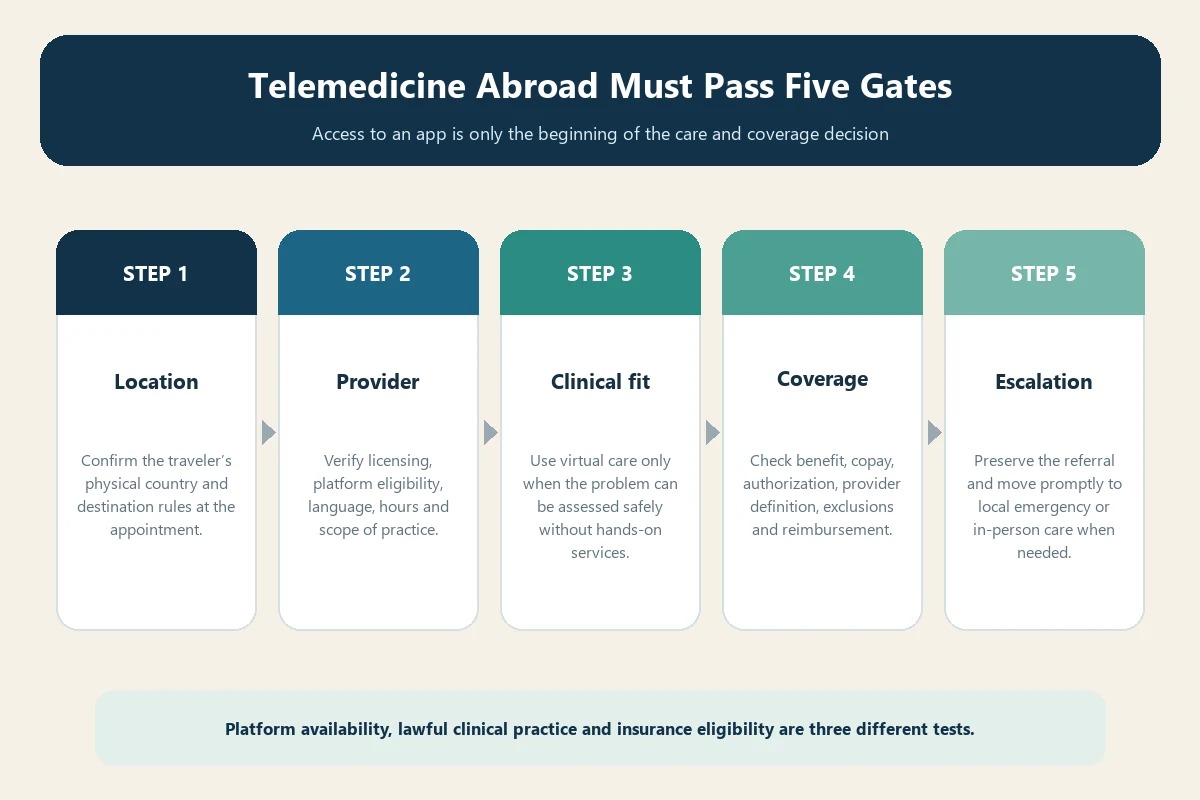
- Treat app access, provider availability and insurance eligibility as separate tests.
- Do not use telemedicine when symptoms require urgent hands-on assessment or emergency care.
- Check prescription, privacy, language, connectivity, preauthorization and reimbursement rules before departure.
- Save the encounter note, diagnosis, referral, prescription, invoice and proof of payment.
Reviewed August 16, 2026. Telehealth law, provider availability and policy terms vary by location; verify the current certificate and seek urgent local care when needed.
Start by identifying the telemedicine model
An insurer or assistance company can offer an embedded platform. A certificate can reimburse medically necessary telemedicine from an eligible provider. A domestic clinician can agree to communicate with an established patient overseas. These models have different networks, billing paths and legal constraints.
Write the model beside the expense. “Telehealth included” is too vague for a coverage decision.
Separate access from insurance payment
An app can help locate or schedule a clinician without making every visit an insured expense. Conversely, a certificate can recognize telemedicine while requiring the traveler to pay and submit a claim. Some services may be non-insurance assistance benefits.
Use the travel medical benefits guide to connect the visit to a named medical benefit, limit, deductible and exclusion.
Verify the patient’s location
Telemedicine usually depends on where the patient is physically located during the encounter, not only where the clinician sits or where the policy was purchased. Give the provider the accurate country and address.
HHS guidance on telehealth licensing across state lines tells providers to verify patient location and explains that authorization varies by jurisdiction. International care can add destination-country rules.
Ask whether the provider may legally treat you there
A familiar U.S. clinician may not be able to conduct a full visit, diagnose or prescribe while the patient is abroad. The destination may regulate medical practice, data transfer or remote prescribing. Do not pressure a clinician to bypass those limits.
Before departure, ask the clinician what communication is possible, what cannot be done and which local alternative to use.
Read the certificate’s provider definition
Search for physician, practitioner, provider, telehealth, telemedicine, remote consultation, network and medically necessary. Determine whether the provider must be licensed in the place of service or selected through a named platform.
A video call with an unrecognized provider can be clinically useful yet fail the certificate’s eligibility test. Confirm before paying when the situation allows.
Check the insurer-arranged platform
Ask whether platform visits require a deductible, copay or claim. Confirm the covered countries, languages, operating hours and number of visits. Availability can change with location and local provider supply.
For example, WorldTrips’ current Air Doctor information describes different in-person and telehealth options inside and outside the United States and warns that policy conditions still apply. This is a product example, not a universal rule or endorsement.
Do not confuse a provider directory with a guarantee
A directory can show a clinician who is not currently available, does not treat the condition or cannot prescribe the needed medicine. Confirm the appointment and payment pathway.
The assistance line versus claims guide explains why operational help and the final insurance decision are different functions.
Use telemedicine for an appropriate problem
A virtual visit can support history-taking, visual review, advice and referral for some non-emergency concerns. It cannot perform a complete physical examination, imaging, laboratory test or procedure. The clinician decides whether remote assessment is adequate.
CDC’s sick-abroad guidance describes telemedicine as a possible option that requires preparation and highlights technical, legal, privacy, licensure and documentation issues.
Know when to escalate immediately
Severe symptoms, major injury, breathing difficulty, chest pain, stroke signs, uncontrolled bleeding, altered consciousness or another urgent concern can require local emergency services. Do not wait for an app callback when delay could be dangerous.
Save the destination emergency number, nearest appropriate facility and insurer assistance number before the trip.
Check preauthorization and referral rules
A policy may require contact with the assistance center before non-emergency care. Another plan can require the platform clinician to refer the traveler for an in-person visit. Determine which services need approval and what happens if contact is impossible.
The travel medical primary care guide provides a framework for first-contact care and referral.
Review prescription limits before the visit
A telemedicine clinician might be unable to prescribe across borders or may be limited by destination law, drug class and the absence of an examination. A U.S. prescription might not be fillable in the destination.
The prescription medication guide separates a new eligible prescription from routine supply, replacement and controlled-substance issues.
Plan for laboratory tests and imaging
A virtual clinician can recommend a test without making the laboratory or imaging charge automatically covered. Ask whether the referral must use a named facility and whether each service needs authorization.
Keep the order, result and follow-up note. These records show why the service was medically necessary and connect later treatment to the initial event.
Check language and accessibility
Confirm available languages, interpreters, captions, relay compatibility and accessible controls. A platform that technically operates in the country can still be unusable for the traveler.
Ask whether the provider can send written instructions and whether the assistance center can arrange an accessible in-person alternative.
Protect privacy on the road
Use a private location, trusted connection and the provider’s approved platform. Avoid discussing sensitive information over public speakerphone or sending records to an unverified account. Destination privacy law and data-transfer rules can differ.
Do not record the visit unless the provider and applicable law permit it. A written clinical summary is usually more useful for a claim.
Prepare for weak connectivity and time zones
Download the app, verify login and store assistance numbers before departure. Confirm whether the service works by video, audio or secure messaging and what bandwidth is needed. Keep a local-care backup when connectivity fails.
Time-zone differences can make an established clinician unavailable. An asynchronous message is not an emergency response channel.
Understand payment and reimbursement
Some platform visits are handled without a separate claim; others require a copay. An independent clinician may require payment up front. Ask which currency conversion date and proof of payment the insurer uses.
CDC’s travel insurance chapter advises checking covered services, preauthorization, provider access and reimbursement in advance. The direct billing guide explains cashless-care limitations.
Apply pre-existing-condition wording
The delivery method does not change the underlying coverage analysis. A telemedicine visit for a known condition can still be tested against symptoms, advice, treatment and medicine changes during a look-back period.
Use the look-back period guide to create a dated record. Do not assume a virtual visit is ignored because it did not occur in an office.
Connect virtual care to in-person follow-up
If the telemedicine clinician recommends a clinic or hospital, save the referral and contact the assistance center when required. Ask whether the in-person provider receives the virtual note and whether the insurer recognizes both services.
The follow-up care guide helps link later tests, medicine and visits to the original covered event.
Build a complete encounter record
Save the appointment confirmation, patient location, provider name and credentials, symptoms reported, encounter note, diagnosis, instructions, referral, prescription, invoice and proof of payment. Record assistance contacts and authorization numbers.
The claim documentation checklist helps organize these records without relying on screenshots alone.
Compare common telemedicine scenarios
| Scenario | Primary question | Backup |
|---|---|---|
| Insurer app schedules a local video visit | Is the visit a benefit, service or reimbursable claim? | Assistance-center referral |
| Traveler calls a U.S. clinician | May the clinician treat a patient in that country? | Local licensed provider |
| Virtual doctor recommends a prescription | Can it legally be issued and filled there? | In-person assessment |
| Symptoms worsen during the call | What emergency escalation is required? | Local emergency services |
| Telehealth leads to tests | Are referral and authorization requirements met? | Insurer-approved facility |
Questions to ask before purchase
- Which telemedicine platform, countries and provider types are eligible?
- Is the service claimless, subject to a copay or reimbursed after a claim?
- May I choose an independent telehealth provider?
- What authorization is required before tests or in-person follow-up?
- Can the platform prescribe in my destination, and what are its limits?
- What languages and accessibility features are available?
- What records must I submit?
Bottom line
Travel medical insurance telemedicine abroad is valuable when access, provider authority, clinical suitability and certificate wording line up. It is not a substitute for emergency care and not every virtual interaction is an insured expense.
Verify the platform and policy before departure, prepare a local-care fallback and preserve the complete clinical and payment record. That produces a safer care path and a clearer claim.
