

Travel insurance for seniors carrying ostomy supplies abroad generally should not be expected to pay for routine supplies used during a trip. A senior traveler needs enough compatible supplies, an accessible carry-on reserve, destination replacement sources, skin and hydration contingencies from the clinical team, and lawful screening plans. Insurance may address a covered emergency, baggage loss or delay, cancellation, interruption, or evacuation, but the ostomy and underlying condition can trigger pre-existing-condition review.
This article is educational, not medical, nursing, legal, aviation, or insurance advice. A wound, ostomy, and continence nurse or treating clinician should guide appliance choice, skin care, diet, hydration, irrigation, medication, and emergency thresholds. Do not alter care based on general travel content.
Key takeaways
- Pack the full ostomy system, not only pouches: barriers, rings, wipes, disposal bags, accessories, prescriptions, and skin-care items.
- Carry treatment-critical supplies with you and place a second reserve separately when practical and permitted.
- Routine supplies, baggage loss, and an unexpected medical complication are different coverage lanes.
- Medicare’s domestic ostomy-supply benefit does not guarantee replacement or delivery abroad.
- Disclose health information as the policy application requires and test the pre-existing-condition provision.
Reviewed: August 16, 2026.
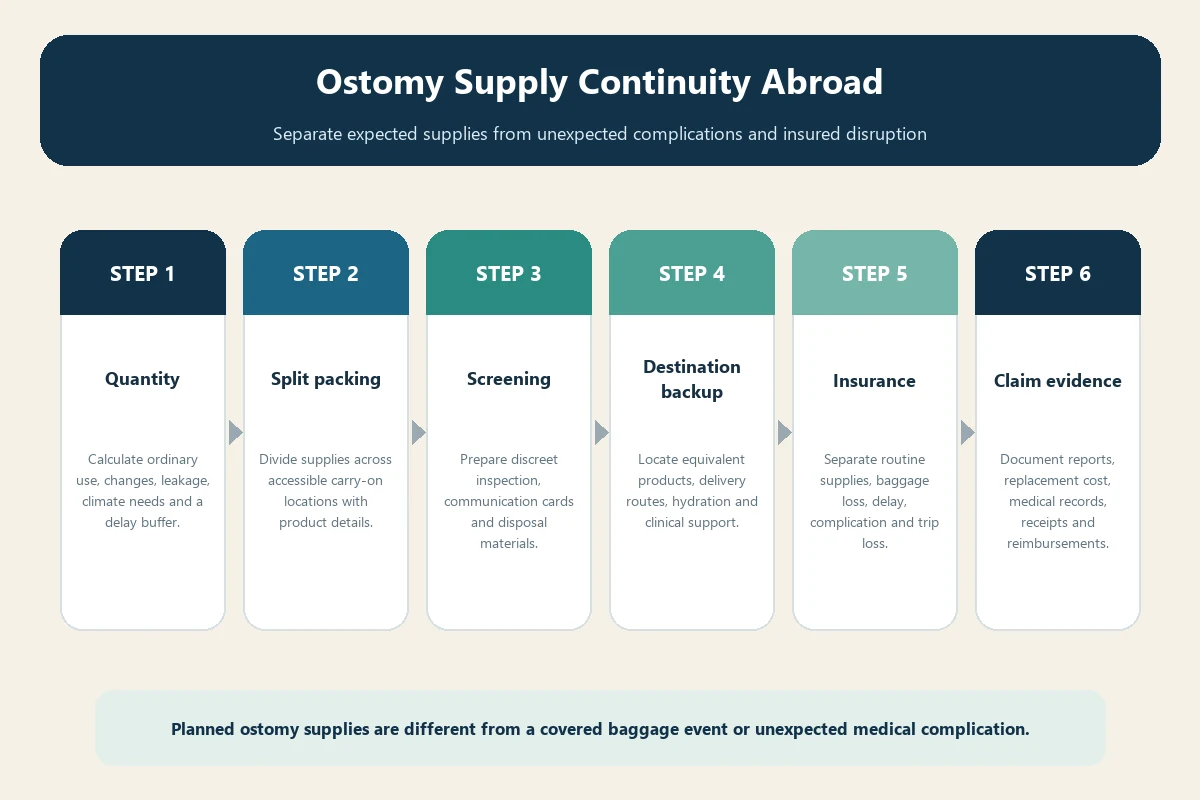
Begin with the ostomy care team
Ask the ostomy nurse or treating clinician whether the traveler’s current appliance fit and skin condition are stable, how many changes to plan, and what symptoms require local care. Discuss heat, humidity, swimming, altitude, long flights, food changes, lifting, and the planned activities.
A recent surgery, revision, obstruction, infection, wound issue, leakage pattern, or dehydration episode can change both clinical readiness and insurance eligibility. Resolve concerns before committing to nonrefundable travel.
Inventory the complete system
List the pouching system by brand, product number, size, cut, and wear schedule. Add barriers, seals or rings, adhesive remover, skin prep, powder, paste, belt, clips, filters, irrigation supplies when prescribed, disposal bags, cleaning materials, measuring guide, scissors where permitted, and protective clothing.
Do not rely on a visual match in a foreign pharmacy. Product names, sizes, and availability vary. Photograph boxes and product codes and carry supplier and manufacturer contacts.
Calculate quantity with a disruption buffer
Start with the traveler’s normal change frequency, then add a clinically and legally appropriate reserve for heat, activity, leakage, delayed bags, travel extension, or a product failure. Pack more than one location so a single loss does not remove everything, while keeping an immediately usable kit accessible.
A long trip requires refill and supplier math. Use our senior long-trip guide to align supply quantity, policy dates, and extension rules.
Build a one-change carry-on kit
Keep a compact kit with a complete change, disposal materials, cleaning supplies, spare clothing, and a concise explanation of the medical supplies. Pre-cut barriers before travel if the clinician recommends it and the fit is stable. This can reduce the need to carry cutting tools through security.
Follow TSA and foreign screening rules for scissors, aerosols, liquids, gels, wipes, powders, and medical supplies. Rules can change by airport and item; check the current official guidance.
Airport security and privacy
TSA provides special procedures for medical conditions and devices. A traveler can tell the officer about the ostomy before screening and request available accommodations or private screening. The pouch should not be opened or removed solely for routine screening; follow current TSA guidance and report concerns to a supervisor.
A medical notification card can make the conversation easier but does not replace security requirements. Return and transit airports may use different procedures, so carry translated terminology if helpful.
Cruises, buses, and rail travel
Identify accessible restrooms, cabin or seat location, transfer duration, and the time between facilities. Keep a change kit with the traveler rather than in luggage stored under a bus or transferred by port staff. Ask a cruise line how medical waste and sharps, if any, should be handled.
For excursions, carry disposal bags and enough supplies for a delayed return. A missed port or weather diversion can extend the time away from the cabin.
Heat, cold, humidity, and storage
Manufacturers specify storage ranges for pouches, adhesives, rings, and skin products. Excessive heat, freezing, moisture, or a hot car can damage them. A hotel bathroom may be humid, and a beach bag may overheat.
Ask the manufacturer how to store the exact products. Keep packaging dry, monitor temperature when needed, and rotate supplies so the emergency reserve remains usable.
Hydration and food changes
Travel, heat, illness, and output changes can affect hydration and electrolytes, particularly for some ileostomy travelers. The individual advice depends on the surgery, kidney and heart health, medicines, and clinician’s plan.
Obtain written guidance for warning signs and emergency care rather than following generic fluid or salt recommendations. Carry the clinical summary and local emergency contacts.
Medication absorption and foreign refills
An ostomy can affect how certain formulations behave, but only the pharmacist and clinical team should evaluate the traveler’s medicines. Arrange a permitted U.S.-dispensed supply, keep original labels, and plan for time zones and storage.
Medicare Part D generally does not cover prescriptions bought outside the United States. Our chronic medication travel guide helps map refills and monitoring.
Medicare ostomy-supply coverage
Medicare Part B may cover medically necessary ostomy supplies as prosthetic and orthotic items under its rules, with a prescription and enrolled supplier. Covered quantities and documentation can depend on medical need and product category.
That domestic benefit does not guarantee shipment, purchase, or reimbursement in another country. Ask the Medicare supplier how early a refill can be sent, whether domestic temporary travel is supported, and what happens if supplies are lost. Medicare Advantage plans can use network and authorization rules.
Routine supplies versus travel insurance
Supplies expected to be used during the trip are planned expenses. A travel medical benefit normally focuses on unexpected illness or injury. Baggage coverage may address loss of carried property but apply sublimits, depreciation, exclusions, and proof requirements.
Ask the insurer to identify how it classifies unused ostomy supplies and accessories. A policy may cover the bag but not the routine replacement cost, or it may exclude medical equipment. Do not assume the emergency medical limit applies.
Baggage loss and delay
File a carrier report immediately when luggage is delayed, lost, or damaged. List the ostomy products with receipts or supplier records and photograph the packed contents before departure. Keep the essential supply with the traveler to reduce clinical dependence on a reimbursement claim.
The baggage delay and lost luggage guide explains waiting periods, per-item limits, and carrier liability.
Pre-existing-condition rules
The ostomy, underlying disease, surgery, and ongoing care are known before policy purchase. A policy may exclude connected losses unless a pre-existing-condition waiver applies. The look-back period can include symptoms, treatment, testing, prescriptions, and changes.
A stable long-term ostomy and a recent operation can produce different timelines. A waiver removes an exclusion only for an otherwise covered event. Use our pre-existing-condition guide for seniors.
Unexpected medical complications
Severe pain, vomiting, bleeding, absent or unusually high output, dehydration, skin breakdown, prolapse, retraction, fever, or another concern requires the clinician’s emergency plan. Do not wait for an insurance decision before seeking urgent care.
Travel medical coverage evaluates the event under emergency, pre-existing-condition, medical-necessity, and exclusion terms. Obtain diagnosis, treatment, itemized bills, proof of payment, and the clinician’s connection to the trip.
Direct billing and supply purchases
A foreign hospital or supplier may require payment. An assistance company may locate a provider but not guarantee routine supplies. Ask whether a covered emergency can receive a payment guarantee and whether supplies are reimbursement-only.
Our direct-billing guide separates network language, assistance, and payment.
Trip cancellation and interruption
Cancellation may be eligible when an unexpected covered medical change makes the traveler unable to depart and the policy’s pre-existing-condition and documentation rules are met. Difficulty obtaining routine supplies may not be a covered reason.
Interruption may address eligible unused trip costs and additional transport after a covered event. It does not automatically pay for a preferred return or a medical escort. Confirm who must authorize arrangements.
Emergency evacuation
An ostomy alone does not create evacuation eligibility. A covered medical complication may require transfer when local care is inadequate. The insurer and medical team decide the route and nearest appropriate facility under the certificate.
If a transfer occurs, the medical evacuation claim checklist helps organize clinical, transport, and authorization records.
Five-event rehearsal
- Carry-on inspection: explain the medical supplies and request the available private procedure.
- Checked bag delayed: use the carried reserve, file the report, and contact the supplier.
- Heat damages adhesive: isolate the products and ask the manufacturer about usability.
- Skin problem develops: follow the nurse’s plan and seek qualified local care.
- Trip is extended: activate the prearranged destination supply and payment route.
Document packet
- Product names, numbers, sizes, and photos
- Prescription or medical-necessity documentation when relevant
- Ostomy nurse and supplier contacts
- Clinical summary, medicines, and allergies
- Supply inventory and purchase records
- TSA or airport-assistance information
- Destination supplier and hospital contacts
- Medicare, MA, and travel policy documents
- Carrier incident and claim forms
- Secure emergency contact authorization
Questions for the insurer
- How are the ostomy, surgery, and underlying condition treated under pre-existing-condition rules?
- Is a waiver available and valid for the purchase timeline?
- Are supplies covered as baggage, medical equipment, or neither?
- What per-item, total, and depreciation limits apply?
- Can delay coverage reimburse emergency replacement supplies?
- How is an unexpected ostomy complication covered?
- Does assistance locate an ostomy nurse or compatible supplier?
- What cancellation, interruption, and evacuation conditions apply?
- What reports, receipts, and medical records are required?
FAQ
Will travel insurance pay for routine ostomy supplies abroad?
Do not assume so. Expected supplies are planned care, while baggage or medical benefits respond only under their specific terms.
Can ostomy supplies go through airport security?
Yes, subject to current security rules for the contents. Tell the officer about the medical condition and request available accommodations when needed.
Does Medicare replace ostomy supplies overseas?
Medicare’s domestic supply benefit does not guarantee foreign purchase, shipment, or replacement. Arrange the full supply before departure.
Must an ostomy be disclosed to travel insurance?
Answer the application’s health questions accurately. The ostomy, underlying condition, surgery, and recent care may be relevant.
Bottom line
Travel with an ostomy succeeds through supply continuity. Confirm fit and clinical readiness, pack accessible reserves, understand screening, protect products from weather, and identify destination replacements. Then verify how the policy treats pre-existing conditions, baggage, medical complications, trip disruption, and evacuation.
