
Travel insurance for seniors after stroke should be tested for the exact international travel itinerary, because the decisive facts are timing, clinical stability, recent symptoms or hospitalization, medication changes, rehabilitation needs, mobility, and the policy’s pre-existing-condition rules. Obtain clearance for the exact itinerary, identify a stroke-capable destination hospital, and test cancellation, emergency medical, interruption, and evacuation benefits against both recurrence and unrelated events.
This article is educational, not neurologic, medical, rehabilitation, legal, aviation, or insurance advice. The stroke and rehabilitation teams must decide fitness to travel, timing, medication, mobility, and emergency response. New stroke symptoms require immediate emergency action, not an insurance call.
Key takeaways
- Build a dated timeline from the stroke or TIA through discharge, follow-up, rehabilitation, and policy purchase.
- Insurers can evaluate the underlying vascular condition, event, residual deficits, and recent treatment.
- Routine rehabilitation and planned follow-up abroad are different from an unexpected emergency.
- Accessibility, medication, communication, and companion needs should be built into the itinerary.
- Evacuation may end at the nearest appropriate stroke center rather than the traveler’s home hospital.
Reviewed: August 16, 2026.
Stroke, TIA, and residual effects all matter
A stroke can be ischemic or hemorrhagic, and a TIA is a temporary neurologic event that can signal future risk. Travelers can also have atrial fibrillation, carotid disease, high blood pressure, diabetes, heart disease, or other conditions. Insurance questions may address the event, diagnoses, symptoms, treatment, medicines, and impairments.
Answer each application question accurately. Do not describe only “recovered stroke” when the application asks about hospitalization, specialist care, tests, medication, or mobility.
Create the recovery timeline
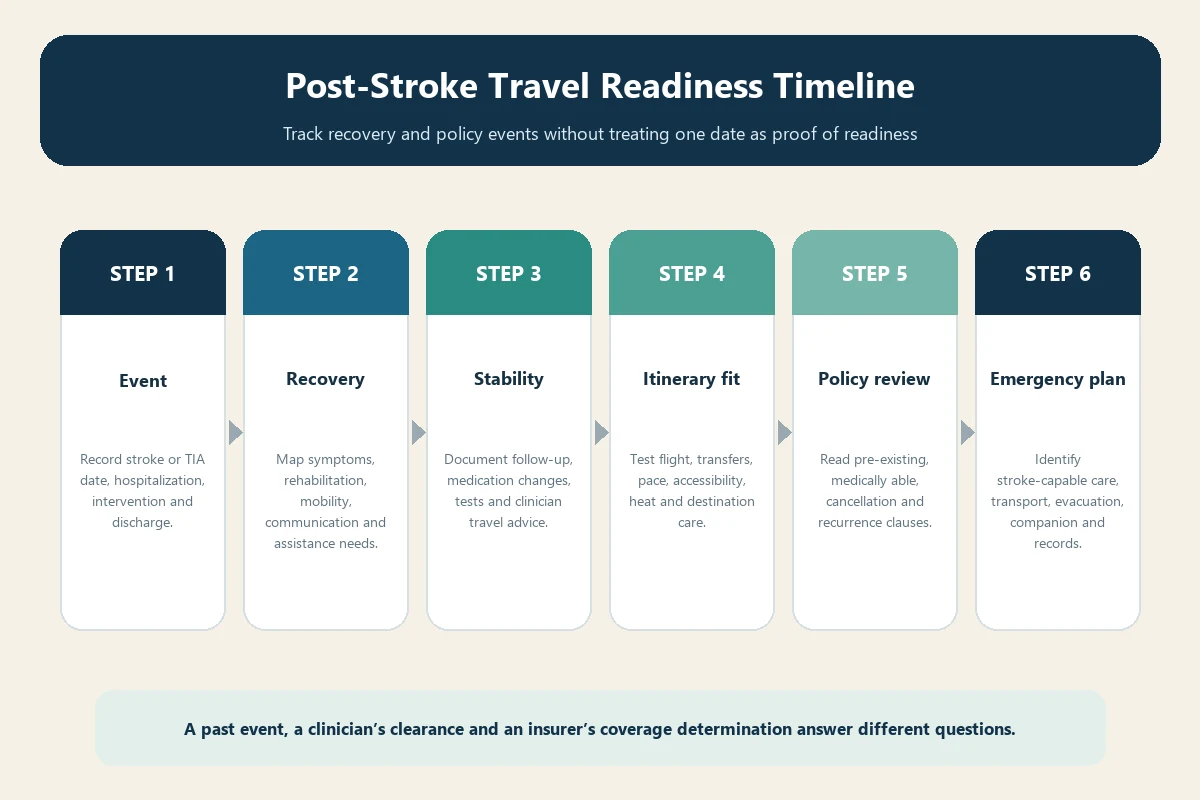
Record symptom and event dates, hospitalization, procedures, discharge, rehabilitation, follow-up, imaging, new symptoms, emergency visits, medication changes, and clinician clearance. Add the trip’s first payment, policy purchase, departure, and cancellation deadlines.
The timeline helps compare the record with the policy’s look-back period and medical-ability requirement. A stroke several years ago with stable care presents different facts from a TIA in the week before purchase.
Clinical clearance for the exact route
Ask the neurology or stroke team whether the traveler is ready for the flight duration, altitude, heat, cruise, high elevation, remote travel, and physical activity. Review blood pressure, swallowing, vision, cognition, balance, fatigue, seizures, continence, sleep, and risk factors relevant to the individual.
The clinician should decide movement, hydration, compression, medication timing, and assistive-device recommendations. An insurer’s willingness to sell a plan does not equal medical clearance.
Pre-existing-condition exclusion
A policy may exclude losses connected to a pre-existing condition unless a waiver applies. The look-back can include symptoms, diagnosis, treatment, testing, prescriptions, and changes. A recurrent event can be connected to the prior stroke or underlying condition even if it happens during the trip.
Use the senior pre-existing-condition guide to review the certificate. Obtain a written response for the actual timeline rather than assuming “stable” has a universal meaning.
What a waiver does
A waiver can remove the pre-existing-condition exclusion for an otherwise covered loss when purchase timing and other eligibility requirements are met. It does not guarantee travel fitness, cover routine rehabilitation, or pay every recurrence. Other exclusions, limits, and documentation requirements remain.
Ask the insurer to address a new TIA before departure, an unrelated injury, recurrent stroke abroad, and a clinician-directed cancellation. Compare the answers with the policy.
Medical ability at the purchase date
Some policies condition a waiver or coverage on the traveler being medically able to travel when the policy is bought. The treating clinician assesses medical status; the insurer applies the contract. Preserve the clinical advice and records from the purchase period.
Buying after symptoms begin or after a recommendation to cancel may change eligibility. Do not wait until the trip is threatened to review coverage.
Medication continuity
Post-stroke travelers may take anticoagulants, antiplatelets, blood-pressure drugs, statins, diabetes medicine, antiseizure drugs, or other prescriptions. Arrange enough medication, original labels, a written schedule, and a lawful backup path. Medicare Part D generally does not cover retail prescriptions bought outside the United States.
The travel prescription medication guide helps plan supply and storage. Never change medication for a flight or time zone without clinician or pharmacist instructions.
Mobility and fall risk
Residual weakness, spasticity, balance changes, fatigue, or visual field loss can affect transfers, boarding, bathrooms, stairs, tours, and evacuation. Request airport or rail assistance early and verify accessible rooms, ground transport, cruise tendering, and excursion requirements.
Travelers using a cane, walker, wheelchair, or brace can use our mobility-aid insurance guide to separate equipment damage from medical care. Clinical safety and insurance classification are different.
Communication and cognition
Aphasia, memory change, processing speed, or fatigue can make emergency communication difficult. Carry a concise card with diagnosis, baseline deficits, medicines, allergies, emergency contacts, and communication preferences. A companion may need written authorization to speak with insurers and clinicians.
Do not assume a new speech or facial change is the traveler’s normal baseline. The care team should explain emergency warning signs and what the companion must do.
Airport and onboard assistance
Airlines can provide disability assistance under applicable rules, but services, advance notice, seating, mobility equipment, and international procedures vary. Accessibility assistance does not include clinical monitoring. A companion may be necessary for personal care or emergency communication.
Test the full door-to-door itinerary, including check-in, security, connections, ground transport, stairs, restroom access, and overnight delays.
Destination stroke care
Time-sensitive stroke treatment requires a capable hospital, imaging, specialists, and emergency transport. Identify destination emergency numbers and hospitals that can evaluate acute stroke. A clinic or cruise medical center may stabilize but lack definitive capability.
Ask the travel assistance company how it verifies facilities and whether it can arrange a payment guarantee. Keep the home neurology team’s contact but do not delay local emergency care to reach it.
Original Medicare abroad
Original Medicare generally does not cover health care outside the United States except in narrow border, Alaska-transit, residence, and cruise situations. A recurrent stroke during an ordinary overseas vacation usually requires another payer.
Medicare Advantage may add worldwide emergency or urgent benefits, and eligible Medigap policies may provide limited foreign emergency coverage. Verify medical, ambulance, post-stabilization, and evacuation separately.
Travel medical coverage
An emergency medical policy may cover eligible evaluation and treatment, subject to pre-existing-condition rules, deductible, coinsurance, maximum, exclusions, and coordination. Ask how hospital, physician, imaging, rehabilitation, prescription, and post-stabilization services are treated.
A routine therapy session or planned follow-up is not the same as an acute stroke emergency. Ask when the emergency is considered stabilized.
Direct billing and cash flow
A foreign hospital may require a deposit. Assistance can guarantee payment for an eligible event, refer the traveler without payment, or reimburse later. The direct-billing guide explains the difference.
Keep itemized bills, diagnostic reports, imaging summaries, medication records, discharge instructions, proof of payment, and insurer references.
Trip cancellation before departure
Cancellation may apply when a covered medical event makes the traveler unable to go. The prior stroke, new symptoms, pre-existing-condition terms, waiver, purchase timeline, and clinician certification affect the claim. Supplier refunds and credits reduce the insured loss.
A preference to rest longer or a family member’s concern may not meet the medical definition. Obtain the clinician’s contemporaneous record.
Trip interruption after departure
Interruption coverage may address unused arrangements, a companion stay, and additional transport after a covered event. The emergency medical claim and trip-cost claim need different evidence. Ask who arranges the return and what fare class is medically necessary.
Medical evacuation and repatriation
Evacuation may be authorized when local care is inadequate. The endpoint is often the nearest appropriate facility with stroke capability, not the home rehabilitation center. After stabilization, a commercial flight may require medical clearance, escort, wheelchair support, oxygen, or another arrangement.
The evacuation approval guide and fit-to-fly guide explain the process.
Five-scenario rehearsal
- New symptom before departure: seek care and document whether the trip must be cancelled.
- Wheelchair damaged in transit: activate equipment and accessibility plans.
- Medication bag delayed: use the carry-on supply and licensed replacement path.
- Possible stroke abroad: call local emergency services immediately.
- Hospital recommends transfer: coordinate insurer authorization and receiving-center acceptance.
Document packet
- Stroke or TIA diagnosis and event dates
- Discharge, procedure, rehabilitation, and follow-up summary
- Baseline deficits and communication preferences
- Medicine, allergy, and device list
- Neurology and rehabilitation contacts
- Clinical travel clearance and emergency instructions
- Accessibility arrangements and equipment details
- Destination stroke center and assistance contacts
- Travel policy and Medicare-related documents
- Trip deposits, refunds, and claim records
Questions for the insurer
- How do the stroke or TIA, underlying conditions, symptoms, and recent care fit the pre-existing-condition definition?
- Is a waiver available and valid?
- What medical-ability requirement applies?
- Would a recurrence be eligible?
- Are routine rehabilitation and follow-up excluded?
- Can assistance arrange direct payment?
- Which hospital qualifies as appropriate?
- What evacuation endpoint applies?
- How are cancellation and interruption documented?
- What claim deadlines and records are required?
FAQ
Can a senior get travel insurance after a stroke?
Often, yes, but availability and coverage depend on timing, stability, recent care, age, destination, and policy terms.
How soon after a stroke can someone fly?
Only the treating stroke team and airline can answer for the individual and route. Do not use a generic waiting period.
Will insurance cover another stroke abroad?
It may if the event is otherwise covered and the pre-existing-condition exclusion is removed or does not apply. Verify the exact certificate.
Will evacuation bring the traveler home?
Not necessarily. Many benefits cover transport to the nearest appropriate facility, followed by separate post-stabilization decisions.
Bottom line
Travel after stroke or TIA requires a recovery timeline, not a simple yes-or-no label. Confirm clinical readiness, medication, mobility, communication, and destination stroke care. Then test pre-existing-condition, emergency, cancellation, interruption, and evacuation provisions against specific events.
Sources
- CDC Yellow Book — Travelers With Chronic Illnesses
- American Stroke Association — Stroke Symptoms
- U.S. Department of Transportation — Passengers With Disabilities
- Medicare — Coverage Outside the United States
- U.S. Department of State — Travelers With Disabilities
- U.S. Department of State — Insurance Coverage Overseas
