

Medical repatriation fit to fly clearance is not one doctor’s note that guarantees boarding. After hospitalization abroad, the treating clinician evaluates the patient’s condition, an assistance medical team evaluates the transport plan, and the operating airline decides whether it will accept the passenger, equipment, escort, and cabin arrangement for a specific itinerary.
Those decisions can agree, conflict, or expire at different times. A stable patient can still lack carrier clearance. An accepted booking can become unsafe after a clinical change. An insurer can deny a non-covered route even when the airline would carry the traveler. This guide is educational, not individualized medical, airline, insurance, legal, or transport advice.
Key takeaways
- Separate clinical advice, assistance-provider approval, and airline acceptance.
- Assess the patient in the expected cabin environment and complete route.
- Document oxygen, equipment, mobility, escort, positioning, toileting, and medication needs.
- Use the operating carrier’s current form and deadline for the exact itinerary.
- Recheck after any clinical, equipment, flight, route, or receiving-facility change.
Reviewed August 16, 2026. Fit to fly, medical certificate, MEDIF, stable for transport, extraordinary medical assistance, direct threat, escort, oxygen, stretcher, inpatient, and medical release are clinical, regulatory, carrier, or contract-specific terms.
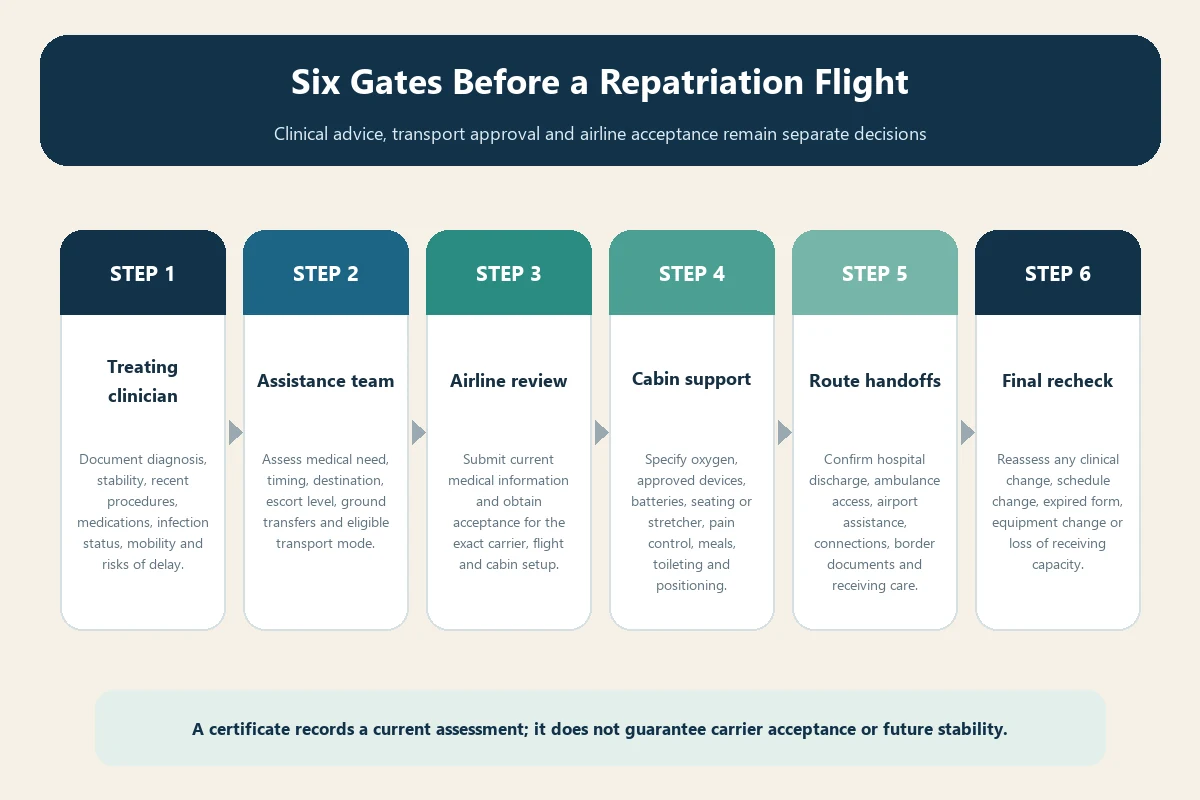
Use six clearance gates
| Gate | Decision | Primary owner |
|---|---|---|
| Treating assessment | Current condition and risk of travel or delay | Treating clinical team |
| Transport assessment | Mode, timing, escort, origin and destination | Assistance medical team |
| Carrier review | Acceptance for the exact flight and cabin plan | Operating airline |
| Cabin support | Oxygen, devices, seat or stretcher, care tasks | Carrier and transport provider |
| Ground handoffs | Hospital, ambulance, airport, border, receiving care | Case coordinator |
| Final recheck | Whether every earlier assumption remains true | All decision makers |
The international hospital-transfer guide explains acceptance and handoffs between facilities. Fit-to-fly work is narrower: it tests whether the patient and planned support can safely complete a particular aviation route.
The treating clinician answers a clinical question
The treating team knows the diagnosis, procedure, current observations, medication, imaging, laboratory results, infection status, mobility, pain, nutrition, oxygen need, wounds, drains, and risk of deterioration. It can document whether travel should be delayed and what care or precautions would be needed.
The CDC Yellow Book air-travel chapter explains that cabin pressure is typically equivalent to an altitude of roughly 6,000–8,000 feet. Reduced oxygen pressure, dry air, immobility, and proximity to others can matter to travelers with cardiopulmonary, blood, cerebrovascular, infectious, or recent procedural risks. Only the clinical team should apply that information to a patient.
The assistance team answers a transport question
An insurer, membership, or medical-assistance team can review whether the proposed movement is medically necessary or permitted, when it can occur, what mode is appropriate, which escort is needed, where the patient may go, and which costs the agreement covers. It may need direct physician-to-physician communication and complete records.
The approval guide separates these roles. A treating physician’s release does not determine insurance eligibility. An assistance physician’s plan does not compel the airline. Record each decision, author, time, assumptions, and conditions.
The operating airline answers an acceptance question
Under current 14 CFR 382.23, a carrier generally may not require a passenger with a disability to provide a medical certificate except in specified situations. The regulation permits a certificate for a passenger traveling in a stretcher or incubator, needing medical oxygen, or whose condition creates reasonable doubt about completing the flight safely without extraordinary medical assistance.
The rule describes a physician’s written statement and a recency requirement for the initial departing flight. It also allows additional review after a significant adverse change or when a certificate materially understates risk. Apply the current rule and the carrier’s procedures to the actual trip; international segments can involve additional law and carrier requirements.
Fit to fly is itinerary-specific
A statement for a nonstop two-hour flight does not automatically support two long-haul segments, a tight connection, high-altitude airport, remote terminal transfer, long ground journey, or overnight delay. Send the operating airline the flight numbers, dates, aircraft if known, connection airports, total door-to-door duration, ground plan, and requested services.
Code-share itineraries need special care. The ticketing airline can differ from the operating airline that controls acceptance and equipment. Obtain written confirmation for every segment and connection rather than relying on a generic reservation note.
Recent hospitalization requires current facts
Document admission and discharge status, diagnosis, procedure dates, complications, fever, vital-sign trend, oxygen saturation, mobility, pain control, medication timing, food and fluid needs, mental status, infection precautions, and planned follow-up. Note what would require delay or escalation.
The CDC’s chronic-illness travel chapter advises obtaining clinical and airline clearance when required and gives condition-specific deferral considerations. It is a professional reference, not a substitute for the patient’s treating specialists.
Medical release and insurance repatriation are not synonyms
Hospital discharge can mean the patient no longer requires inpatient care at that facility. A transport membership may require continued inpatient hospitalization. An insurance benefit may require medical necessity, advance approval, or a particular destination. A traveler can be fit for ordinary travel but no longer eligible for a provider-arranged inpatient transfer.
The hospital-of-choice membership guide explains why discharge status, receiving admission, home-country geography, and provider-selected mode can change the case. Ask about transport eligibility before discharge when the timing can affect a benefit.
Oxygen has three separate plans
Specify oxygen on the ground, in each airport, during every flight, and after arrival. The FAA’s medical-oxygen guidance says passengers may not carry their own compressed or liquid oxygen in baggage or on their person for use onboard; airline-provided oxygen and eligible portable oxygen concentrators follow different rules. Airlines are not required to offer oxygen service.
Confirm device model, acceptance, flow or settings ordered by the clinician, continuous versus intermittent need, battery type, required runtime, spare-battery handling, power availability, layover duration, and a delay margin. A device that works on the ward may not be approved or adequate for the cabin plan.
Seat, stretcher, and positioning change the case
A seated traveler may need an aisle chair, lifting assistance, adjacent seats, business-class space, limited recline, pressure relief, limb elevation, or a particular side. A stretcher installation requires carrier approval, aircraft capability, space, equipment, medical documentation, and often substantial lead time. Some routes or aircraft do not accept stretchers.
Describe transfer ability, sitting tolerance, weight-bearing status, cast or brace, wound protection, spinal precautions, body dimensions, pressure-injury risk, and how the traveler will use the lavatory. Avoid promising a cabin configuration until the operating carrier confirms it.
The escort must match the care tasks
A companion, non-medical escort, nurse, paramedic, physician, or critical-care team has different training, equipment, authority, and scope. List every anticipated task: medication timing, injections, oxygen management, suction, monitoring, wound care, mobility, transfers, toileting, communication, behavioral support, and response to deterioration.
The travel-companion evacuation guide explains why a personal companion is not automatically a medical escort. Confirm who employs and licenses the escort, who carries supplies, what the airline permits, and the escalation plan at each airport.
Infection creates clinical and public-health gates
The treating team should document diagnosis, symptoms, testing, treatment, communicability, precautions, and the relevant public-health advice. A medical certificate for a communicable condition can need different statements from a general fit-to-fly certificate. Airlines and authorities can restrict boarding when a condition poses a direct threat.
Do not conceal fever, respiratory symptoms, rash, vomiting, diarrhea, confusion, or a known communicable disease to preserve a booking. A delayed, controlled route is safer than an in-flight event or border intervention.
Ground transfers are part of fitness
The patient must move from bed to vehicle, vehicle to terminal, through security and border processes, to the aircraft, across any connection, and from the arrival airport to a caregiver or facility. Confirm ambulance level, lifting equipment, stairs or jet bridge, wheelchair type, terminal distance, waiting position, restroom access, climate exposure, and handoff responsibility.
The home-country evacuation guide shows why arrival at an airport is not equivalent to admission or care. A safe plan names the receiver and proves ground access at both ends.
A receiving plan is part of clearance
If the patient needs continued inpatient treatment, obtain an accepting physician and available bed. If the traveler is going home, identify the caregiver, equipment delivery, prescriptions, follow-up, accessibility, and emergency plan. Send a concise clinical summary and transport record through secure authorized channels.
Insurance authorization should state whether it covers the commercial ticket, escort, seats, oxygen, devices, ambulance, accommodation, companion, and changes. The pre-authorization guide helps preserve the approved scope.
Recheck whenever the facts move
Repeat the review after new fever, bleeding, oxygen change, uncontrolled pain, confusion, fall, procedure, infection finding, medication change, flight cancellation, aircraft swap, longer connection, expired medical form, unavailable escort, failed equipment, lost receiving bed, or changed ground route. Tell the carrier and assistance team promptly.
The IATA Medical Manual portal explains that airline medicine covers passenger health, cabin environment, and operational handling. Airline medical desks can therefore need information beyond a generic discharge letter.
Build this clearance packet
- Diagnosis, hospital course, procedure dates, current observations, and clinical summary
- Medication, allergies, infection status, wounds, drains, mobility, nutrition, and toileting needs
- Treating-clinician recommendation, conditions, contact details, signature, and date
- Assistance-team assessment, authorized mode, escort, destination, and case number
- Operating-airline medical form, approval reference, itinerary, cabin setup, and deadlines
- Oxygen prescription, device model, batteries, equipment, consumables, and backup plan
- Origin and destination ambulance, airport assistance, border papers, and connection plan
- Receiving physician, bed or caregiver, records handoff, payment authority, and final recheck
The practical conclusion
Medical repatriation fit-to-fly clearance is a chain of current, role-specific decisions. The treating clinician assesses the patient, the assistance team designs and authorizes the transport, and the operating airline accepts or rejects the exact cabin plan. None of those decisions should be silently substituted for another.
Start early, send complete facts, and build the door-to-door route before booking. Then recheck the patient, form, flight, equipment, escort, ground access, and receiving arrangement close to departure. A safe certificate is not the end of the process; it is one controlled input to a transport plan that must remain true.
