
Travel medical insurance for seniors traveling from the USA to Asia should be tested as a route, not purchased from a destination label. “Asia” can mean a nonstop flight to a large city, several connections followed by a rural tour, an island itinerary, or multiple countries with different medical systems and transport options. The relevant policy must work across every segment.
This guide builds a route-continuity file for a U.S. senior traveler. It is educational and does not recommend a provider, coverage amount, vaccine, or medical treatment. Insurance eligibility and benefits are contract-specific; health preparation should be individualized with a qualified clinician.
Key takeaways
- Name every country, territory, layover, and side trip instead of using “Asia” as one destination.
- Check medical access and evacuation logic separately for each overnight location.
- Resolve Medicare, primary-versus-secondary payment, and advance-payment requirements.
- Build medication and medical-record continuity for long flights and time-zone changes.
- Verify pre-existing-condition and age rules against the exact issued form.
Reviewed August 16, 2026. Destination, eligible expense, emergency, medically necessary, preauthorization, and evacuation point are policy-defined terms.
Build the route-continuity file
Start with a chronological table containing the departure airport, every connection, each country or territory entered, overnight city, rural or island segment, cruise or ferry, planned activity, and return route. Add the traveler’s age on departure, trip length, current health coverage, medication requirements, mobility or oxygen needs, and prepaid costs.
The CDC’s pre-travel framework emphasizes countries and specific regions, trip order, layovers, rural or urban settings, season, duration, transport, accommodations, and activities. That same itinerary detail is needed to audit insurance. A certificate that fits Tokyo cannot automatically be assumed to fit a remote island or a separate stop in South Asia.
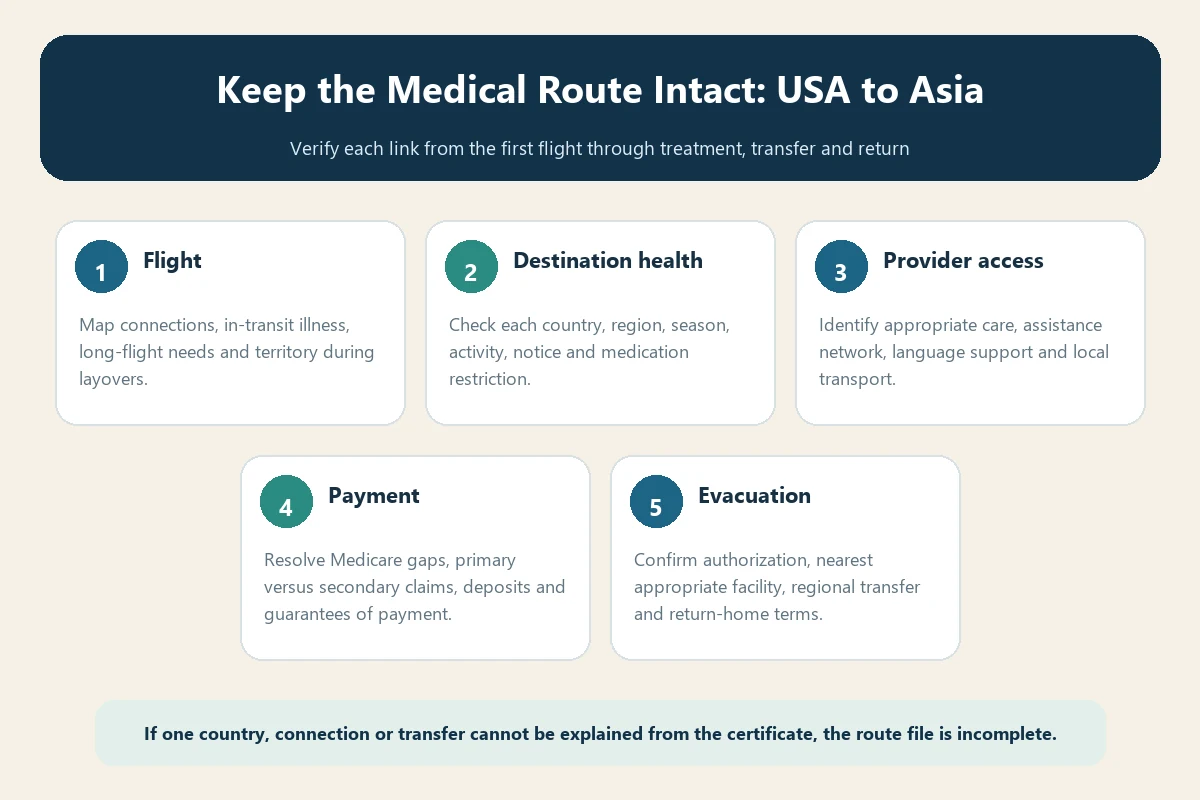
Do not treat Asia as one medical market
Use the CDC destination directory and the U.S. Department of State destination pages for each country. Review current health notices, recommended pre-travel preparation, local emergency numbers, entry rules, medication restrictions, security conditions, and the State Department’s description of medical care and payment expectations.
Then write a one-line care path for every overnight stop: nearest appropriate facility, how the traveler would reach it, whether the policy assistance team has a usable network there, whether payment may be required before treatment, and the next higher level of care. The site’s medical evacuation destination guide provides a location-by-location worksheet.
Audit the long flight separately from destination care
Travel insurance does not prevent a medical problem. Long travel time changes the risk conversation and the evidence a claim may require. CDC’s Yellow Book identifies prolonged limited mobility as a factor in travel-associated venous thromboembolism and lists older age among the risk factors. It recommends individualized counseling for travelers with additional risks.
Ask the traveler’s clinician about fitness to travel, mobility, medications, compression or other measures, and warning signs; do not use a policy article as medical advice. From the insurance side, confirm how an illness that begins during a connection is handled, whether the layover country is inside the territory, and what documentation is required if travel is interrupted before reaching the booked destination.
Resolve Medicare and existing U.S. coverage
The U.S. Department of State says Medicare and Medicaid do not pay for medical care abroad. Medicare’s official guidance describes only limited foreign-care exceptions, while some Medigap policies may include foreign emergency benefits. Medicare Advantage and employer or retiree plans can have their own network and reimbursement rules.
Record the exact existing plan, not “I have Medicare.” Ask whether the travel medical policy is primary or secondary; whether a claim must first be submitted to Medicare, a supplement, or another carrier; what denial or explanation-of-benefits document is required; and whether the travel insurer can arrange a guarantee of payment.
The medical evacuation claim-document guide lists records to save before, during, and after an emergency.
Test hospital access, not just the medical maximum
| Route question | Evidence to obtain | Failure to avoid |
|---|---|---|
| Where is appropriate care? | Assistance-network or destination information | Assuming every clinic can manage a complex event |
| Who pays first? | Primary/secondary clause and payment procedure | Discovering a large deposit requirement at admission |
| Who authorizes transfer? | Evacuation and preauthorization clauses | Self-arranging transport that is not reimbursable |
| Where may the patient go? | Nearest-appropriate-facility wording | Assuming transport directly to the United States |
| What happens after stabilization? | Continuation, return, and repatriation wording | Coverage ending while the traveler remains abroad |
A large advertised maximum does not answer any of these operational questions. Call the assistance administrator with the itinerary and ask how it would coordinate care in the least accessible overnight location. Save the response with the date, representative, and policy form.
Map evacuation as a chain of decisions
A serious event can require local ambulance transport, stabilization, transfer to a regional center, fit-to-fly assessment, a commercial flight with an escort, or an air ambulance. Each step may have a different decision-maker and benefit limit. The international hospital-transfer guide explains the handoff between facilities and the assistance company.
Do not equate “medical evacuation” with “flight home.” Many contracts use the nearest appropriate facility as the covered destination. A separate benefit, membership, or medical determination may govern later transport. Review the fit-to-fly repatriation guide before assuming a stable patient can take a commercial flight.
Create medication continuity across time zones and borders
The State Department advises older travelers to bring enough prescription medication, keep it in original labeled containers, know generic names, check destination restrictions, and carry a clinician letter describing conditions, allergies, and medicines. CDC also recommends planning extra medication for delays and discussing timing when travel crosses time zones.
Build a medication sheet with generic and brand names, dose, prescribing clinician, refrigeration or device needs, legal-status checks for every country, and a clinician-approved timing plan. Carry essential medicine and documentation in hand luggage, subject to carrier and security rules. Insurance may reimburse an eligible emergency prescription, but it does not make a restricted drug legal or guarantee the same formulation is locally available.
Check age and pre-existing-condition rules together
Request a quote using the exact date of birth, residence, trip dates, and destination list. Copy the available medical maximum, deductible, coinsurance, evacuation amount, and any age-based sublimits. Confirm which date sets the age tier if a birthday occurs during travel.
Next, locate the policy’s pre-existing-condition definition, look-back period, waiver conditions, stability requirement, and exclusions. Ask how related evacuation is treated. The senior pre-existing-condition question list turns this review into a written record.
Match trip length and multi-country territory
Count every travel day, including departure and return dates if the contract does. Confirm coverage for long layovers, side trips, and any extension after a covered event. If the journey crosses a policy expiration date, get written guidance before purchase.
For a multi-country Asia itinerary, search the exclusions for sanctions, war, civil disorder, government advisories, epidemics, mountaineering, motorbikes, diving, and other planned activities. A general worldwide territory can still contain country, event, or activity exclusions.
Price the four gaps that quotes hide
- Up-front cash gap: the amount a hospital might require before reimbursement.
- Transport gap: the difference between local care, regional transfer, and return home.
- Time gap: treatment or lodging after the scheduled return date.
- Evidence gap: translation, records, receipts, physician statements, and prior-carrier decisions needed for a claim.
Compare premiums only after these gaps are understood. A cheaper plan can be expensive to use if it has an unaffordable deductible, weak payment coordination, a narrow territory, or a transport rule that does not fit the route.
Questions to ask the insurer or administrator
- Are all listed countries, territories, and layovers covered?
- What happens if symptoms begin in transit?
- Is medical coverage primary or secondary to Medicare-related or private coverage?
- Can the administrator guarantee payment to a hospital?
- Who selects the treating facility and any receiving hospital?
- Does evacuation end at the nearest appropriate facility?
- What benefit can continue treatment after the scheduled return date?
- Are age-based limits different on any departure date?
- How are pre-existing conditions and related transport handled?
- Which activities and modes of transport require an endorsement?
FAQ for senior travel medical insurance to Asia
Does Medicare cover a U.S. senior in Asia?
Generally no, except for limited circumstances described by Medicare. A Medigap, Medicare Advantage, employer, or retiree plan may have separate terms. Confirm the exact plan and claim order.
How much travel medical insurance does a senior need for Asia?
There is no universal amount for a continent-wide label. Build the limit from the itinerary, local payment conditions, medical needs, evacuation route, deductible, coinsurance, and existing coverage, then verify what is available at the exact age.
Will travel insurance fly a patient back to the United States?
Not automatically. Many policies cover medically necessary transport to the nearest appropriate facility under the administrator’s approval. Return-home transport can depend on separate wording and a fit-to-fly determination.
Should one policy cover several Asian countries?
It can, but the certificate must cover every destination and travel day. Country, event, advisory, sanction, and activity exclusions still need a route-by-route review.
Bottom line
The right travel medical insurance for seniors from the USA to Asia is the contract that keeps the care path intact from the first airport to the final return. Map every segment, verify foreign medical payment, connect local care to an authorized evacuation route, protect medication continuity, and document age and medical-history rules. “Asia coverage” is a label; a route-continuity file is evidence.
