
Can you file a travel insurance claim without receipts? You can notify the insurer and submit a claim, but payment depends on the benefit, policy wording, facts, and quality of alternative proof. A missing paper receipt is different from having no evidence of ownership, purchase, payment, loss, or amount.
Start by requesting a duplicate from the merchant, provider, airline, hotel, pharmacy, or card issuer. If no duplicate exists, build a transparent evidence chain. Do not create a replacement receipt or edit a bank statement to look like one.
Key takeaways
- Open the claim on time even when a receipt is missing.
- Ask the seller for a duplicate, folio, invoice, ledger, or transaction lookup first.
- Alternative proof should address who bought what, when, for how much, and how the covered loss occurred.
- Bank statements show payment but often do not prove the item or service.
- Acceptance of photos, emails, warranties, or affidavits is policy- and claim-specific.
What a receipt normally proves
A strong receipt identifies the seller, buyer or patient when relevant, date, item or service, amount, currency, taxes, payment method, and status. In a claim, it can help establish ownership, prepaid cost, an additional expense, or payment of a medical bill. It does not by itself prove that a covered event occurred.
A restaurant receipt during a flight delay may show an expense, but the carrier record proves the delay. A baggage receipt may show original value, while the airline report proves the bag was delayed or lost. Claims need both the loss event and the amount.
First choice: obtain a duplicate
Contact the merchant before relying on substitute evidence. Airlines can often resend e-ticket receipts; hotels can issue folios; pharmacies can print histories; hospitals can provide itemized ledgers; online retailers retain order records; card issuers can show transaction details.
Give the approximate date, location, amount, last card digits, email, loyalty number, reservation number, and item description. Save the request and response. If the merchant refuses or no longer exists, that record supports the explanation.
Alternative proof ladder
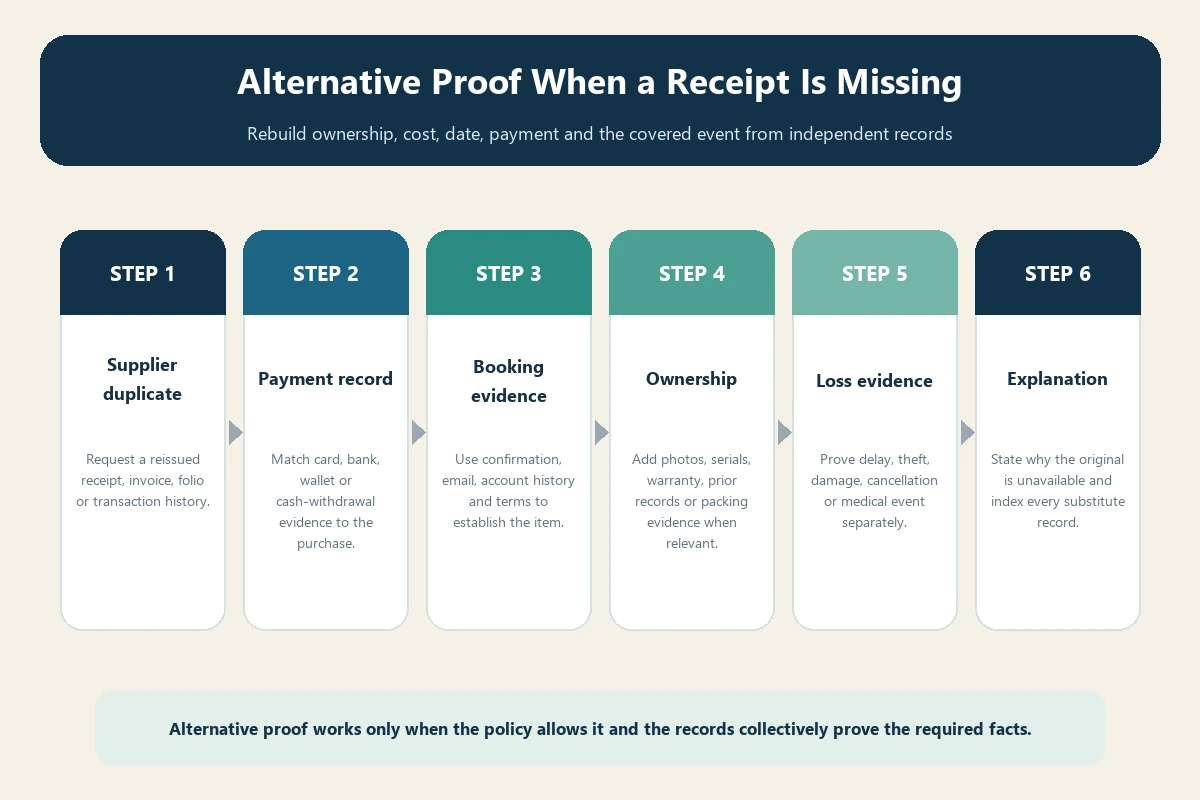
- Supplier duplicate: invoice, folio, e-ticket receipt, order history, medical ledger, or official transaction lookup.
- Financial record: final card statement, bank statement, canceled check, payment-app record, or cash withdrawal.
- Contract record: confirmation, booking terms, warranty, registration, serial number, or membership account.
- Possession record: dated photos, repair history, user manual registration, or prior appraisal.
- Loss record: airline property report, police report, carrier disruption record, physician note, or supplier cancellation statement.
- Explanation: a signed factual statement describing the missing receipt and attached evidence.
No single substitute necessarily equals a receipt. Several independent records can corroborate one another. Ask the adjuster which alternatives it accepts before paying for appraisals or formal declarations.
Bank or card statement limitations
A statement can show merchant, date, amount, currency, and account holder. It may not show what was purchased, which traveler used it, whether part was refunded, or whether the expense relates to the covered event. A supermarket charge during a delay could include unrelated items.
Pair the statement with an order email, merchant description, contemporaneous photo, itinerary, and short explanation. Keep the final posted transaction rather than a pending authorization. Redact unrelated activity only as permitted while retaining account identity and transaction context.
Email and app records
Booking confirmations, digital wallet histories, retailer accounts, loyalty profiles, delivery records, and chat transcripts can help reconstruct a purchase. Export the complete record with sender, recipient, date, order number, item, price, and URL or account context.
A cropped screenshot is weaker than a downloadable invoice or full email. Preserve metadata when possible. Do not alter timestamps or recreate a confirmation in a document editor.
Trip cancellation without a receipt
Cancellation claims need proof of prepaid, nonrefundable cost and the covered reason. A booking confirmation, card statement, supplier terms, cancellation record, and final refund or credit statement may collectively prove the loss. Ask the supplier for a zero-balance or nonrefund letter.
Separate the original cost, cash refund, voucher, cancellation fee, and amount requested. Use our refundable trip cost guide and report later recoveries under our refund and recovery workflow.
Trip delay and interruption expenses
For meals, lodging, and transportation, policies can require itemized receipts and impose per-person or daily limits. Some products may have a fixed inconvenience benefit with different proof, but never assume a receipt-free rule applies. Check the certificate.
If a restaurant cannot duplicate a lost receipt, use the card charge, delay record, travel timeline, names of travelers, and an explanation of the purchase. Alcohol, tips, upgrades, or expenses outside the delay window may be treated differently.
Baggage ownership without old receipts
Travelers rarely retain every clothing or luggage receipt. Alternative proof can include dated photographs, order history, warranty registration, serial numbers, prior repair records, model information, card statements, and replacement quotes. The policy may apply depreciation, item limits, exclusions, or require original proof for high-value property.
File the airline property irregularity report and any police report required by the certificate. For delayed baggage, preserve replacement-item receipts even if ownership receipts for the delayed contents are unavailable. U.S. DOT guidance explains airline baggage responsibilities, which are separate from policy benefits.
Foreign medical claims without a receipt
A card slip is not a medical invoice. Request an itemized bill and provider ledger showing patient, service dates, treatment, charges, currency, payments, and balance. If the facility accepted cash, ask for a stamped paid statement and identify the person who paid.
Follow our foreign medical bill guide. Clinical records, translation, payment evidence, and an EOB can each be required; one does not replace the others.
Cash expenses
Cash is the hardest payment method to reconstruct. A withdrawal proves cash was obtained, not where it was spent. Seek a merchant duplicate, signed paid invoice, provider stamp, contemporaneous message, and independent record of the event. Explain why cash was necessary and how the amount was determined.
Do not ask a merchant to backdate or invent a receipt. A truthful statement that its system cannot reprint the record is better than fabricated proof.
When the merchant has closed
If a tour operator, retailer, or medical provider has ceased business, preserve evidence of the closure and every retrieval attempt. Search the original confirmation for a booking platform, payment processor, franchise, administrator, or successor that may retain records. A card issuer can sometimes identify a merchant descriptor or acquirer, but it may not have an itemized invoice.
Do not rely on an undated search result saying the business is closed. Save an official notice, insolvency filing, returned email, disconnected-number log, or dated message from the platform. Explain why a duplicate cannot reasonably be obtained and provide the strongest independent evidence for each missing fact.
Original value versus replacement value
For baggage or personal-property claims, the amount paid for a replacement is not automatically the value of the lost item. The policy may consider original purchase price, age, condition, depreciation, actual cash value, repair, replacement, or a per-item maximum. Submit any known model, approximate purchase date, photos, comparable historical listing, warranty, and replacement receipt as separate evidence.
Label estimates honestly. If the original price is unknown, say so and explain the basis for the estimate. Ask how the adjuster calculated depreciation or applied category limits before treating a reduced payment as an arithmetic error.
Write the missing-receipt explanation
Include the claimant, policy, benefit, expense, merchant, date, amount, currency, payment method, reason the receipt is missing, attempts to obtain a duplicate, and a list of substitute records. State only facts within the signer’s knowledge. If another person paid, identify that person and provide any required authorization.
An affidavit or notarized statement is not automatically required or sufficient. Obtain instructions before incurring cost. Notarization verifies the signature process, not the truth or coverage of the expense.
Submit an evidence matrix
Create columns for claim line, fact to prove, preferred document, substitute provided, remaining gap, and follow-up. Example: a hotel folio proves lodging and itemization; a card statement proves payment; the airline record proves the covered delay; the itinerary links the traveler to the trip.
Use the organization method in our travel insurance claim guide. If another payer processed a medical bill, add the full Explanation of Benefits.
Protect claim deadlines
Do not wait indefinitely for a duplicate. Give notice, submit available evidence, identify the missing receipt, document retrieval attempts, and ask how to supplement. Follow our notice and proof-of-loss deadline guide.
If the insurer denies the claim for insufficient proof, read the exact reason. A focused appeal should provide new corroboration or explain why the evidence satisfies the cited provision.
Common mistakes
- sending only a transaction total with no item description;
- creating or editing a receipt;
- submitting a pending charge instead of the final posting;
- omitting refunds, credits, or another payer;
- mixing several travelers’ purchases;
- claiming current replacement price as original value without explanation; and
- missing notice deadlines while searching for perfect proof.
FAQ
Is a bank statement enough?
Sometimes it helps, but it often needs supplier, item, event, and refund evidence. The policy and adjuster decide sufficiency.
Can photos prove baggage ownership?
Photos can corroborate possession but may not establish purchase date, model, value, or condition. Add other records.
Can I make my own receipt?
No. Provide a factual missing-receipt statement and authentic substitute evidence; never fabricate a merchant document.
Should I delay filing until I find it?
No. Protect notice and proof deadlines, submit available evidence, and explain what is pending.
Bottom line
A missing receipt is an evidence problem, not permission to guess. Request a duplicate first, then combine authentic financial, supplier, possession, and loss records to prove each required fact. Submit on time, disclose gaps and refunds, and let the issued policy determine whether the alternative proof is sufficient.
Sources
- NAIC — What to Know About Travel Insurance
- NAIC — Travel Insurance Model Act
- New York DFS — Travel Insurance
- California Department of Insurance — Travel Insurance Guide
- U.S. DOT — Lost, Delayed, or Damaged Baggage
- CFPB — Disputing a Credit Card Charge
Reviewed August 16, 2026. This guide is educational information, not a promise that substitute evidence will be accepted. The policy and claim decision control.
