

Insure the trip cost the policy requires, but calculate it from actual prepaid exposure—not the itinerary’s headline price. Fully refundable reservations usually do not create a cancellation loss while they remain refundable, but a policy can still require reporting or insuring all prepaid costs for a pre-existing-condition waiver or CFAR. Separate each supplier’s cash refund, credit, penalty, points, taxes, and cancellation date, then obtain the insurer’s written calculation.
This article is educational, not legal, tax, financial, or insurance advice. Trip-cost definitions and time-sensitive benefit rules vary by certificate and state. Confirm the amount with the licensed seller or administrator.
Key takeaways
- Trip price, prepaid amount, nonrefundable amount, insured cost, and claim loss are different figures.
- Refundability changes over time as supplier penalties increase.
- A future credit can reduce a cash loss but may have limited value.
- Points and miles require separate treatment from taxes and redeposit fees.
- CFAR or a waiver can require broader cost insurance than a basic cancellation claim suggests.
Reviewed: August 16, 2026.
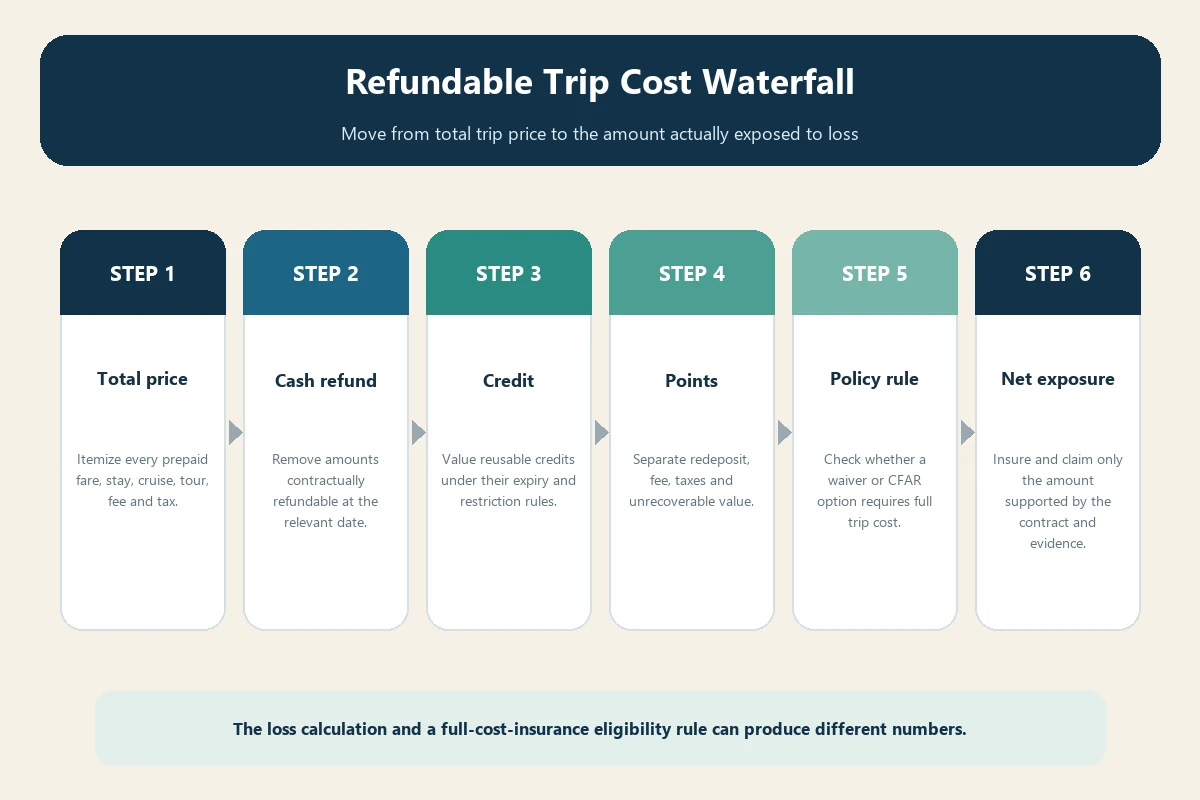
Five different trip-cost numbers
- Headline price: advertised total.
- Prepaid amount: money or value already committed.
- Nonrefundable amount: current supplier penalty.
- Insured trip cost: amount accepted on the declarations.
- Claim loss: eligible amount after refunds, credits, and exclusions.
These numbers can match, but often do not. A clean ledger prevents overinsurance and underinsurance.
Build a supplier-by-supplier ledger
| Supplier | Paid | Cash refund today | Credit | Penalty |
|---|---|---|---|---|
| Airline | $1,200 | $0 | $1,200 credit | Credit restrictions |
| Hotel | $900 | $900 | $0 | $0 |
| Tour | $3,000 | $1,000 | $0 | $2,000 |
The figures are illustrative. The policy decides how credits and required trip cost are valued.
Fully refundable bookings
If a hotel will return the full payment in cash when cancelled on time, there is no current cancellation loss. The risk begins when the free-cancellation period ends. A policy may allow the amount to be added later, but reporting deadlines can apply.
Record the exact local-time deadline, time zone, and refund method. A refund minus a service fee is not fully refundable.
Partially refundable bookings
A tour can refund 80% today, 50% next month, and nothing near departure. Insurable exposure grows through the penalty schedule. Ask whether the policy wants the full prepaid cost from the start or the current nonrefundable amount updated over time.
Do not wait until a known cancellation threat appears. Insurance cannot cover a loss that became known before the update.
Refundable airfare
A truly refundable fare can return cash to the original payment method. A changeable fare can instead issue a credit or charge a fee. “Flexible” and “refundable” are not synonyms.
Read the fare rules for cancellation, no-show, schedule change, and voluntary refund. Separate seat, bag, and upgrade charges.
Airline credits
A credit can have expiration, name, route, transfer, blackout, and fare-difference restrictions. Some policies reduce the claim by the credit’s face value; others examine whether it is usable. The supplier’s refusal to issue cash is not proof of a total loss.
Keep the credit terms and ask the insurer how it values the benefit.
Points, miles, and award travel
Points can be redeposited free, for a fee, or not at all. Taxes and carrier charges can have separate refund rules. Travel policies vary in whether they cover point value, redeposit fees, or only cash paid.
Do not insure the retail ticket price without written approval. Preserve the award statement and cancellation terms.
Gift cards and vouchers
A trip paid with a gift card can return value to the same card rather than cash. A promotional voucher may expire or have no cash value. Determine who owns it and who receives the refund.
Ask whether the policy treats the form of value as insured trip cost.
Vacation rentals
Rental deposits, host payments, cleaning fees, platform fees, damage deposits, and taxes can have different refund schedules. A security deposit expected back after the stay is not the same as prepaid rent.
Capture the original terms before cancellation changes the online page.
Cruises and tours
A cruise invoice can contain fare, port charges, taxes, gratuities, insurance, excursions, transfers, and packages. Some components are refundable when fare is not. Group or promotional rules can differ.
Ask the supplier for a written cancellation quote, not only a percentage from a brochure.
Visa and entry costs
Government visa fees, service fees, biometrics, and document shipping can be nonrefundable but may not qualify as insured trip cost. A visa denial can have its own covered-reason or exclusion rules.
The visa denial and insurance refund guide illustrates why visa fees and trip cancellation are separate.
Travel insurance premium
The insurance premium itself is not generally part of trip cost for a cancellation claim. A free-look period may allow a refund when no claim or departure has occurred, subject to the plan and state. After that, premium refundability can be limited.
Do not add the premium to the trip-cost figure without the administrator’s direction.
Credit-card protection
Credit-card trip coverage can overlap with travel insurance and use separate definitions, limits, and covered reasons. The card issuer’s possible benefit is not a supplier refund. Ask whether the travel policy is primary or secondary and what documentation is required.
Do not subtract a card benefit before it is determined, but disclose other insurance during the claim.
Supplier bankruptcy or default
A supplier can promise a refund and later become unable to pay. Financial-default coverage, when included, has eligibility, timing, supplier, and waiting rules. A general cancellation benefit may exclude insolvency.
Assess supplier risk separately from ordinary refundability.
Pre-existing-condition waiver
A waiver may require insuring all prepaid nonrefundable trip costs and reporting later additions within a specified period. Some plans use different wording. Underinsuring can affect waiver eligibility beyond the missing dollars.
Use the pre-existing-condition guide and ask how refundable arrangements count.
CFAR requirements
CFAR commonly requires insuring the full prepaid nonrefundable cost and cancelling before a policy-defined deadline. It reimburses a stated percentage rather than the full amount. The exact time windows and percentages vary.
Our CFAR guide explains the conditions. Do not omit a later payment because the standard cancellation claim would be smaller.
When refundability changes
Set calendar reminders before every supplier penalty date. Recalculate the ledger and update the policy as required. Save the new declarations and additional premium receipt.
A cost that was refundable at purchase can become fully at risk without any notification to the insurer.
When the supplier changes the trip
A schedule change, cancelled cruise, hotel closure, or tour revision can trigger a supplier refund or credit. Supplier nonperformance can reduce the travel-insurance loss. Ask the supplier first and preserve the response.
Travel insurance should not pay an amount the supplier already owes.
Trip interruption cost
Interruption can include unused arrangements and additional transport after departure, but supplier refunds still matter. The insured trip cost can also cap the benefit. The trip interruption guide explains the after-departure calculation.
At claim time
Provide the original invoice, payment, policy declarations, cancellation date, supplier penalty, refund, credit, and remaining balance. A spreadsheet is an index, not proof. The travel insurance claim guide helps build the packet.
Six calculation scenarios
- Refundable hotel: no cash loss before deadline.
- Airline credit: value depends on policy and restrictions.
- Tour 50% penalty: current exposure is the forfeited half.
- Award ticket: test redeposit fee, taxes, and point treatment.
- CFAR: full required cost can matter despite partial reimbursement.
- Supplier default: separate financial-default eligibility.
Allocate cost by traveler
Couples, families, and groups should not divide the total automatically. One traveler may have a nonrefundable cruise fare while another has a refundable hotel or a host-paid flight. Record who is insured, who paid, who receives the refund, and whose cost appears on each declarations page. A shared credit-card statement does not prove equal loss.
This allocation matters when one traveler cancels and another continues, when a single supplement is charged, or when an adult child paid a parent’s trip. Ask whether the payer, traveler, or refund recipient must submit the claim. Reconcile the sum of all individual insured costs with the supplier invoice so the household neither duplicates nor omits exposure.
What a zero-dollar trip cost means
A traveler can buy a medical-focused policy with no insured trip cost in some markets, but cancellation and interruption benefits may be absent or limited. Award travel, hosted lodging, and refundable arrangements can still create taxes, redeposit fees, medical risk, baggage, or evacuation exposure. Ask which benefits remain when trip cost is entered as zero and whether cost can be added later.
Questions to ask
- What does this policy define as trip cost?
- Do fully refundable arrangements need to be insured?
- How are credits, vouchers, and gift cards valued?
- Can points or redeposit fees be insured?
- When must a newly nonrefundable cost be added?
- Does the waiver require full cost?
- Does CFAR require full cost?
- How are taxes and fees treated?
- Will a decrease produce a premium refund?
- What claim proof shows actual loss?
FAQ
Should a fully refundable hotel be insured?
Maybe not for basic cancellation loss, but time-sensitive benefits can have broader cost rules. Confirm the certificate.
Does an airline credit count as a refund?
It can reduce the claim, depending on policy and usability. Keep the credit restrictions.
Can points be insured at retail value?
Do not assume so. Policies can cover redeposit fees, taxes, or another defined amount.
Can insurance pay more than the actual loss?
No. Eligible reimbursement is reduced by refunds, credits, other insurance, and policy limits.
Bottom line
Refundability is a moving calculation, not a booking label. Track every supplier, payment, penalty date, cash refund, credit, and point rule. Insure the amount the certificate requires, update it on time, and claim only the documented eligible loss after all recoveries.