
Knowing how to appeal a denied travel insurance claim begins with the insurer’s stated reason, not with a generic complaint that the decision is unfair. A useful appeal connects four elements: the exact policy language, a dated chronology, the evidence supporting each disputed fact, and a clear request for reconsideration. It also arrives before the applicable deadline.
Travel insurance is not one benefit. Cancellation, interruption, delay, medical, evacuation, baggage, and rental-car claims have different triggers and proof. Build the appeal around the benefit actually denied, and keep any health-plan, airline, card, or supplier dispute on its own track.
Key takeaways
- Read the entire denial and identify every policy provision and factual finding.
- Appeal the stated reason with targeted evidence; do not simply resubmit the original packet.
- Use the certificate issued for the trip, not current marketing copy.
- Calendar internal appeal, proof, complaint, and legal-action deadlines separately.
- A regulator complaint can review claim handling, but it does not guarantee coverage or replace legal advice.
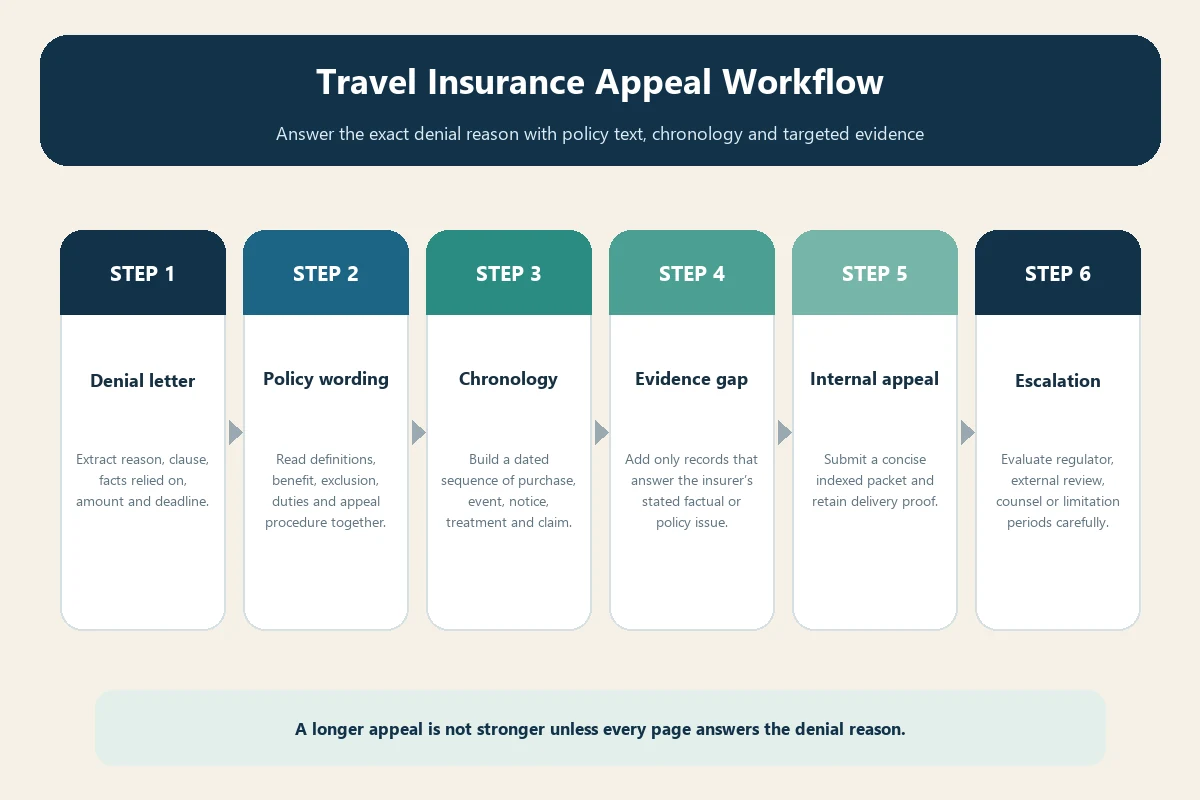
Step 1: preserve every deadline
Record the denial date, delivery date, appeal deadline, required submission channel, and any contractual legal-action limitation. Do not assume a telephone call or request for more explanation counts as an appeal. Do not assume an internal review pauses another deadline. Follow the certificate and denial instructions, and ask for clarification in writing when dates conflict.
Our notice-of-claim and proof-of-loss guide explains why several clocks can run at once. Submit a protective appeal before the earliest reasonable deadline if a medical record, airline letter, or refund statement is still pending. List the missing item and explain when it was requested.
Step 2: classify the decision
Not every adverse message is a final coverage denial. The claim may be closed for missing documents, reduced by a supplier refund, pending another insurer’s EOB, denied under an exclusion, or rejected because the event does not fit the benefit definition. Identify whether the letter offers reconsideration, an internal appeal, or only a complaint address.
Ask the administrator to confirm the status and provide a complete missing-document list. If the decision is final, request the exact certificate provisions, endorsements, and factual basis used. Save envelope dates, portal status, and every version of the letter.
Step 3: create a denial-reason table
Use one row for each reason. Columns should include: insurer statement, cited policy section, disputed fact, existing evidence, new evidence, and requested correction. A denial can contain multiple independent grounds. Refuting one does not resolve the others.
For example, a cancellation claim might be denied because the event is not listed and because the traveler did not cancel promptly. The appeal must address both the covered-reason language and the timing or increased-loss issue.
Step 4: use the correct policy version
Locate the declarations, certificate, schedule of benefits, state-specific endorsements, and confirmation from the purchase. Verify the insured names, trip dates, destination, coverage dates, and benefit limits. Marketing pages and sample certificates can change after purchase.
Quote only the short provision needed and identify its page. Read definitions, exclusions, conditions, and benefit language together. A term such as “family member,” “traveling companion,” “physician,” “inclement weather,” or “uninhabitable” may have a specific contractual definition.
Step 5: build the chronology
Create a dated, factual sequence from purchase through denial. Include first trip payment, policy purchase, onset of circumstances, medical consultation, cancellation or interruption, supplier contact, emergency-assistance calls, claim notice, proof submissions, requests for information, and decisions. Cite the document supporting each entry.
A chronology exposes misunderstandings without emotional argument. It can show that the insurer used the wrong treatment date, overlooked a call, confused a voucher with cash, assigned one traveler’s condition to another, or treated a provisional card credit as a final refund.
Step 6: obtain targeted evidence
More pages do not automatically make a better appeal. Add evidence that answers the denial:
- a physician statement addressing the policy’s required medical facts and dates;
- an itemized bill, medical record, or discharge summary;
- the full airline, cruise, hotel, or tour cancellation record;
- proof of original payment and final refund or credit status;
- weather, carrier, police, or government documentation from an authoritative source;
- an EOB or formal denial from the first health payer; or
- portal and call records showing timely notice or authorization efforts.
Do not ask a physician or supplier to adopt legal conclusions. Ask for facts within that person’s knowledge. A clinician can document diagnosis, onset, treatment, functional limitations, and medical advice; the insurer decides whether those facts satisfy coverage.
Medical-claim appeals
Separate the provider’s charge, the first health plan’s decision, and the travel insurer’s adjustment. The Explanation of Benefits may show deductible, noncoverage, missing coding, or another payer—not the same reason as the travel denial. Obtain a corrected EOB if the first payer made an error.
If the dispute involves pre-existing-condition wording, assemble records around the policy’s look-back period and waiver requirements. Protect sensitive information and follow the authorization process; do not send an entire lifetime medical file without understanding the request.
Cancellation and interruption appeals
Match the event to the covered-reason definition and prove that it caused the trip change. Include the original itinerary, cancellation or interruption date, unused arrangements, new transportation, supplier terms, refunds, and credits. Our trip interruption guide explains why unused cost and extra return transportation must be separated.
If a refund or chargeback changed after the denial, use the reconciliation method in our later refunds and recovery guide. Do not conceal a new payment; explain which loss line it affects.
Evacuation and assistance disputes
Evacuation benefits frequently turn on necessity, assistance-company coordination, approved destination, treating-physician information, and whether the carrier arranged the transport. Produce call logs, case numbers, medical facility capabilities, transfer notes, and the assistance company’s instructions.
A preference to return home is not always the same as medically necessary evacuation. Frame the appeal around the certificate’s standard and documented medical or logistical facts, not the traveler’s understandable preference.
Write the appeal letter
Use a concise structure:
- Identify the insured, claim number, policy, trip, decision date, and benefit.
- State that reconsideration is requested before the deadline.
- List each denial reason and the relevant policy provision.
- Provide the chronology and document citations.
- Explain how the new or overlooked evidence changes the stated reason.
- Request a specific action: reversal, recalculation, reopening, or a detailed response.
- Attach an indexed exhibit list and retain proof of delivery.
A professional, calm tone helps the reviewer locate the issue quickly and understand the precise remedy supported by the record. Avoid accusations of fraud, bad faith, discrimination, or legal violations unless qualified advice supports them. Preserve those questions without making unsupported claims.
What not to do
- Do not send only the same documents with “please reconsider.”
- Do not rely on a salesperson’s oral summary without documenting it.
- Do not alter receipts, medical records, screenshots, or timestamps.
- Do not mix different expenses into one unexplained total.
- Do not let a supplier or health-plan dispute erase the travel appeal date.
- Do not sign a broad release affecting recovery rights without review.
Ask for the claim file and calculation
Depending on law and procedure, the insurer may provide relevant claim records, correspondence, or a detailed payment calculation. At minimum, ask for the documents it says are missing, the policy pages applied, the source of disputed facts, and a line-by-line explanation of any partial payment. This can narrow the appeal.
Compare the calculation with the organized workflow in our claim documentation guide and the recurring problems in our travel claim denial guide.
When to contact a state insurance regulator
Travel insurance is generally regulated at the state level. The relevant department may depend on the policy, insurer, residence, and transaction. Use the insurer name and NAIC number shown on the certificate, then find the correct department through the NAIC directory.
A complaint can ask the department to review whether the insurer followed applicable rules and its contract. Include the certificate, denial, appeal, response, chronology, and proof of submission. State the requested resolution. The department usually cannot rewrite the policy, create coverage, decide every factual dispute, or serve as private counsel.
When professional advice may be appropriate
Consider a licensed attorney or other qualified adviser when the loss is large, a legal-action deadline is near, the insurer requests repayment, the facts involve serious injury or death, multiple jurisdictions apply, or a settlement could release rights. Ask about fees, scope, and deadlines at the outset.
Appeal packet checklist
- cover letter and requested outcome;
- denial letter and delivery evidence;
- issued certificate and endorsements;
- reason-by-reason response table;
- dated chronology;
- new and previously overlooked evidence;
- line-by-line loss and refund reconciliation;
- claim communications and confirmation numbers; and
- indexed exhibits with sensitive data transmitted securely.
FAQ
How long do I have to appeal?
There is no safe universal period. Use the denial, certificate, applicable law, and the earliest defensible date.
Can I appeal without every document?
Protect the deadline with available evidence, identify outstanding records, and request written supplementation instructions.
Does a regulator complaint replace an appeal?
No. Preserve the insurer’s appeal and any legal deadline separately unless authoritative written guidance says otherwise.
Should I use an appeal template?
A structure can help, but the substance must answer the actual denial reasons, policy language, and facts.
Bottom line
A strong travel insurance appeal is an evidence map. Preserve the deadline, decode every denial reason, use the issued certificate, build a dated chronology, and add only evidence that changes the disputed facts. Request a specific written result, and escalate to the appropriate regulator or professional without abandoning other deadlines.
Sources
- NAIC — What to Know About Travel Insurance
- NAIC — Travel Insurance Model Act
- NAIC — State Insurance Departments
- New York DFS — File a Complaint
- California Department of Insurance — Getting Help
- Washington OIC — File a Complaint
Reviewed August 16, 2026. This article is general educational information, not legal advice or a guarantee of coverage, appeal rights, or outcome.
