
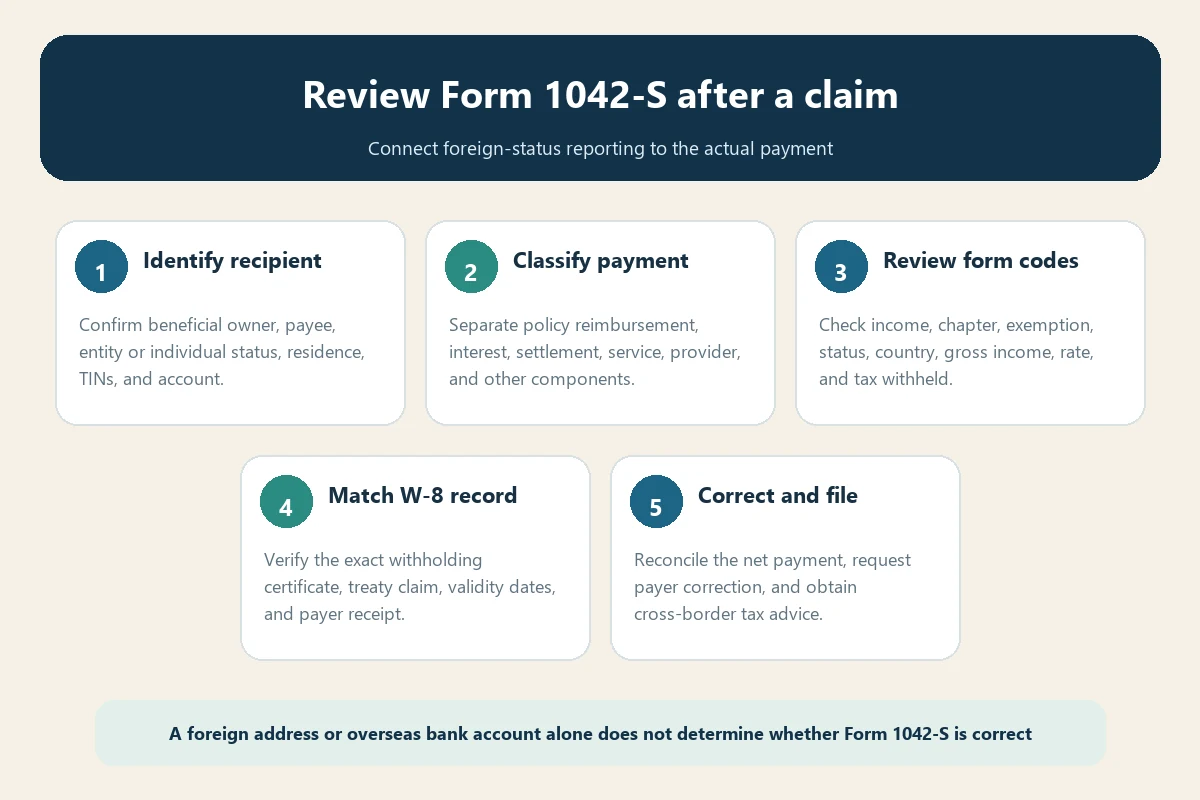
If you received a travel insurance claim Form 1042-S, reconcile it with the actual payment before using it on a tax return. Confirm the legal payer, recipient, foreign-status documentation, income source and code, gross amount, exemption code, withholding rate, tax withheld, payment date, and net funds.
Form 1042-S is not automatically required merely because the traveler lives abroad or used a foreign bank. The result can depend on whether the recipient is a foreign person, what the payment represents, its source, treaty documentation, and the withholding agent’s records. This guide is general information, not tax, legal, immigration, accounting, or insurance advice.
Start with the claim payment itself
Obtain the policy, claim decision, settlement agreement if any, and gross-to-net payment advice. Record every component rather than treating the entire deposit as one item.
| Question | Evidence | Why it matters |
|---|---|---|
| What was paid? | Benefit and settlement ledger | Payment categories can differ |
| Who received it? | Payee and beneficial-owner records | Payee and owner may differ |
| Who paid it? | Legal payer and withholding agent | Brand and filer may differ |
| What was sourced? | Payer’s source analysis | Foreign status alone is insufficient |
| What was withheld? | Rate, base, tax, and deposit record | Reconciles gross to net |
| How was it reported? | Form 1042-S codes and year | Explains the payer’s position |
Understand what Form 1042-S reports
The IRS page for Form 1042-S describes it as reporting specified income and amounts withheld for foreign persons. The detailed instructions control which U.S.-source amounts and chapter 3 or chapter 4 items are reportable.
The existence of a form does not prove the payer correctly classified the travel claim. It records the withholding agent’s filing position, which should be tested against the policy benefit, settlement, interest, recipient, documentation, and source rules.
Identify the beneficial owner and payee
The claimant, traveler, policyholder, beneficiary, medical provider, attorney, estate, business, bank-account owner, and beneficial owner can be different parties. Ask whose foreign status and taxpayer identifiers the payer used.
Record recipient name, address, country code, U.S. TIN if any, foreign TIN, account number, entity status, and intermediary details. Never change the recipient merely to match a payment account.
Do not infer status from an overseas address
A U.S. citizen or resident can live abroad and use a foreign bank. A nonresident may have a U.S. address or U.S. account. Immigration status, tax residency, treaty residency, citizenship, and payer documentation are related but not identical.
Ask a qualified cross-border professional to determine status for the relevant year. Do not submit Form W-8BEN solely because the mailing address is foreign or Form W-9 solely because the bank is in the United States.
Separate payment components before source analysis
A claim can include policy reimbursement, fixed benefits, medical-provider payments, interest, damages, attorney-related gross proceeds, services, or another component. Different components may have different source and reporting analyses.
The claim interest 1099 guide separates delayed-payment interest from principal. The settlement attorney-fee guide separates claimant reporting from funds routed through counsel.
Ask the payer for its source determination
The payer should identify which amount it considered U.S.-source and why. Ask for the income category, sourcing rule, legal recipient, gross amount, withholding chapter, and any exemption or treaty basis.
Do not assume that a U.S. insurer makes every payment U.S.-source or that a loss occurring abroad makes every component foreign-source. The analysis can depend on the nature of the income, not merely payer location or trip destination.
Read every Form 1042-S box and code
Inventory the unique form identifier, income code, gross income, chapter indicator, exemption code, tax rate, federal tax withheld, withholding agent, recipient status codes, country, address, TINs, intermediary, account, and tax year.
The current IRS Instructions for Form 1042-S explain these fields. Do not guess an income code from a short label; ask the filer to identify the payment behind it.
Match the gross amount to the claim ledger
Compare Form 1042-S gross income with the approved principal, interest, settlement additions, provider payments, and any amount paid to an agent. Then reconcile tax withheld and non-tax charges to the actual net funds.
The claim payment fee guide helps separate wire, bank, card, processing, and exchange charges. A foreign-bank fee should not be mistaken for U.S. tax withholding.
Review the withholding rate and chapter
Ask whether the payer applied chapter 3, chapter 4, another provision, or no withholding. Record the rate, gross base, exemption code, treaty article if claimed, and tax actually deposited.
The IRS Publication 515 explains withholding for nonresident aliens and foreign entities. It is a payer-focused reference and does not replace individualized advice about the claimant’s status, source, treaty, or return.
A 30% deduction still needs explanation
Do not assume that a 30% difference is automatically valid nonresident withholding. It might be withholding on a particular reportable component, a presumption caused by missing documentation, or an unrelated adjustment.
Require the payer to identify the income amount subject to the rate and show the arithmetic. The claim tax withholding guide helps reconcile tax type, base, rate, form, and net payment.
Match the exact W-8 certificate
Forms W-8BEN, W-8BEN-E, W-8ECI, W-8EXP, and W-8IMY serve different recipients and purposes. Record the form requested, signer, capacity, beneficial owner, entity classification, treaty claim, foreign TIN, reference number, signature date, expiry, and payer receipt.
Do not self-select a W-8 form from a generic checklist. The IRS requester instructions for Forms W-8 explain the payer’s documentation framework, while a cross-border adviser can address the recipient’s facts.
Verify any treaty claim carefully
A treaty rate or exemption can depend on residence, beneficial ownership, income article, limitation-on-benefits rules, permanent establishment or effectively connected income, and valid documentation. Country of citizenship alone may not determine eligibility.
Ask the payer to identify the treaty article, rate, exemption code, and documentation it accepted or rejected. Do not claim a reduced rate merely because the country has a U.S. income tax treaty.
Check whether the form reports zero withholding
Form 1042-S can sometimes report an amount even when no tax was withheld because an exemption or treaty provision applied. Therefore, the presence of the form does not necessarily mean money was deducted.
Compare gross income, rate, tax withheld, and net payment. If the payer says the amount was exempt, ask it to explain the code and supporting certificate.
Foreign banking is a separate operational issue
SWIFT routing, intermediary fees, foreign-exchange spread, local bank compliance, beneficiary-name matching, and returned transfers affect delivery but do not by themselves decide the U.S. tax form.
The foreign bank claim payment guide handles the banking trail. Maintain separate ledgers for U.S. tax withholding and bank or currency deductions.
Request a complete payer explanation
Send the withholding agent a written, field-specific request. Include the claim and payment reference but transmit full TINs only through a verified secure route.
Request:
- legal withholding agent and any intermediary;
- beneficial owner, payee, and recipient used;
- payment component and source determination;
- income, chapter, status, exemption, and country codes;
- gross amount, rate, and tax withheld;
- W-8 form and treaty record relied on;
- payment and tax-deposit reconciliation; and
- correction and recipient-statement timeline.
Correct the payer’s filed record
If the recipient, amount, code, rate, tax, country, year, or withholding agent is wrong, ask for the formal Form 1042-S correction. A revised claim letter or bank transfer does not necessarily update IRS reporting.
Keep original and corrected statements. Confirm that the gross amount and tax withheld on the final form match the payer ledger and funds received.
Protect refund and filing deadlines
Incorrect withholding can affect a U.S. return, refund claim, treaty position, foreign tax reporting, or both. Give a cross-border tax professional the policy, payment ledger, W-8 record, Form 1042-S, bank proof, and correction correspondence.
Do not wait indefinitely for a correction or assume the form itself creates a refund. Filing status, form, deadlines, supporting TIN, and documentation can be decisive.
Watch for withholding and refund scams
A scammer may demand a tax-release payment, promise an immediate Form 1042-S refund, or ask for passport scans, bank credentials, remote access, gift cards, wire, or cryptocurrency. Verify the insurer and withholding agent independently.
The claim payment scam guide covers fake tax demands and changed banking instructions. Legitimate withholding should appear on a traceable form and payment ledger.
Keep a secure cross-border claim file
Retain the policy, claim decision, settlement, payment calculation, status and residency advice, W-8 certificates, treaty documents, Form 1042-S, bank records, tax deposit evidence, corrections, returns, and professional workpapers.
The final file should show who owned the payment, what it represented, why it was treated as U.S.-source, which code and rate applied, how tax was withheld, and how the final form reconciled with net funds.
Bottom line
For Form 1042-S connected to a travel insurance claim, begin with the payment and beneficial owner—not the foreign address or bank account. Verify source, income code, chapter, exemption, treaty, W-8 record, gross amount, rate, tax withheld, and correction with qualified cross-border advice.
