
If a travel insurance claim payment fee was deducted, first compare the written claim approval with the amount that entered your account or payment instrument. A policy deductible, coverage adjustment, payment-method fee, bank charge, card fee, exchange spread, tax, and processing error are different entries.
Do not assume the insurer imposed every deduction, and do not accept “fees” as a complete explanation. Identify the party, service, amount, timing, disclosure, and contractual basis for each difference. This U.S.-focused guide is general information, not legal, banking, tax, accounting, foreign-exchange, or insurance advice.
Lock down the approved claim amount
Obtain the final decision and explanation of benefits showing claimed amount, covered amount, excluded items, deductible, coinsurance, benefit limit, depreciation, supplier refund, other-insurance offset, prior payment, and approved net amount. The decision should state the currency.
Use the travel claim EOB guide to rebuild the claim calculation. A policy deductible belongs in the adjudication ledger; a $5 payment-platform withdrawal charge belongs in the delivery ledger.
| Difference type | Likely record | Responsible party to ask |
|---|---|---|
| Coverage adjustment | Claim decision or revised EOB | Insurer or administrator |
| Payment-method fee | Election screen or fee schedule | Payer or payment vendor |
| Prepaid-card fee | Cardholder agreement and history | Card issuer or program manager |
| Bank fee | Account statement or bank tariff | Receiving bank |
| Intermediary fee | Wire trace or bank message | Sending and correspondent banks |
| Exchange difference | Rate, timestamp, spread, currencies | Converting institution |
| Tax or withholding | Payment advice and tax document | Payer and qualified tax adviser |
Map the entire payment route
Record the insurer, claim administrator, payment vendor, sending bank, intermediary bank, receiving bank, card issuer, wallet, and any merchant or ATM used. Identify the payment method, original amount and currency, conversion point, trace, value date, and final amount received.
One payment can pass through several companies. The insurer may send the full approved amount while a receiving institution imposes a fee. Conversely, a payment vendor may subtract a charge before the funds ever reach the bank. The transaction records should show where the amount changed.
Separate a fee from a claim reduction
If the amount sent by the payer already falls below the decision, ask for a revised calculation. The difference could be a newly applied deductible, refund, prior payment, limit, benefit classification, or clerical error rather than a payment fee.
The partial claim payment guide helps reconcile unpaid line items. Do not let a payment processor describe a disputed coverage reduction, and do not ask the claims examiner to reverse a fee charged later by a bank without evidence.
Review the payment election screen
Save the original choice screen, confirmation email, fee disclosure, terms, and alternatives. Determine whether check, ACH, debit-card push, virtual card, prepaid card, wallet, instant payment, standard payment, or expedited delivery was selected.
Ask whether a no-fee method was available, whether the claimant affirmatively selected the charged method, and whether the amount was disclosed before acceptance. A faster optional method can have different terms from a standard claim payment.
Prepaid and virtual card fees need the product agreement
A claim payment delivered through a prepaid or virtual card can involve activation, monthly, transaction, ATM, cash-out, replacement, foreign transaction, or account-closing fees. The exact product and agreement control the analysis.
The CFPB explains that covered prepaid-card disclosures show key fees and direct consumers to the long-form disclosure for all fees. See its official prepaid fee disclosure guide. A claim disbursement card may or may not fall within the same product category, so identify the issuer and terms first.
If the card expired or cannot be used, follow the expired virtual claim card guide before paying a replacement or cash-out fee.
Check the card transaction history
Download the original load, available balance, purchases, holds, withdrawals, reversals, fees, and current balance. A temporary merchant authorization can reduce available funds without becoming a final charge. A declined ATM attempt can also create an operator or account fee under some terms.
Ask the issuer to identify each fee by name, date, amount, agreement section, and waiver rule. Do not repeatedly test transactions while the balance is disputed.
Bank charges can occur after full payment
A receiving bank may charge an incoming wire, foreign check collection, returned item, account, currency, or intermediary-related fee. Compare the bank statement with its current fee schedule and the account agreement in effect on the transaction date.
Ask whether the fee would differ for ACH, domestic wire, international wire, check, or another account type. The claim payment method guide helps compare delivery and tracing before a replacement is chosen.
International transfers can have multiple deductions
A sending bank, correspondent, receiving bank, and foreign authority can each affect the net amount. Allianz Care’s public international-claims FAQ notes that multiple banks may be involved and that receiving banks can impose charges even when the payer instructs its bank to pay associated claim-payment charges. See the official Allianz Care claim payment FAQ. Its process is an example, not the terms of every U.S. travel policy.
The foreign bank claim payment guide provides a complete SWIFT, IBAN, intermediary, currency, and trace workflow.
Reconcile exchange rate and spread
Record the claim currency, sent currency, received currency, rate, timestamp, converting institution, explicit conversion fee, and implicit spread. The claim can be correctly calculated in USD but lose value when a bank converts it later.
Use the claim exchange-rate guide to distinguish expense conversion, insurer calculation, payout conversion, and final bank credit. Ask which party selected the conversion route and whether a same-currency option existed.
Taxes and withholding are not generic processing fees
If the payment advice identifies withholding, levy, tax, garnishment, or government offset, request its legal and calculation record. Do not treat it as an unexplained card or bank fee.
If a W-9, W-8 series form, Form 1099, foreign tax, or tax treaty issue appears, obtain qualified tax advice. The claim W-9 request guide explains why a tax form does not by itself decide whether the insurance payment is taxable.
Ask who selected and benefits from the method
Determine whether the claimant chose the method, the insurer defaulted to it, or a provider received a virtual card. Ask whether the payer or vendor earns revenue connected to the chosen instrument and whether another fee-free route was offered.
Provider-payment laws and contracts can differ from consumer travel-claim payments. For example, New York Insurance Law section 3217-b contains specific rules for certain healthcare-provider reimbursement methods that impose identified fees. Do not apply that provider statute automatically to a traveler’s private benefit; use it only to recognize that recipient type and jurisdiction matter. Review the current law through the New York Senate legislation page.
Request a line-item fee explanation
Send a written request containing the claim, approved amount, payment reference, amount sent, amount received, and exact difference. Ask for:
- name and legal entity that imposed each fee;
- fee amount, currency, date, and service;
- agreement or disclosure section;
- when and how the claimant accepted it;
- available lower-cost or no-fee alternative;
- waiver, refund, or dispute procedure;
- corrected payment if the deduction was erroneous.
Ask the payer to confirm whether its claim ledger still shows the full approved benefit as paid.
Dispute with the party that imposed the charge
A coverage dispute goes to the claim administrator. A card-account fee goes to the card issuer. A bank fee goes through the account complaint process. A transfer error goes to the payment provider. Send supporting records to the correct party and preserve the deadline.
If a method was misrepresented, state the exact representation, disclosure, selection, charged amount, and requested correction. Avoid a broad complaint that mixes policy exclusions with downstream bank charges.
Choose correction without creating duplicate payment
The remedy may be a fee refund, additional claim payment, card balance credit, bank reversal, revised exchange credit, or new delivery method. Obtain written confirmation of which instrument is being corrected and whether the original remains usable.
Do not accept a complete duplicate claim payout merely to replace a small fee unless the payer controls and reconciles the original. Preserve every refund and adjusted balance.
Document the final net receipt
Create a closing ledger: approved claim, amount sent, each permitted deduction, each disputed or reversed fee, final credit, currency, and remaining difference. Save the decision, fee disclosure, statement, trace, dispute, response, refund, and zero-balance confirmation.
A final credit should reconcile to the corrected decision. If it does not, continue the specific claim, bank, or payment dispute rather than describing the case generally as “underpaid.”
Escalate by jurisdiction and product
If the insurer or administrator will not explain a deduction it imposed, identify the relevant department through the NAIC state insurance regulator directory. A prepaid, bank, remittance, or card complaint may belong with a financial regulator instead.
Provide the policy, claim decision, payment election, fee disclosures, payment trace, account history, calculations, dispute, and responses. Redact full account and card numbers from complaint copies unless the secure authority requires them.
Bottom line
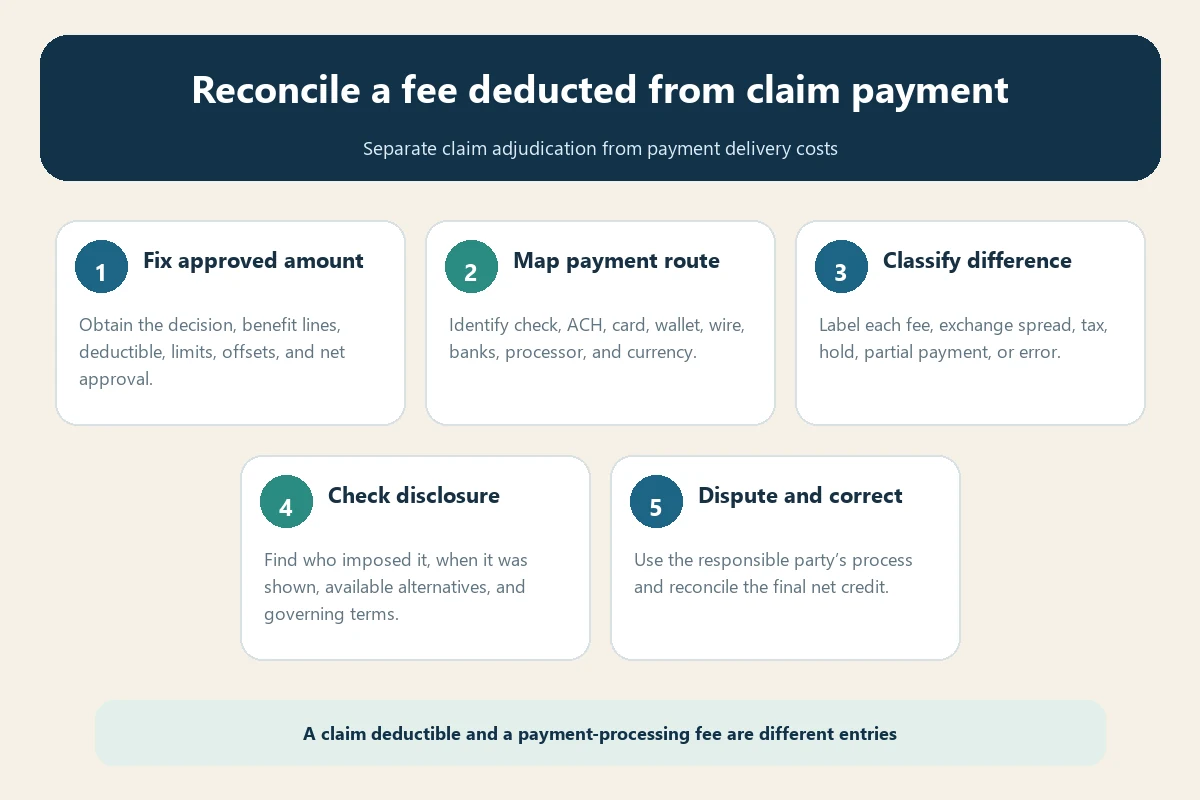
When a fee is deducted from a travel insurance claim payment, establish the approved benefit first and follow the money through each company. Label the difference as claim adjustment, payment fee, card fee, bank charge, intermediary deduction, exchange spread, tax, or error. Then use the responsible party’s dispute process and reconcile the corrected net receipt.
