
If a travel insurance claim payment had tax withheld, request a payment advice showing the gross amount, tax base, rate, tax type, authority, payee, and net amount. Do not assume every insurance reimbursement is taxable or every 24% difference is valid backup withholding.
Tax treatment can depend on what the payment replaces, who received it, whether it is reportable, residency, business context, settlement language, and federal and state rules. This U.S.-focused guide is general information, not tax, legal, accounting, payroll, banking, or insurance advice. Consult a qualified tax professional.
Separate gross claim approval from net payment
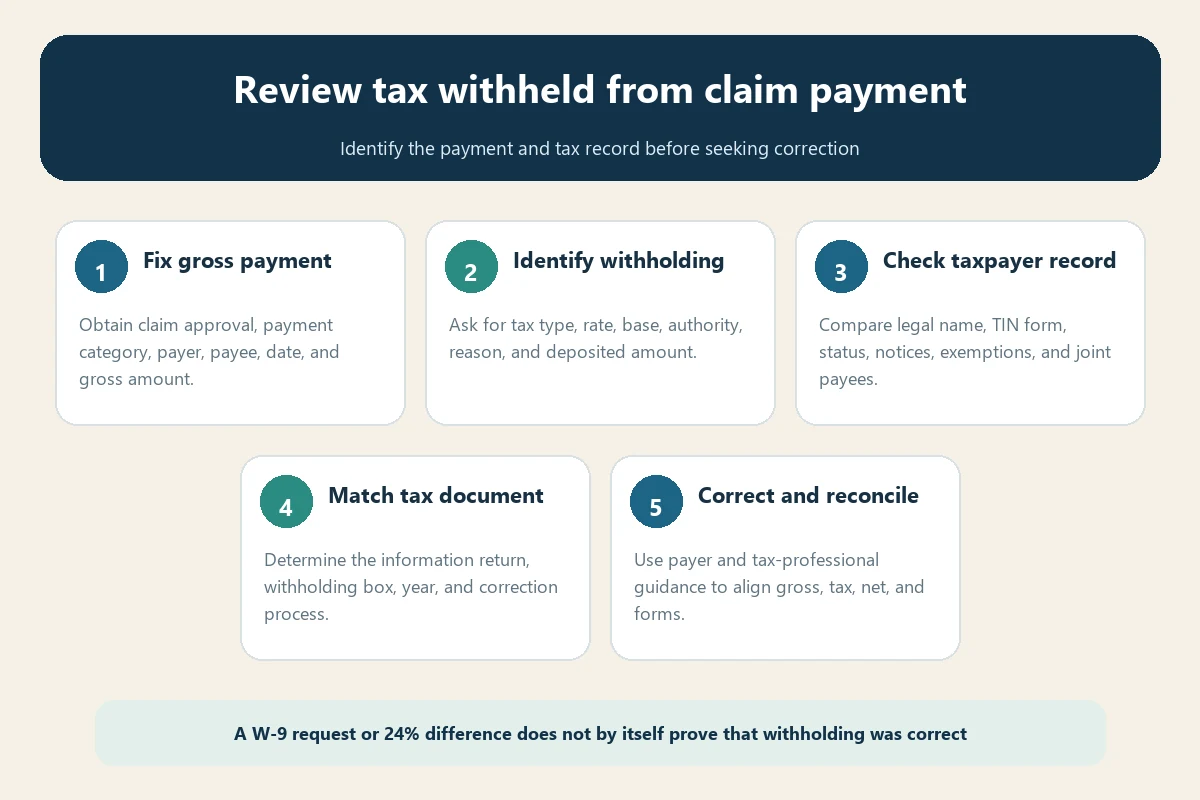
Obtain the written claim decision and line-item calculation. Record the claimed amount, approved benefits, deductible, limits, offsets, prior payments, currency, gross disbursement, withholding, payment fees, and final net credit.
The claim payment fee deduction guide helps separate tax from bank, card, wire, exchange, and processing charges. A deduction labeled only “adjustment” needs clarification.
| Question | Record to request | Why it matters |
|---|---|---|
| What was paid? | Benefit or settlement description | Payment category affects analysis |
| Who was paid? | Legal payee and taxpayer record | Claimant and payee can differ |
| What tax? | Federal, state, foreign, backup, or other | Routes use different rules |
| What rate and base? | Gross amount × stated rate | Tests the arithmetic |
| Why withheld? | Notice, missing TIN, classification, residency | Identifies correction path |
| How reported? | Form type, box, year, payer ID | Supports tax return and correction |
Identify what the payment represents
A travel policy can pay reimbursement of trip cost, medical expense, baggage value, travel delay allowance, accidental death benefit, provider charge, vendor service, interest, settlement, attorney fee, or another amount. These do not automatically share one tax or reporting result.
Ask the payer for its stated characterization and the policy or settlement line that generated the payment. Do not rely on a claims representative for individualized tax advice, but require the company to explain its own reporting and withholding action.
Do not infer taxability from a W-9 request
Form W-9 gathers a U.S. person’s taxpayer identification number and certifications for a requester. It does not by itself establish that a travel insurance reimbursement is income or that withholding is required.
The claim W-9 request guide explains how to verify the requester, payee, purpose, secure channel, and later information-return follow-up. Keep the W-9 question separate from the claim calculation.
Understand backup withholding carefully
The IRS Instructions for the Requester of Form W-9 say a payer of certain reportable payments may have to apply backup withholding when a payee does not furnish a TIN, the IRS notifies the payer that the TIN is incorrect, specified underreporting notice applies, or a required certification is missing. The current instructions state a 24% rate for affected reportable payments. See the official IRS requester instructions.
The critical phrase is reportable payments. The fact that a claimant received an insurance payment or that a company requested a W-9 does not prove the payment belongs to a backup-withholding category. Ask the payer to identify the information-return category and legal basis.
Check the name and TIN reason
Ask whether withholding occurred because no TIN was supplied, the number was obviously invalid, the name-TIN combination did not match, a certification was missing, or the IRS sent a notice. These are different events with different evidence.
Compare the legal payee name with the W-9, Social Security or IRS record, entity classification, estate or trust name, disregarded entity, and payment account. Do not email a Social Security number in ordinary correspondence; use the verified secure route.
A B notice should be handled as a tax record
The IRS’s CP2100/CP2100A guidance explains that those notices identify missing or nonmatching payee names and TINs for payers and can lead to backup-withholding actions. See the official IRS notice explanation.
If the payer refers to a first or second “B notice,” request the payee notice, account reference, response deadline, and exact corrective document. Do not send a new tax form to an unverified email or change the TIN merely to match a claims screen.
Joint and alternate payees need allocation
A check or transfer can involve multiple travelers, a claimant and provider, an estate, attorney, or another alternate payee. Ask whose TIN and information return the payer used and how the gross payment was allocated.
The IRS requester instructions contain specific procedures for joint payees in the W-9 context. Those tax procedures do not decide who owns the insurance benefit. Use the two-payee claim check guide for endorsement and bank questions, and obtain tax advice for reporting.
Foreign payees use a different tax analysis
A non-U.S. claimant, provider, entity, or beneficiary may be asked for a W-8 series form rather than Form W-9. Residency, source, treaty, beneficial ownership, entity status, and payment type can affect withholding and reporting.
IRS Publication 515 covers withholding for nonresident aliens and foreign entities. See the current official Publication 515, but do not self-select a form or treaty rate from a summary. Obtain qualified cross-border tax guidance.
If the payment also goes to an overseas bank, the foreign bank claim payment guide separates banking route, currency, and fees from tax withholding.
Ask for the information return
Request the form type, tax year, payer legal name and taxpayer ID, recipient name and TIN ending, gross amount, withholding box, and expected furnishing date. Depending on the payment, a payer may say no information return applies or may identify a Form 1099 or another form.
Do not assume the form type from the rate alone. Compare the payment advice with the eventual recipient copy and tax transcript when appropriate. A mismatch should be addressed promptly with the payer.
Recalculate the withholding arithmetic
Multiply the stated tax base by the stated rate and compare it with the deduction. Confirm whether the base is the entire claim payment or only a reportable component. Check whether withholding occurred before or after another adjustment.
Create a clear equation: gross reportable payment minus federal withholding minus state or foreign withholding minus separately disclosed delivery charges equals net payment. Never combine tax and payment fees into one unexplained percentage.
Erroneous withholding may have a payer correction window
An IRS internal manual notes that, under applicable regulations, a payer or broker that withheld in error may be able to refund erroneous withholding before the end of the calendar year and before furnishing the related Form 1099. See the official IRS backup-withholding compliance procedures.
This does not guarantee that the travel claim payer can or must refund every disputed deduction directly. Ask the payer and a tax professional what correction method applies, whether deposited tax can be adjusted, and what form will show the final figures.
Send a precise correction request
A written request can ask the payer to provide:
- gross claim payment and payment category;
- tax type, authority, rate, base, and amount;
- reason withholding was triggered;
- name and TIN record used, masked appropriately;
- notice or certification relied on;
- information return type and tax year;
- payer correction or refund procedure;
- revised payment advice and corrected form timeline.
State which facts are disputed without certifying tax conclusions outside your knowledge. Attach the relevant W-9 receipt, notice response, payment advice, and identity correction through a secure channel.
Do not repay or pay “tax release” fees to a stranger
A scammer may claim that taxes, customs, AML clearance, or IRS fees must be paid before insurance funds are released. Verify any request independently with the insurer and tax authority. The IRS does not require payment by gift card or cryptocurrency.
The claim payment scam guide covers fake tax demands, changed bank instructions, remote access, and identity theft. Never share a one-time code or banking password to receive a claim.
Protect tax-year and filing deadlines
Record the payment date, withholding date, tax year, form delivery date, correction request, payer response, and return-filing deadline. A correction that crosses year-end can require different handling from one completed in the same year.
Do not file based solely on a claim portal if a tax form is expected. Conversely, do not delay a required return indefinitely while waiting for a correction; ask a tax professional how to file accurately and preserve the dispute.
Reconcile the final records
Keep the policy, decision, gross payment advice, withholding calculation, W-9 or W-8 receipt, notices, information return, correction, refund, net bank credit, and tax-professional workpapers. Protect full TIN and account data.
The final ledger should show gross claim payment, taxable or reportable characterization as stated by the payer, withholding, other deductions, net receipt, any refund, and corrected tax form. Ask for written confirmation when the payer’s records have been updated.
Escalate the correct issue
A dispute over claim amount belongs with the insurer. A disagreement about tax reporting or withholding requires payer tax staff and qualified tax guidance. Bank fees, payment fraud, and identity theft have separate routes.
If the insurer will not explain how its claim payment was calculated or disbursed, the NAIC state insurance department directory links to official regulators. Insurance regulators generally do not prepare tax returns or decide individual federal tax liability.
Bottom line
When tax is withheld from a travel insurance claim payment, begin with the gross approval and identify the exact payment category, payee, tax type, rate, base, and reporting form. Verify the TIN or residency record securely, challenge errors within the payer’s correction window, and reconcile the corrected tax document with the net funds received.
