
If a travel insurance claim payment included interest and a 1099, separate the interest from the policy benefit before reviewing the tax document. Obtain the principal amount, legal basis, rate, accrual period, calculation method, payment date, payee, withholding, and Form 1099-INT details.
Do not assume that the insurance benefit and added interest share the same tax treatment. A reimbursement may have one characterization while interest for delayed payment has another. This U.S.-focused guide is general information, not tax, legal, accounting, actuarial, or insurance advice.
Start with the approved claim principal
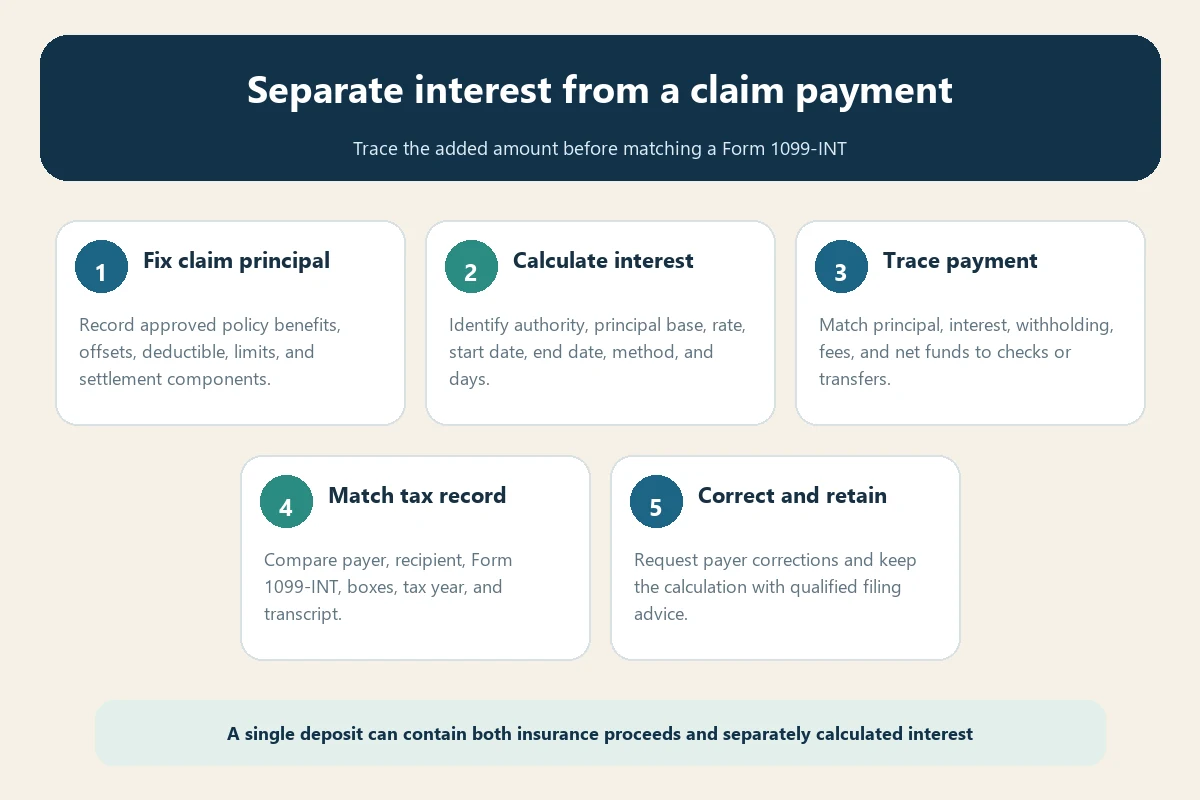
Obtain the written claim decision and line-item calculation. Record claimed loss, approved benefits, deductible, limits, exclusions, depreciation, coordination offsets, prior payments, settlement additions, and the amount designated as principal.
| Calculation field | Record to request | Reason |
|---|---|---|
| Principal base | Approved benefit or settlement component | Interest may not apply to every dollar |
| Authority | Policy, statute, judgment, or agreement | Explains why interest was added |
| Rate | Annual, statutory, contractual, simple, compound | Controls the calculation |
| Start date | Due, proof-of-loss, decision, or other date | Defines the accrual period |
| End date | Issue, availability, settlement, or paid date | Defines when accrual stopped |
| Tax record | Form, box, payer, recipient, year | Matches interest to reporting |
Identify why interest was paid
Interest may arise from a policy provision, state prompt-payment rule, judgment, arbitration award, settlement agreement, delayed death benefit, or voluntary resolution. Ask the payer to cite the exact provision and describe the amount as interest in writing.
Do not infer the legal basis from the percentage alone. A payment labeled penalty, consequential damages, appreciation, inflation adjustment, or additional benefit may require a different analysis.
Separate interest from claim proceeds
Create two ledger lines even if the insurer sent one check or ACH transfer: claim principal and interest. Add separate lines for withholding, bank fees, currency conversion, liens, attorney fees, and other deductions.
The IRS Topic 403 on interest states that taxable interest generally must be reported even if no Form 1099-INT is received. It also gives interest received with damages or delayed death benefits as examples of other interest reported by a business under applicable thresholds.
Recalculate the interest independently
Ask for the formula and reproduce it. Confirm whether the calculation uses simple or compound interest, a 365- or 360-day convention, whole months, business days, calendar days, changes in statutory rate, rounding, and partial payments.
A basic simple-interest check is principal multiplied by annual rate multiplied by days divided by the stated day-count basis. This is only an arithmetic check; the contract or law decides the proper inputs.
Test the principal base
The payer may calculate interest on the full approved claim, only overdue benefits, a judgment amount, or a settlement component. Determine whether deductibles, policy limits, prior payments, disputed items, or offsets were included.
Request a date-by-date balance if the insurer made partial payments. Interest on a declining balance should reconcile with each payment and effective date rather than one headline total.
Check whether the principal changed after appeal, appraisal, mediation, or supplemental documentation. A later benefit adjustment may require a revised interest schedule.
Verify the accrual start and end dates
Possible start dates include the loss date, proof-of-loss receipt, expiration of a claim-review period, coverage decision, demand, filing, judgment, or agreement date. Possible end dates include check issue, transfer, availability of funds, settlement, or final payment.
Record every candidate date and the payer’s stated choice. The claim 1099 tax-year guide helps distinguish loss, approval, issue, availability, return, and reissue events.
Trace the gross payment to the bank
Reconcile approved principal plus calculated interest, less withholding and separately disclosed charges, to the actual net funds received. Preserve the check, ACH advice, wire confirmation, virtual-card statement, or attorney trust ledger.
Use the claim payment fee guide to separate non-tax delivery charges. A payer should not hide a fee by reducing the interest calculation without explanation.
Form 1099-INT may report only the interest
The IRS page for Form 1099-INT identifies interest-income reporting and relevant thresholds. The form’s amount should be compared with the interest component, not automatically with the entire insurance deposit.
Record payer name and TIN ending, recipient and masked TIN, account number, tax year, box 1 or other populated boxes, federal and foreign tax withheld, and whether the form is corrected.
A missing 1099-INT does not erase the ledger
A form may be missing because the payer determined no filing was required, used a threshold or exemption, sent it electronically, used the wrong address, or has not completed reporting. Ask for the payer’s tax-document status.
The missing claim 1099 guide explains replacement requests and transcript timing. Tax advice should use actual interest records, not only whether an envelope arrived.
Check whether interest was combined on another form
A settlement or claim form may appear to include both principal and interest in one amount. Ask the payer to explain the reporting form and box and provide an allocation that reconciles with the agreement and payment advice.
Do not create your own Form 1099-INT or shift an amount between forms. If the payer used the wrong form or amount, request its formal correction.
Attorney-handled payments need a trust ledger
If counsel received the claim or settlement, obtain the gross trust receipt, interest amount, legal fees, litigation costs, liens, withholding, and client distribution. Confirm whether interest was paid to the claimant, attorney as nominee, or another recipient.
The settlement attorney-fee 1099 guide separates claimant reporting from gross proceeds paid to counsel. A net client check is not the starting gross figure.
Joint recipients and nominees need ownership analysis
A form may report interest under one TIN even though some belongs to another traveler, estate, provider, or beneficiary. Do not divide it informally. Obtain the payment allocation and qualified advice.
IRS Topic 403 describes nominee-recipient situations and points to Schedule B instructions and information-return duties. Those procedures can create filing obligations, so do not apply them without confirming ownership and form requirements.
Check withholding on the interest
If federal, state, or foreign tax was withheld, identify the rate, base, authority, recipient, and form box. Confirm whether withholding applied only to interest or to a broader payment component.
The claim tax withholding guide explains name-TIN records, backup withholding, gross-to-net calculations, and corrections. Preserve proof that withheld tax was deposited and attributed to the correct taxpayer.
Request a complete payer calculation
Send the insurer or legal payer a written request for:
- approved claim principal and excluded components;
- legal or contractual authority for interest;
- rate, method, day-count basis, and rounding;
- accrual start, end, and partial-payment dates;
- gross interest, withholding, and net interest;
- payer, recipient, form type, box, and tax year;
- payment and information-return correction procedures; and
- a revised claim ledger and corrected statement if needed.
Require a case number and response date. Do not send full taxpayer or bank credentials by ordinary email.
Correct arithmetic and tax-form errors separately
The interest calculation can be wrong even when Form 1099-INT matches what the payer actually disbursed. Conversely, the payment can be correct while the form reports the wrong payer, recipient, amount, box, or year.
Use the incorrect claim 1099 guide for formal information-return correction. A revised calculation letter alone may not update data filed with the IRS.
Use a wage and income transcript as a cross-check
An IRS wage and income transcript can show Form 1099-INT and other information-return data. The official IRS Topic 159 explains transcript access.
Compare payer, year, account, and interest amount. Current processing-year data and recent corrections may lag, so retain dated transcript copies and payer confirmation.
Protect the filing deadline and tax year
Record when interest became available, when the payer issued or credited it, and whether a transfer failed or was reissued. These facts may cross calendar years and require professional analysis.
Do not wait indefinitely for a corrected form. Give a tax professional the policy, calculation, payment records, forms, transcript, and correspondence so the return can report accurate facts by the deadline and be amended if necessary.
Watch for fake interest and release fees
A scammer may promise extra interest or claim tax must be prepaid before insurance funds are released. Verify the payer independently and never provide a one-time code, bank password, remote access, gift card, wire, or cryptocurrency payment.
The claim payment scam guide covers fake tax demands and changed instructions. Legitimate interest should appear in a traceable calculation and payment ledger.
Keep a permanent interest file
Retain the policy, decision, authority for interest, formula, daily or periodic calculation, payment proof, withholding record, original and corrected forms, transcripts, tax return, and professional workpapers.
The final file should let another reviewer reproduce the interest and trace it from the claim principal to the Form 1099 and funds received.
Bottom line
When interest is added to a travel insurance claim, separate it from policy proceeds and verify the principal base, rate, accrual period, payment, withholding, recipient, Form 1099-INT, and tax year. Correct calculation and reporting errors through the payer and file using complete records and qualified advice.
