

Europe travel insurance for open-jaw flights should cover the entire trip window, every country and the surface journey between the arrival and departure cities. The key is not the ticket shape itself. It is whether the policy treats all prepaid components as one trip and whether delay, missed-connection and interruption wording fits the separate air, rail, ferry or road contracts.
Key takeaways
- An open-jaw ticket arrives in one city and returns from another.
- The traveler is responsible for the unflown gap between those cities.
- One airline reservation can still sit beside several separate ground contracts.
- Return-transport wording matters if the trip is interrupted away from the planned airport.
- Airline refunds and credits reduce the amount claimed from insurance.
Map the open jaw before comparing policies
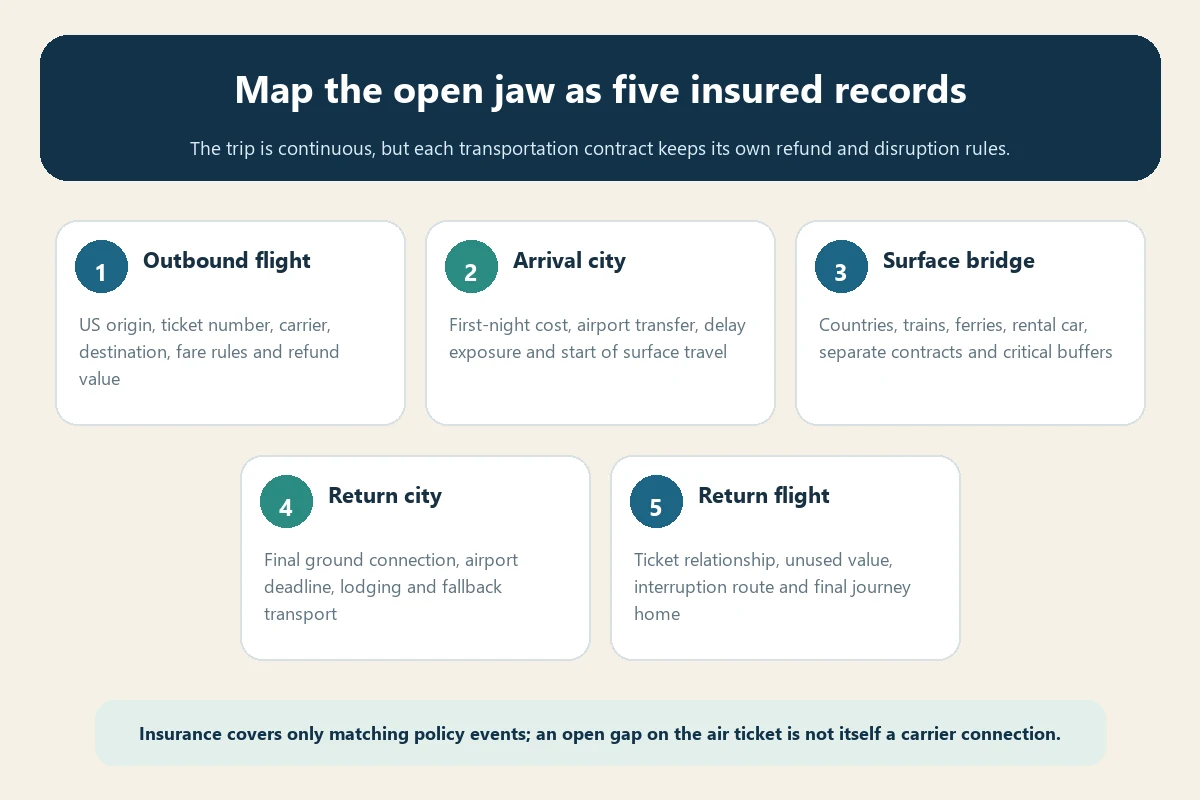
A typical itinerary might fly from Chicago to Paris, travel overland through several countries, and fly home from Rome. Paris-to-Rome is the open part of the jaw. The transatlantic flights may be issued as one multi-city ticket, but the trains, ferries, rental car and hotels between them are separate travel arrangements.
Create a route map with five records:
- US departure point and outbound flight contract;
- European arrival city and date;
- every surface leg, country and overnight stop;
- European departure city and return flight contract; and
- arrival back home, including any final domestic connection.
Use the multi-country Europe insurance worksheet to capture transits, side trips and changes. A country omitted from the quote can create a territory problem even when no flight lands there.
One trip does not mean one transportation contract
A single-trip insurance plan can cover a multi-city vacation, but the certificate defines when the trip begins and ends. Confirm that the dates run from leaving home through returning home and that every destination is eligible.
Then identify each transportation contract:
| Component | Possible contract | Main gap |
|---|---|---|
| Outbound and return flights | One open-jaw airline ticket | Fare rules may link segments on the same ticket |
| Intra-Europe flight | Separate one-way ticket | No automatic protection from an earlier train or ferry |
| Rail bridge | Pass, through-ticket or several tickets | Connection rights depend on the rail contract |
| Ferry | Separate scheduled sailing | Weather and onward-airport timing |
| Rental car | Vehicle rental agreement | Breakdown and return-city obligations |
The airline that flies the outbound segment is not normally responsible for moving the traveler across the deliberate surface gap. Likewise, the return carrier does not automatically protect a passenger who reaches the departure airport late because a separately booked train failed.
The guide to separate tickets and missed connections explains why appearing in one calendar or email does not merge contracts.
Insure the cost by component
Record each prepaid item and the amount that would be nonrefundable after a covered cancellation. Include eligible flights, trains, ferries, rental cars, hotels and tours. Exclude recoverable amounts according to the certificate.
For the open-jaw air ticket, save:
- ticket number and all flight coupons;
- operating and marketing carriers;
- fare and refund rules;
- award-mile redeposit and change fees;
- seat, baggage and upgrade charges; and
- the value of any credit after cancellation.
Do not divide the airfare between outbound and return segments without evidence. Airlines and insurers may value a partly used ticket differently. Ask for a residual-value or refund statement when one portion is unused.
The Europe trip insurance checklist provides a clean cost ledger and purchase audit.
Airline refunds come before the net claim
If an airline cancels a flight and the traveler declines the offered alternative, the U.S. Department of Transportation refund guidance describes when a refund is due for flights subject to US rules. A nonrefundable ticket that operates as scheduled is treated differently when the traveler chooses not to fly.
Insurance evaluates the eligible loss that remains after refunds, credits and other recoveries. Preserve:
- airline cancellation or significant-change notice;
- alternative offered and whether it was accepted;
- refund request and final amount;
- travel credit terms and expiration; and
- unused value of the rest of the ticket.
For flights covered by European rules, the European Commission air passenger rights page links to current cancellation, delay and denied-boarding guidance. Geographic scope depends on the flight and operating carrier, not on the traveler’s nationality alone.
Trip delay on an open-jaw route
Trip delay reimburses qualifying temporary expenses after a covered cause and waiting period. An open-jaw route creates several possible delay points:
- outbound flight delays arrival in the first city;
- an intermediate train or ferry delays a hotel or tour;
- a surface leg delays arrival at the return airport; or
- the final flight delays the trip home.
For each critical connection, check that the arriving transportation meets the common-carrier definition and that the policy covers the cause. Record the minimum delay, daily limit and eligible lodging, meals and local transport.
The trip-delay reimbursement guide explains why a large headline limit can still be unusable when the waiting period or cause does not fit.
Missed return flight: test the surface bridge
The highest-risk connection is often the final ground leg into the open-jaw departure city. Ask:
- Is the train, ferry or bus a covered common carrier?
- Does the missed-connection benefit protect a separately ticketed flight?
- How many hours of qualifying delay are required?
- Is a same-day self-transfer considered reasonable?
- What replacement airfare and lodging limits apply?
- Must assistance approve the new ticket?
Build a buffer from the last viable alternative, not the scheduled arrival alone. A train due two hours before an international departure can be a poor risk even if the timetable technically connects.
Use the missed-connection insurance guide to evaluate the trigger and evidence.
Trip interruption changes the return-transport question
If a covered illness or other event ends the trip early, the traveler may be nowhere near the planned return airport. The policy’s interruption wording decides whether additional transport can be arranged from the current location, from the scheduled departure city or by another route.
Read:
- covered interruption reasons;
- definition of return destination;
- economy or same-class transport rule;
- maximum additional transportation benefit;
- unused nonrefundable arrangement coverage;
- carrier credit and ticket-change treatment; and
- prior-approval or assistance requirements.
A policy might pay reasonable additional transport home after subtracting the value of the unused return ticket. It does not automatically buy any flight from the traveler’s current city.
The trip interruption guide separates unused trip value from added return transport.
Ticket structure changes airline options
Open-jaw flights can be issued as one ticket or as independent one-way tickets. One ticket can simplify rebooking when the airline changes a segment, but the fare rules may also connect the coupons. Skipping a segment without airline approval can affect later segments on the same ticket.
Independent one-way tickets isolate the contracts. A change to one carrier’s flight may not create any obligation for the other carrier. Insurance may help only when the event fits a covered benefit.
Before booking, record whether flights are:
- one ticket with one validating carrier;
- codeshare or partner-operated segments;
- separate one-way tickets;
- award tickets with different programs; or
- sold by an online agency with its own service terms.
Then use the Europe policy comparison worksheet to test the same itinerary against every plan.
Baggage does not cross the open jaw automatically
Checked baggage normally travels only on the ticketed air journey. During the surface gap, the traveler controls it and may encounter rail, ferry, car and hotel custody rules. A return flight from another city requires a new check-in.
Check baggage delay at both international gateways, personal-property limits during the surface trip and electronics or valuables sublimits. If an intermediate low-cost flight is separately booked, its baggage rules and claim process are independent.
Medical and evacuation territory
Medical and evacuation coverage should remain active throughout the surface journey, not only in the arrival and departure countries. List every country, island and overnight transit. Confirm how the policy treats a medical evacuation when the planned return airport is hundreds of miles away.
The U.S. Department of State travel insurance guidance distinguishes trip cancellation, travel health and medical evacuation protection. Use the site’s Europe travel medical insurance guide to review treatment, evacuation and assistance terms.
The open-jaw disruption file
- Full airline ticket receipt and fare rules.
- Surface-leg tickets and contracts.
- Day-by-day itinerary with every country.
- Prepaid nonrefundable cost ledger.
- Airline and ground-carrier notices.
- Refunds, credits and residual-ticket value.
- Delay and missed-connection proof.
- Assistance approvals and claim numbers.
- Replacement transport and lodging receipts.
- Medical or other covered-event documentation.
An open-jaw insurance checklist
- □ Arrival and departure cities both listed.
- □ Every surface country and transport contract mapped.
- □ Insurance dates cover departure from and return to home.
- □ Open-jaw flights identified as one ticket or separate tickets.
- □ Nonrefundable costs and carrier refunds separated.
- □ Critical surface-to-flight connection has a realistic buffer.
- □ Missed-connection wording includes the relevant transport.
- □ Interruption return-transport wording reviewed.
- □ Baggage and medical cover remain active across the gap.
- □ Ticket, itinerary and policy documents stored offline.
Frequently asked questions
Can one travel policy cover an open-jaw Europe trip?
Often yes, if the full route qualifies as one insured trip, every country is eligible and the dates run from leaving home to returning home. Confirm the itinerary with the insurer.
Does insurance cover the train between the two flight cities?
It can, but delay or missed-connection coverage depends on the common-carrier definition, covered cause, waiting period and separate-ticket terms. The train must be included in the documented itinerary.
What if I become ill far from my planned return airport?
Trip interruption and medical assistance terms decide the eligible route home. Contact the assistance company before buying replacement airfare whenever possible.
Does the airline refund the entire open-jaw ticket after one cancellation?
The answer depends on which flight was canceled, whether travel has begun, the ticket’s residual value and the alternative accepted. Obtain a written refund calculation before filing insurance.
