

Europe travel insurance for points bookings usually protects the eligible cash losses around an award trip, not a traveler-assigned dollar value for the miles themselves. List taxes, carrier surcharges, hotels, tours and other prepaid costs separately, then check whether the policy has a specific benefit for loyalty-point redeposit fees. The answer can change when bank points buy a revenue ticket through a portal instead of being transferred to an airline.
Key takeaways
- Do not insure an award ticket at the retail cash fare unless the certificate expressly tells you to value it that way.
- Record miles, taxes, carrier charges and cancellation rules as separate entries.
- Only nonrefundable, eligible cash costs belong in the trip-cost calculation.
- Airline refunds or restored points come before an insurance claim for the same loss.
- Portal bookings, airline awards and cash-plus-miles tickets may be treated differently.
Start with the transaction, not the cash ticket price
An award seat may replace a $1,400 fare, but that comparison price is not necessarily the insured trip cost. The traveler did not pay $1,400. The actual transaction might be 60,000 miles plus $86 in taxes and $240 in carrier-imposed charges.
Build three records for every points booking:
- Loyalty currency: program name, points or miles redeemed, account owner and transfer history.
- Cash paid: taxes, fees, surcharges, service charges, seat fees and the card used.
- Recovery rules: what the airline, hotel or portal returns after cancellation and whether a redeposit charge applies.
This prevents a common comparison error: entering the hypothetical retail fare as trip cost, paying a higher premium and later learning that the certificate excludes non-monetary rewards. Use the issued policy, not a points-blog valuation.
Separate four types of points booking
Airline miles redeemed with the airline
The airline issues an award ticket and collects any cash taxes or surcharges. Program rules govern whether miles are reinstated. For example, American Airlines says it reinstates eligible AAdvantage miles and refunds eligible taxes and fees when the traveler cancels before the first flight departs, subject to its stated conditions. That airline recovery affects the remaining insurance loss.
Bank points used through a travel portal
A bank portal may use points to purchase what operates like a paid ticket. The portal receipt, card benefit guide and insurance certificate determine whether the redemption has an assigned value. Do not assume that rules for transferred airline miles apply to a portal ticket.
Points transferred to an airline
Once transferable points move to an airline program, they commonly become subject to that program’s award rules. A canceled trip may return miles to the airline account rather than reverse the original bank transfer. Save both transfer confirmation and ticket receipt.
Cash plus miles
Some programs reduce a cash fare with miles; others issue a conventional award with a cash copay. Those structures can look identical at checkout but produce different refund records. Ask the program whether the ticket is a revenue fare, an award or a separate redemption credit.
Calculate the insurable trip cost line by line
Use the same disciplined comparison process described in our Europe policy comparison guide. For each booking, record the amount paid, the form of payment and the amount refundable on the date coverage is purchased.
| Trip component | What to record | Initial insurance treatment |
|---|---|---|
| Airline miles | Miles redeemed and program rules | Do not self-assign a cash value unless the certificate permits it |
| Air taxes and surcharges | Exact cash receipt and refundability | Potential trip cost only to the extent eligible and nonrefundable |
| Hotel paid with points | Points, cash copay and cancellation deadline | Separate refundable points from nonrefundable cash |
| Cash hotel or tour | Deposit, balance and cancellation schedule | Include eligible nonrefundable amounts as they become at risk |
| Redeposit charge | Program fee and when it is charged | Check for a specific frequent-traveler reward benefit |
A current Travel Guard policy document, for example, distinguishes costs paid with loyalty rewards from monetary trip costs and contains its own definitions and benefit conditions. It is an illustration, not a universal rule; the form issued for the traveler’s state and plan controls.
Do not confuse a refund with trip cancellation insurance
If the airline cancels or significantly changes a covered US itinerary and the passenger rejects the alternative, start with the carrier. The U.S. Department of Transportation refund guidance explains when airlines must provide refunds for covered flights. An insurer generally should not pay a cost the supplier already refunded or owes.
If the traveler cancels for a covered policy reason, the analysis is different. First request any mileage reinstatement, refundable taxes and supplier credits. Then document the eligible nonrefundable balance. Our guide to insurance and canceled flights separates carrier responsibility from policy benefits.
Check the redeposit-fee clause word for word
Some policies include a limited benefit for the fee charged to return miles to a loyalty account. That is not the same as reimbursing the miles. Read for:
- whether the feature is inside trip cancellation or a separate benefit;
- the maximum per traveler or per account;
- whether a covered cancellation reason is required;
- whether the loyalty program must actually charge the fee;
- the evidence required to show the miles were restored.
If the program restores miles for free, there is no redeposit fee to reimburse. If points expire or award space disappears after restoration, do not assume that lost convenience is covered unless the wording says so.
Delay and interruption can matter more than ticket value
A low insured airfare cost does not eliminate the need to review delay, medical or interruption benefits. A traveler can still face an overnight hotel, meals, local transport or a costly new route home. Each benefit has its own triggers, waiting periods, limits and exclusions.
For interruption, check how additional transportation is calculated and whether unused arrangements are eligible after supplier refunds. The trip interruption guide shows how the return journey and unused trip value are evaluated. An open-jaw points itinerary also needs clear records for the unflown ground section and the airport from which the return award departs.
Compare card coverage with a standalone policy
The card used for the taxes or portal redemption may include travel protection, but eligibility can depend on how much of the trip was charged and how the guide defines a covered trip. Read the current benefits guide for that specific account.
Use our credit card versus standalone policy comparison to identify differences in medical benefits, trip-cost definitions and claim administration. Then review the common card cancellation gaps before relying on a card simply because it paid the award taxes.
Buy coverage using the policy’s timing rules
Points bookings create a timing problem because there may be no large cash deposit on day one. Yet some time-sensitive benefits measure eligibility from the first trip payment or deposit, as defined by the policy. Record the award booking date, the date points were transferred, every cash charge and each later nonrefundable payment.
Do not delay solely because the airfare cost only a few dollars in taxes. Ask the insurer in writing which event starts its purchase window and how to update trip cost after paying hotels or tours. Keep the answer with the certificate and follow the Europe trip insurance checklist before the final payment.
Medical coverage is a separate decision
The value of the award ticket says nothing about the potential cost of medical care or evacuation. The U.S. Department of State recommends considering travel health and evacuation insurance and notes that US health coverage may not follow a traveler abroad.
Compare the medical and evacuation limits, network or reimbursement process, pre-existing-condition terms, territory and assistance service independently from the cancellation trip cost. Our Europe coverage-limits guide provides a worksheet for that review.
Example: a points-funded Europe trip
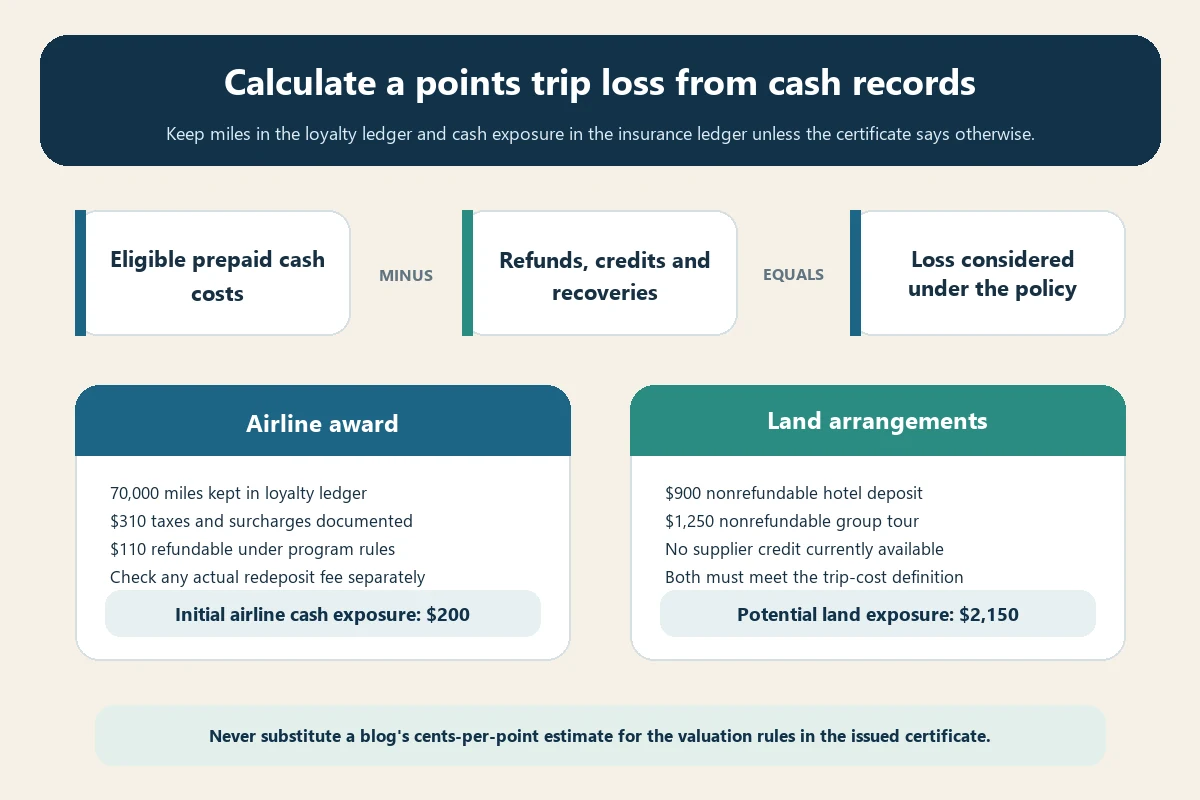
A traveler books a round trip for 70,000 airline miles plus $310 in taxes and surcharges. They also prepay a $900 nonrefundable hotel deposit and a $1,250 small-group tour. The airline program says the miles can be reinstated and $110 of the cash charge is refundable.
The traveler should not automatically declare the cash retail fare. Instead, they document the 70,000 miles separately, identify the potentially nonrefundable $200 airline balance, and add the $2,150 of nonrefundable land costs if all meet the chosen policy’s definition. The working amount is $2,350, subject to the certificate and future refunds—not the award seat’s advertised cash price.
If the airline later returns the full $310, the airline loss falls to zero. If a covered interruption creates a new economy ticket home, that additional transportation is evaluated under the interruption benefit rather than by pretending the original miles were cash.
Build a claim file before departure
- award confirmation showing miles and cash charged;
- loyalty-account statement before and after cancellation;
- bank-point transfer or portal receipt;
- airline and hotel cancellation terms saved on the booking date;
- cash receipts for every insured component;
- refund, credit and mileage-reinstatement correspondence;
- policy schedule, certificate and written insurer clarification.
Frequently asked questions
Can I insure the cash value of my airline miles?
Only if the issued policy expressly provides a valuation method or treats that redemption as eligible trip cost. Many standalone forms do not reimburse a traveler-selected cents-per-point value.
Should I include award-ticket taxes in trip cost?
Record them, then determine whether they are refundable and eligible under the certificate. Include only the nonrefundable amount that meets the policy definition.
Does insurance return expired miles?
Do not assume it does. The loyalty program controls reinstatement, while a policy may cover only a stated redeposit fee or another specifically defined loss.
What if I paid with points through a credit-card portal?
Save the portal receipt and benefits guide. The transaction may be treated differently from miles transferred to an airline, and the issuer may specify its own redemption value or remedy.