

Europe travel insurance with zero deductible can improve small eligible claims, but it is worth paying extra only after a break-even comparison. The useful calculation compares the added premium with the deductible avoided, how often that deductible can apply and every other term that changes payment. A $0 label by itself does not prove a better policy.
Key takeaways
- Compare otherwise equivalent plans before assigning a price to the deductible.
- Per-incident and per-person deductibles can make zero more valuable than a once-per-trip structure.
- No claim means the zero-deductible premium uplift produced no financial return.
- Coinsurance, sublimits and allowed-charge rules can remain after a $0 deductible.
- Cash flow and claim effort can matter as much as the simplified break-even number.
Use the deductible guide as the foundation
Our Europe travel insurance deductible guide explains per-trip, per-person, per-incident and annual structures. Read that first if the quote does not state when the deductible repeats.
This page answers the narrower purchase question: when is the $0 option worth a higher premium? The answer comes from a quote-pair worksheet, not a universal recommendation.
The National Association of Insurance Commissioners defines a deductible as the dollar amount or percentage a policyholder pays before the insurer pays its share. Travel policies can attach that cost to particular benefits and frequencies, so copy the wording rather than relying on the quote tile.
Build a clean quote pair
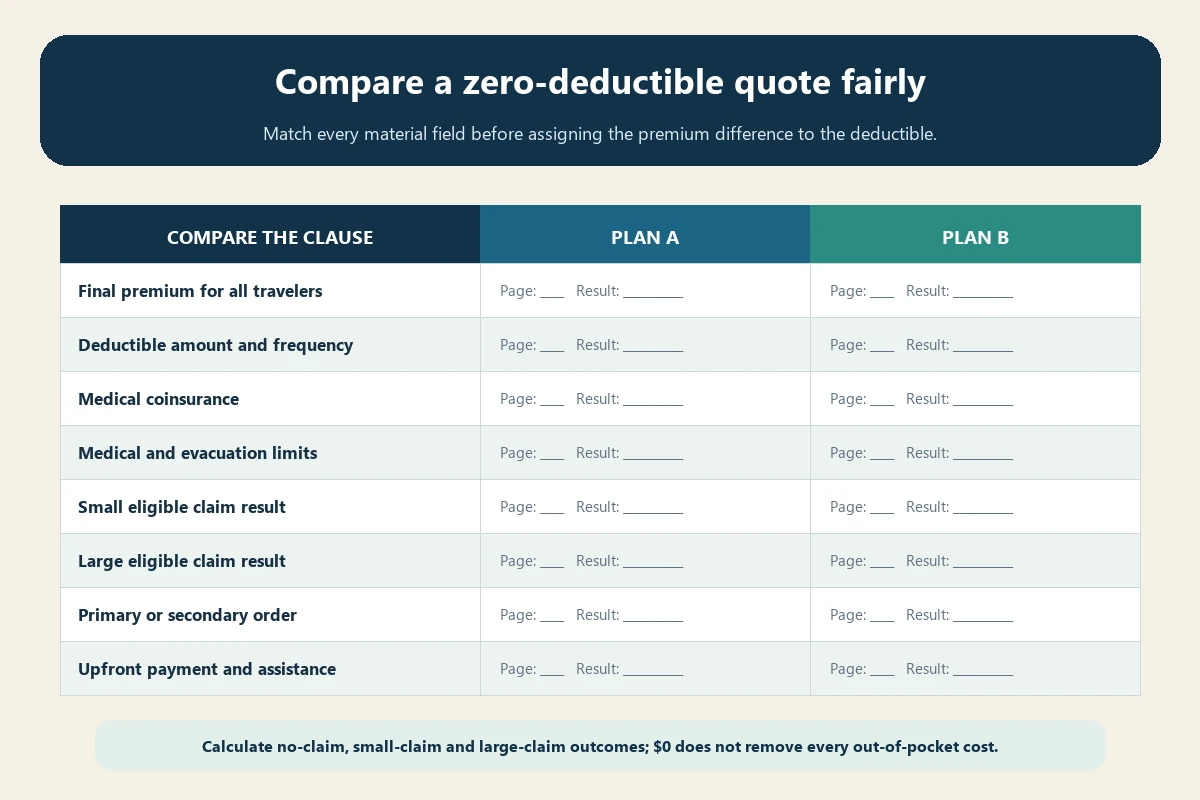
A valid comparison changes the deductible and as little else as possible. Record both plans for:
- total premium for every traveler;
- medical and evacuation maximums;
- deductible amount and frequency;
- medical coinsurance;
- emergency dental, therapy and prescription sublimits;
- primary or secondary payment order;
- pre-existing-condition provisions;
- activity and destination exclusions; and
- assistance and direct-payment process.
If the zero-deductible quote also raises the medical limit or removes coinsurance, the premium difference is buying several changes. Do not attribute the entire price gap to zero deductible.
Calculate the premium uplift
Subtract the higher-deductible plan’s total premium from the zero-deductible plan’s total premium. Use the final price after optional benefits, taxes and traveler changes. Call the result the premium uplift.
Example: Plan Z costs $214 and Plan D costs $166 for the same travelers and dates. The premium uplift is $48. That $48 is certain and paid even when no claim occurs. The deductible is conditional: it matters only after an expense is eligible and the deductible applies.
Do not use the insurer’s advertised “from” price or compare different ages, trip costs or territories. Save both quote summaries on the same date because prices and availability can change.
Find the maximum deductible avoided
For a deductible that applies once per covered trip, the largest simplified advantage of the $0 option is the stated deductible. For a per-person structure, multiply by the number of travelers who could separately incur eligible claims. For a per-incident structure, the deductible can repeat across unrelated covered events.
This is an exposure ceiling, not a prediction. A couple with a $150 per-person deductible has a potential $300 deductible exposure if both people have eligible claims. It does not mean two claims are expected.
When the certificate is unclear, ask: “If one traveler receives care twice for the same illness and later for an unrelated injury, how many deductibles apply?” Keep the written answer with the policy.
Run three simplified claim scenarios
Use the quote pair above: $48 extra for Plan Z and a $150 deductible under Plan D. Assume, only for illustration, that both plans recognize the same expense, pay 100% after the deductible and have no other reduction.
No eligible claim
Plan D costs $48 less. The zero-deductible option does not produce a reimbursement benefit. This is the most important row because insurance decisions are made before the outcome is known.
One eligible $120 claim
Plan D’s deductible can absorb the simplified claim, while Plan Z can begin payment from the first eligible dollar. Before other terms, Plan Z’s potential claim advantage is $120. After subtracting the $48 premium uplift, the simplified net advantage is $72.
One eligible $2,000 claim
The simplified payment difference is capped at the $150 deductible. After the $48 premium uplift, Plan Z’s simplified net advantage is $102. The zero option does not become more valuable merely because the bill grows beyond the deductible.
These are arithmetic examples, not benefit promises. Eligibility, coinsurance, provider charges, other insurance and maximums can change the actual result.
Use expected value carefully
A pure expected-value calculation multiplies each possible deductible saving by the traveler’s reasonable probability of that outcome, then compares the result with the certain premium uplift. Most travelers do not have credible personal claim probabilities, so false precision can make the spreadsheet look smarter than the inputs.
A safer decision uses two tests:
- Worst-case affordability: Could the traveler comfortably absorb the maximum repeating deductible plus any provider deposit?
- Quote break-even: Is the premium uplift smaller than the deductible saving in a plausible eligible claim scenario?
Passing both tests does not make zero deductible mandatory. It shows the tradeoff clearly enough to choose.
Small claims are where zero matters most
When an eligible bill is below the deductible, a higher-deductible plan can produce no claim payment even though the event is covered. A zero-deductible plan can make urgent-care, prescription or minor-injury claims more economically meaningful, subject to sublimits and other rules.
But small claims still require time and documents. If the traveler would not collect an itemized bill or submit a $60 claim, the theoretical advantage may never be used. Review the travel insurance claim process before valuing convenience that the plan does not actually provide.
Zero does not remove coinsurance
A $0 deductible can coexist with 20% coinsurance. For a simplified $1,000 eligible expense, a plan paying 80% after a zero deductible could pay $800, leaving $200 to the traveler. Another plan with a $100 deductible and 100% payment afterward could pay $900.
The second plan has the larger deductible and the larger simplified payment. Record the order of calculation and the percentage in the policy. The Europe coverage-limits guide helps identify sublimits that can reduce payment after both deductible and coinsurance.
Primary and secondary status can outweigh zero
A zero-deductible secondary plan may still require a US insurer’s Explanation of Benefits before it pays. A primary plan with a modest deductible may create a shorter claim route. Decide which burden matters more for the traveler’s actual domestic coverage.
Our guide to Europe primary medical travel insurance explains claim order, direct billing and payment guarantees. A zero deductible does not mean the European provider will bill the insurer.
Upfront payment remains possible
The U.S. Department of State’s overseas health guidance notes that payment or a deposit can be required before care in many locations. That cash-flow exposure exists even when the policy later applies no deductible.
Ask whether assistance can arrange a payment guarantee for inpatient care and what usually happens for outpatient treatment. The CDC Yellow Book insurance chapter likewise recommends preparing for point-of-service payment and checking direct-payment capability.
Our US health insurance abroad guide shows why the traveler needs both a reimbursement plan and access to emergency funds.
Do not sacrifice a stronger benefit for zero
A $0 deductible is rarely worth choosing if the plan has a materially weaker medical maximum, no suitable evacuation benefit, narrower activity coverage or an unfavorable pre-existing-condition rule. Compare the consequence of the uncovered loss, not just the first dollars of a covered one.
Use the policy-reading guide to check definitions and exclusions. The NAIC travel insurance overview also distinguishes medical, evacuation, cancellation and other travel products; one attractive cost-sharing field does not combine missing benefits.
When zero deductible may be a rational choice
- The premium uplift is small relative to the deductible avoided.
- The deductible would repeat per person or unrelated incident.
- The traveler values coverage for smaller eligible bills.
- The household prefers a known premium over variable claim cost.
- The plans are otherwise materially equivalent.
When a deductible may be reasonable
- The premium saving is close to or greater than the maximum deductible exposure.
- The deductible applies only once per trip or policy period.
- The traveler is protecting mainly against a large eligible loss.
- Emergency funds can absorb the deductible and provider deposit.
- The higher-deductible plan has stronger limits or broader wording elsewhere.
Premium is only one cost driver. Our guide to what changes travel insurance price helps keep age, trip cost, duration and optional benefits constant during the comparison.
Zero-deductible purchase checklist
- What is the final premium uplift for all travelers?
- Does the alternative deductible apply per trip, person, incident or policy period?
- Are medical limits, coinsurance and sublimits identical?
- Are primary status, exclusions and waivers identical?
- What happens in no-claim, small-claim and large-claim scenarios?
- Could the traveler absorb the maximum deductible and an upfront provider payment?
- Would the traveler actually submit the small claims that make zero valuable?
- Which plan protects the more serious loss after all fields are compared?
General educational information, not insurance, medical or financial advice. Examples are simplified and do not predict claims. The issued policy and state-specific certificate determine eligibility, deductible frequency and payment.
Comparing deductible options? Use the travel medical insurance deductible guide to check scope, eligible expenses, multiple incidents, coinsurance and provider payment.
