

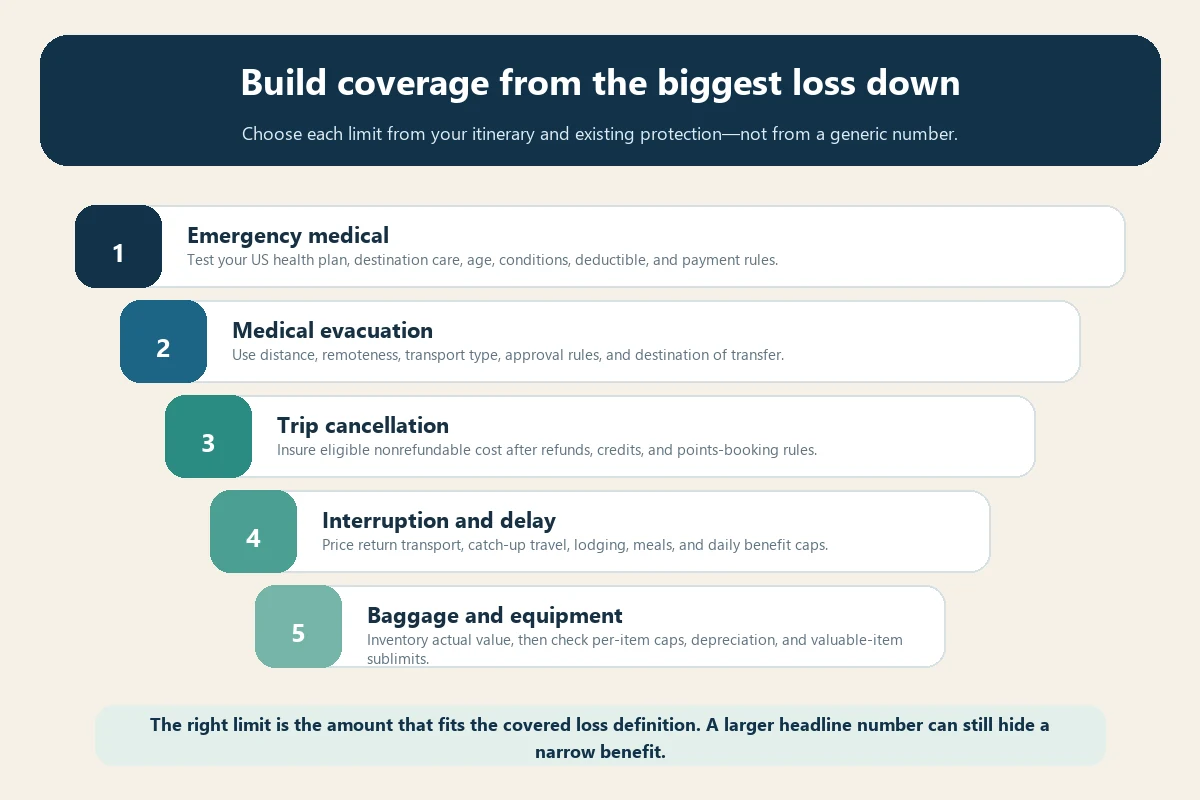
There is no single “correct” travel insurance limit for every Europe trip. A useful limit is one that matches the loss you could face, the part your existing insurance would pay, and the definitions inside the travel policy. Start with emergency medical and evacuation risk, then calculate nonrefundable trip cost, interruption transport, delay expenses and the actual value of baggage.
Key takeaways
- Choose limits from your itinerary and existing protection, not from a generic recommendation.
- Medical treatment and medical evacuation are separate benefits.
- The largest advertised number may contain deductibles, sublimits or a narrow trigger.
- Trip cancellation should reflect eligible nonrefundable cost after supplier refunds.
- Age, health, activities, islands, mountains and long transfers can change the exposure.
Coverage limit is only half the answer
A policy can show a large dollar limit and still leave an important gap. The event must first meet the benefit definition. A medical bill may be excluded because of a pre-existing condition. An air ambulance arranged without required approval may not qualify. A delayed bag benefit may begin only after a stated number of hours. An expensive camera may face a much smaller per-item cap than the total baggage limit.
Compare both parts of every benefit:
- Trigger: What event must happen, and what exclusions or approval rules apply?
- Amount: What deductible, percentage, daily limit, per-item sublimit and maximum applies after the trigger is met?
Our broader guide to travel medical insurance for US citizens visiting Europe explains the main policy types. This guide focuses on building a defensible set of limits for one itinerary.
Step 1: audit the insurance you already have
Do not assume your US health plan stops at the border, and do not assume it follows you unchanged. Ask the plan administrator specific questions and keep the answers:
- Is emergency care outside the United States covered?
- Is the claim treated as in-network or out-of-network?
- Do the deductible and coinsurance differ abroad?
- Must you obtain preauthorization for hospital admission or follow-up care?
- Will the plan pay a foreign provider directly, or must you seek reimbursement?
- Does it pay for medical evacuation or repatriation?
The US Department of State says Medicare and Medicaid do not pay for medical care outside the United States. Original Medicare has only narrow exceptions, and some Medicare Advantage or Medigap arrangements may provide limited foreign emergency benefits. Older travelers should compare the actual plan documents with our guide to Medicare coverage in Europe rather than treating a membership card as proof of full overseas cover.
Review credit-card benefits separately. A card may provide trip delay, cancellation, rental-car or baggage protection without providing meaningful travel medical insurance. It may also require that a specific part of the trip was charged to the account.
Step 2: choose an emergency medical limit
The medical limit should be considered against four things: destination care, your existing plan, your personal health profile and how the benefit pays. A short city trip by a healthy traveler with confirmed international coverage presents a different gap from a month-long itinerary involving an older traveler, multiple prescriptions and rural stays.
The CDC advises international travelers to verify their domestic health coverage and notes that foreign providers may require payment at the point of service. That means a high policy limit does not remove the need for an emergency payment plan. Check whether the assistance company can provide a guarantee of payment and whether you have enough available credit or savings to handle a deposit while the claim is arranged.
Medical-limit questions to answer
- Is the maximum per person, per trip, per incident or per policy period?
- Does a deductible apply once or to each incident?
- Is there coinsurance after the deductible?
- Are hospital rooms, prescriptions, emergency dental care, therapy or mental-health care subject to smaller caps?
- Does the policy pay primary or only after a US health plan responds?
- Are complications of a pre-existing condition covered through a waiver?
- Does the policy cover the activities on the itinerary?
Do not buy a medical limit without reading the definition of sickness, injury, medically necessary treatment and pre-existing condition. The guide to pre-existing condition waivers shows why a purchase deadline can matter more than the headline medical maximum.
Step 3: calculate medical evacuation exposure
Medical evacuation is not simply a more expensive version of medical treatment. It pays for an approved move when suitable care is not available where the traveler is being treated. The insurer or assistance team usually decides whether the transfer is medically necessary and where the patient should go.
The CDC’s 2026 Yellow Book says medical evacuation can range from about $25,000 within North America to more than $250,000 from distant or remote locations. That range is not a quote for a Europe trip. It demonstrates why route, distance, medical condition and transport type matter more than a universal minimum.
For Europe, raise the scrutiny when the itinerary includes:
- remote islands or ferry-dependent locations;
- mountain areas where search and rescue is separate from medical transport;
- skiing, trekking, cycling or other activities with special exclusions;
- a cruise ship or expedition vessel;
- a traveler who may need a medical escort, oxygen or a stretcher on a commercial flight; or
- a preference for transport home rather than the nearest suitable facility.
Read the destination language carefully. A benefit that moves you to the nearest suitable hospital is not a hospital-of-choice benefit. Our guide to medical evacuation limits and approval rules explains the distinction.
Step 4: insure the net nonrefundable trip cost
Trip cancellation is usually tied to eligible prepaid cost that you cannot recover from the airline, hotel, cruise line, tour company or other supplier. Build a ledger rather than entering the gross price from memory.
| Booking | Amount paid | Expected supplier refund | Potential insured cost |
|---|---|---|---|
| Airfare | Use your receipt | Separate refundable taxes or credits | Eligible remaining loss under the certificate |
| Hotels | Total deposits | Apply each cancellation window | Nonrefundable amount on the loss date |
| Tours and rail | Prepaid tickets | Supplier refund or voucher | Net eligible loss |
| Points booking | Taxes and fees | Miles redeposit and refunds | Only the amount the policy recognizes |
If later payments increase the nonrefundable amount, update the insurer within any deadline in the certificate. This is especially important when a pre-existing condition waiver or Cancel For Any Reason option requires all eligible costs to be insured. For a multi-stop route, use our multi-country Europe policy checklist to make sure new destinations and dates are also added.
Step 5: price interruption, catch-up travel and delay
Trip interruption can include the unused insured part of a trip and added transport to return home or rejoin the itinerary, subject to the policy. Compare the benefit limit with a realistic last-minute one-way fare from the most distant point on the route. Then check whether the original ticket credit or supplier refund reduces the claim.
For trip delay, estimate one unplanned night for every traveler:
- airport-area or city-center lodging;
- meals within the policy’s rules;
- ground transport;
- essential communication or rebooking costs; and
- the policy’s daily and total caps.
A $1,000 total delay benefit is not the same as $1,000 available on the first day. A certificate may apply a smaller daily limit and a waiting period. It may also require a carrier statement that names the reason. Compare the triggers in our guide to trip delay, interruption and cancellation.
Step 6: inventory baggage instead of guessing
List the property you would take and record its current value, not the retail cost of buying everything new. Then check the per-item limit and sublimits for electronics, jewelry, cameras, sports gear and medical devices. Look for depreciation, unattended-property and checked-baggage exclusions.
Airline liability, homeowners or renters insurance, credit-card coverage and the travel policy may all interact. Travel insurance generally addresses the covered net loss, not a second full payment for the same item. A modest baggage limit with workable per-item terms may fit better than a larger total with a restrictive valuables cap.
Three traveler profiles, three different limit tests
Short city itinerary
A healthy traveler spends eight days in Paris and Amsterdam, uses direct trains and has refundable hotels. The key tasks are verifying overseas medical terms, emergency payment mechanics and rail-delay definitions. A large cancellation maximum may have little value if the traveler has little nonrefundable cost.
Family trip with islands and activities
A family visits Athens, an island reached by ferry and a guided hiking area. Medical transfer distance, ferry disruption, child eligibility, shared limits and activity wording all need review. The baggage calculation should also consider strollers, sports gear or medical devices separately from ordinary clothing.
Older traveler on a cruise and land tour
An older traveler combines a Mediterranean cruise with prepaid hotels and tours. The review should start with Medicare or private-plan gaps, pre-existing condition rules, shipboard medical bills, evacuation, trip-duration limits and the high nonrefundable cost. The same advertised limit can produce a very different result after age-based eligibility and exclusions are applied.
A worksheet for comparing two policies
For each plan, record the certificate page and answer—not just the number—for these fields:
- Emergency medical trigger, deductible, coinsurance, sublimits and maximum.
- Pre-existing condition definition and waiver requirements.
- Medical evacuation trigger, approval and transport destination.
- Trip cancellation reasons and maximum eligible trip cost.
- Interruption calculation and additional transport rules.
- Trip delay waiting period, daily cap and total cap.
- Baggage per-item limits, valuables sublimits and depreciation.
- Territory, trip-duration limit, activities and excluded destinations.
The lowest premium is meaningful only after the two policies are normalized. Our guide to what drives travel insurance cost explains why age, trip cost, duration and selected benefits can move the quote.
If a claim happens
Call the assistance service before arranging expensive transport when it is safe to do so. Ask medical providers for itemized invoices, clinical notes and proof of payment. Request written delay reasons from carriers. Keep supplier cancellation terms, refunds, credits and card statements.
A good coverage limit cannot repair missing evidence. The guide to travel insurance claim documentation shows what to collect for medical, cancellation, delay and baggage claims.
Sources and methodology
This framework was checked against the CDC Yellow Book travel insurance chapter, the US Department of State travel insurance guidance, and the NAIC consumer guide. The official sources describe risks and questions to ask; they do not prescribe one universal dollar limit. The state-specific policy certificate determines coverage.
Editorial note: This article provides general educational information for US travelers. It does not recommend a particular limit or insurer and is not medical, legal or financial advice.
Comparing medical deductibles? See the Europe travel insurance deductibles guide for per-trip, per-incident and per-person examples before choosing a coverage limit.
Comparing two plans? Use the Europe travel insurance policy comparison worksheet to record the clause, page, trigger, limit, deductible and exclusion before comparing premium.
Planning Europe during extreme summer temperatures? The summer heat travel insurance guide separates medical illness, carrier disruption, wildfire evacuation and ordinary discomfort.
Checking the legal floor? Our Schengen insurance minimum coverage guide explains why €30,000, required benefits, territory, dates, sublimits and claim access must be evaluated together.
Choosing a medical maximum? Use the travel medical insurance policy limits guide to test eligible expenses, sublimits, age, activities and evacuation wording together.