

A travel insurance deductible is the part of an eligible covered loss that you pay before the policy pays its share. For a Europe trip, the important question is not only whether the deductible is $0, $100 or $250. You must also know which benefit it applies to, whether it is charged per person or per incident, and whether coinsurance or a sublimit is applied afterward.
Key takeaways
- A deductible applies only after the loss meets the policy’s coverage terms.
- “Per incident,” “per person” and “per policy period” can produce very different claim payments.
- Medical benefits may have a deductible even when cancellation, delay or baggage benefits do not.
- A $0 deductible does not remove coinsurance, sublimits, exclusions or upfront payment.
- Compare the total out-of-pocket risk, not the deductible in isolation.
What a deductible does
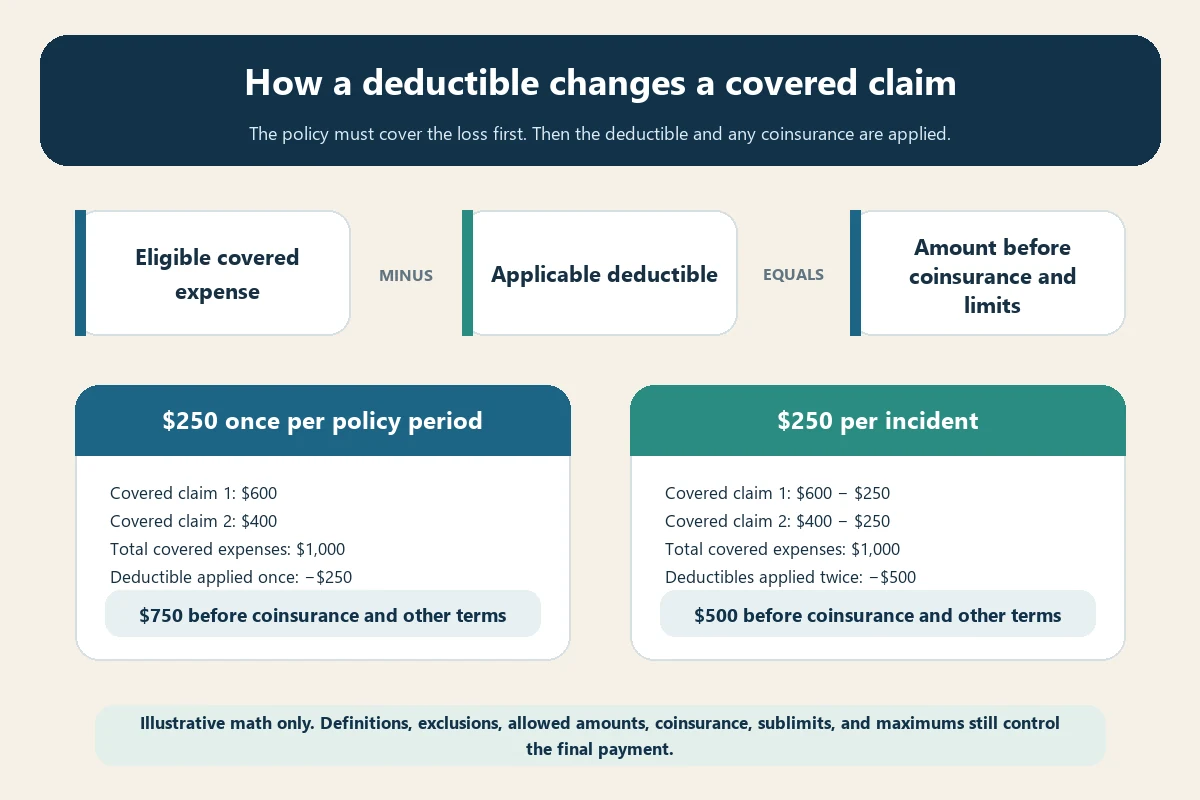
The National Association of Insurance Commissioners defines a deductible as the dollar amount or percentage of a claim the insured pays before the insurer pays its share. In a simple eligible medical claim, the insurer starts its calculation with the covered amount, subtracts the applicable deductible, then applies any coinsurance, sublimit and maximum.
The word “covered” matters. A deductible does not make an excluded service payable. If a policy excludes routine care, an ordinary checkup does not become covered after you spend the deductible. If an activity is excluded or a preauthorization rule was not followed, the entire claim can remain the traveler’s responsibility.
Before comparing deductibles, use the Europe travel insurance coverage limits guide to identify the medical, evacuation, cancellation, delay and baggage losses the policy is meant to address.
Where to find the deductible in a policy
Start with the schedule of benefits or declarations page, but continue into the full certificate. The schedule may show a medical deductible without explaining how often it applies. Search the definitions and benefit sections for these terms:
- deductible;
- per covered trip;
- per policy period;
- per incident or per sickness and injury;
- per insured or per person;
- coinsurance;
- eligible or covered expense;
- reasonable and customary charge; and
- excess or secondary coverage.
The policy may use a different deductible for different benefits. It may also have no deductible for some nonmedical benefits. Do not apply the medical deductible to cancellation or baggage math unless that benefit section says to do so. Our guide to reading a travel insurance policy shows how the schedule, definitions, exclusions and state endorsements fit together.
Five deductible structures to recognize
1. Per policy period or covered trip
The traveler satisfies the deductible once during the stated period. Later eligible claims in the same period may not face it again. Confirm whether “policy period” means one single trip, an annual policy term or another defined interval.
2. Per incident
The deductible can apply separately to unrelated events. A respiratory illness and a later cycling injury might be treated as two incidents. The certificate may also explain when repeated treatment is part of one incident rather than a new one.
3. Per person
Each insured traveler may have to satisfy a separate deductible. A family plan with a $250 per-person medical deductible could require more out-of-pocket spending than a reader expects from seeing “$250” on the quote. Check whether there is also a family maximum.
4. Annual deductible
Some annual or long-term medical arrangements accumulate eligible expenses across the policy year. This is different from a comprehensive annual travel policy that treats every covered trip separately. Record the exact policy period and renewal date.
5. Percentage deductible
A deductible can be stated as a percentage rather than a fixed amount, although fixed dollar amounts are easier to recognize. If a percentage appears, identify the amount to which it applies and whether a minimum or maximum is stated.
Worked example 1: one covered medical claim
Assume a policy recognizes $600 as an eligible covered medical expense and applies a $250 deductible:
- Eligible covered expense: $600
- Less deductible: $250
- Amount remaining: $350
The $350 is not necessarily the final insurer payment. If the policy then pays 80%, the illustrative payment would be $280 and the traveler’s coinsurance would be $70, in addition to the $250 deductible. A benefit maximum or sublimit could reduce it further.
This example also assumes the entire $600 is allowed. If the provider billed $600 but the policy recognized only $500 under its covered-expense rules, the calculation could start with the smaller amount. The certificate controls the order.
Worked example 2: two incidents on one trip
Assume two eligible covered claims total $1,000: one for $600 and one for $400. With a $250 deductible applied once per policy period, $750 remains before coinsurance and other terms. With a $250 deductible applied to each incident, $500 remains. The label “$250 deductible” is identical, but the claim result differs by $250.
For a couple or family, add the per-person rule. If each traveler has a separate incident and the deductible applies per person, both may need to satisfy it. This is why the frequency language belongs in every quote-comparison worksheet.
Worked example 3: primary and secondary insurance
Secondary travel medical coverage may require the traveler to submit the claim to a US health plan first. The travel insurer then reviews the eligible balance under its own certificate. Do not assume the travel-policy deductible is reduced by whatever the domestic plan already required.
For example, a foreign provider bills $2,000. The US plan recognizes part of the bill and pays $1,200. A balance remains, but the secondary travel insurer still applies its definition of eligible expense, deductible, coinsurance and maximum. The original provider balance is not automatically the secondary insurer’s payment.
Read our comparison of primary and secondary travel medical coverage before treating a deductible as the only difference between two plans.
Why a zero deductible is not zero out-of-pocket
A $0 deductible can simplify small eligible claims, but the traveler may still pay because of:
- Coinsurance: the traveler pays a percentage after the deductible.
- Sublimits: emergency dental, prescriptions, therapy or another service may have a smaller cap.
- Noncovered charges: routine care, upgrades or excluded activities may not qualify.
- Allowed amounts: the policy may recognize less than the provider billed.
- Upfront payment: a European provider may require payment before reimbursement.
- Primary-plan requirements: secondary coverage may wait for another insurer’s decision.
- Missing evidence: a claim can be delayed or denied without itemized records and proof of payment.
The CDC advises travelers to be prepared to pay for care abroad and submit bills afterward in many situations. It also recommends asking whether an insurer can arrange direct payment. The overview of US health insurance abroad explains why the practical cash-flow gap can remain even when the deductible is zero.
Does a higher deductible lower the premium?
In insurance generally, a higher deductible can reduce premium because the policyholder retains more small-loss risk. Travel insurance products do not all offer a simple deductible slider, and changing one field can be bundled with different limits or benefits. Compare quotes with the same territory, travelers, dates, limits and benefit wording before assigning a price difference to the deductible.
Use a break-even test:
- Record the premium difference between otherwise comparable options.
- Record how many times the deductible can apply.
- Estimate whether you could comfortably pay the largest possible deductible total.
- Check whether the lower-deductible option changes coinsurance, sublimits or network rules.
A traveler should not pay a large premium increase to remove a small deductible without checking the rest of the contract. Likewise, a very high deductible may make a medical benefit less useful for the smaller urgent-care claims the traveler expected it to cover. The guide to travel insurance cost factors provides the wider comparison.
Which deductible may fit your trip?
There is no universal answer, but these questions make the choice more concrete:
- Can you pay the deductible immediately if a provider also requires a deposit?
- Does it apply once, per person or per incident?
- Are you mainly protecting against a catastrophic loss or also smaller medical visits?
- Does a US health plan already impose an international deductible or coinsurance?
- Are older travelers or children insured under separate per-person rules?
- Could planned activities produce more than one unrelated incident?
- Is the premium saving large enough to justify the added out-of-pocket exposure?
For a multi-stop route, also confirm that one deductible structure applies consistently across all destinations. The multi-country Europe travel insurance checklist helps verify territory and dates before comparing the numbers.
Claim documents that support the calculation
Ask the provider for an itemized invoice, clinical summary and proof of payment. Save card statements showing the exchange rate and any statement from a primary insurer. When the travel insurer responds, compare the explanation line by line with the certificate:
- billed amount;
- eligible or allowed amount;
- deductible;
- coinsurance;
- sublimit or maximum;
- other insurance payment; and
- final covered payment.
If the deductible was applied more than once, ask which incidents, people or benefit sections created each charge. Use the travel insurance claim documentation guide to organize the full file.
Sources and methodology
This guide was checked against the NAIC explanation of deductibles and insurance, the NAIC travel insurance consumer guide, the CDC Yellow Book travel insurance chapter, and the California Department of Insurance policy guide. The dollar examples are illustrative calculations, not benefit promises. The state-specific certificate determines the deductible and order of payment.
Editorial note: This article provides general educational information for US travelers. It does not recommend a particular deductible or insurer and is not medical, legal or financial advice.
Comparing two plans? Use the Europe travel insurance policy comparison worksheet to record the clause, page, trigger, limit, deductible and exclusion before comparing premium.
Considering a $0 deductible? The zero-deductible Europe insurance guide uses a quote-pair and break-even test to compare premium uplift, claim size, deductible frequency, coinsurance and cash flow.
Need the document for your application? Use the Schengen travel insurance certificate guide to request the correct proof, audit every field and obtain a corrected version before your appointment.
Comparing deductible options? Use the travel medical insurance deductible guide to check scope, eligible expenses, multiple incidents, coinsurance and provider payment.
Trying to understand an 80/20 split? Use the travel medical insurance coinsurance guide to calculate the allowed amount, deductible, percentage share, caps and exclusions.
