

A Schengen travel insurance certificate is the insurer-issued proof used to show that a visa applicant has the required medical cover. Get it from the insurer or plan administrator, then audit the document against the passport, itinerary and destination consulate’s current checklist. A receipt, benefits webpage or insurance card may prove that a product exists without proving every fact the visa officer needs.
Key takeaways
- Request a visa or Schengen certificate, not merely a purchase confirmation.
- Match the insured name to the passport and the coverage dates to the intended stay.
- Require explicit territory, medical-limit and repatriation wording on the face of the proof.
- Use the checklist published by the consulate where the application will be lodged.
- If a field is missing, obtain a reissued certificate; do not alter an insurer’s document yourself.
First confirm that a visa application is involved
The certificate discussed here is primarily a documentary requirement for people applying for a Schengen short-stay visa. The European Commission’s application guide explains that visa requirements depend on nationality and that the application normally goes to the consulate of the main destination. A person living in the United States may still need a visa because the rule follows the travel document and the applicant’s circumstances, not simply US residence.
Most US passport holders are visa-exempt for ordinary short visits, so they generally do not file this certificate with a consulate. They may still choose medical cover for the trip; that separate decision is covered in our Europe insurance guide for US travelers. Applicants should use the official visa tool or destination-consulate page rather than assume that a green card, US visa or place of residence changes the rule.
If a visa is required, begin with our Schengen visa insurance requirements overview. That page explains the governing coverage rule. This guide stays narrower: it explains how to turn an eligible policy into acceptable documentary proof.
Know which document you are asking for
Insurance purchases can produce several files. They are not interchangeable:
| Document | What it usually proves | Why it may be insufficient alone |
|---|---|---|
| Receipt or payment email | A transaction occurred | May omit the insured person, territory, dates and benefits |
| Insurance card | A membership or policy reference exists | Often lacks the Schengen-specific coverage statement |
| Plan summary | General benefits offered by a product | May not connect those benefits to this traveler and itinerary |
| Full policy or certificate of insurance | Contract wording and general terms | Can be lengthy and may still require a personalized confirmation letter |
| Schengen or visa letter | Personalized proof of dates, territory and required benefits | Still needs a field-by-field audit before submission |
Ask the company for its “Schengen visa insurance certificate,” “visa letter” or “coverage confirmation for a Schengen visa.” The name varies by provider. The function matters: the file should connect a named insured person with specific coverage, dates and territory.
How to obtain the certificate
1. Save the consulate’s current insurance instructions
Open the official website of the consulate or visa authority where the application will be filed. Save the checklist or PDF with its access date. Requirements can be implemented through country- and location-specific document lists, so the destination’s current instructions are the controlling practical reference.
For example, the German Missions in the United States insurance sheet requires an insurer-issued letter and lists the wording it expects, including the insured person’s name, stay dates, Schengen-wide validity and specified benefits. It also says employer confirmation letters are not accepted. That is more operational detail than a generic checkout page provides.
2. Buy only after verifying certificate support
Before paying, ask whether the provider issues a personalized certificate for the relevant consulate and how quickly a corrected version can be produced. Check refund terms separately. “Schengen compliant” in an advertisement is not a substitute for seeing which fields will appear in the issued file.
Also read the terms that sit behind the letter. Our travel insurance policy-reading guide helps separate a benefit headline from definitions, sublimits and exclusions. A polished certificate does not repair an ineligible contract.
3. Enter identity and itinerary details carefully
Use the passport’s biographical page for the insured name. Include middle names when the application and passport use them. Enter the intended arrival and departure dates from the same itinerary used in the visa file. If the form asks for a destination, do not shorten a multi-country trip to one city unless the provider explains how the certificate will still show Schengen-wide territory.
4. Download the final insurer-issued PDF
Retrieve the personalized certificate from the policy portal or request it from support. Save the original PDF rather than a screenshot. Keep the purchase receipt and full policy in the same folder, but label them separately so the correct document is easy to print and upload.
5. Audit it before the appointment
Do not wait for the submission counter to discover that a field is missing. Compare the PDF with the passport, itinerary and official checklist as soon as it arrives. The European Commission Visa Code handbook notes that consular cooperation includes checking whether insurance products provide adequate cover and whether claims can be met in member states. A document that merely looks formal does not answer those questions.
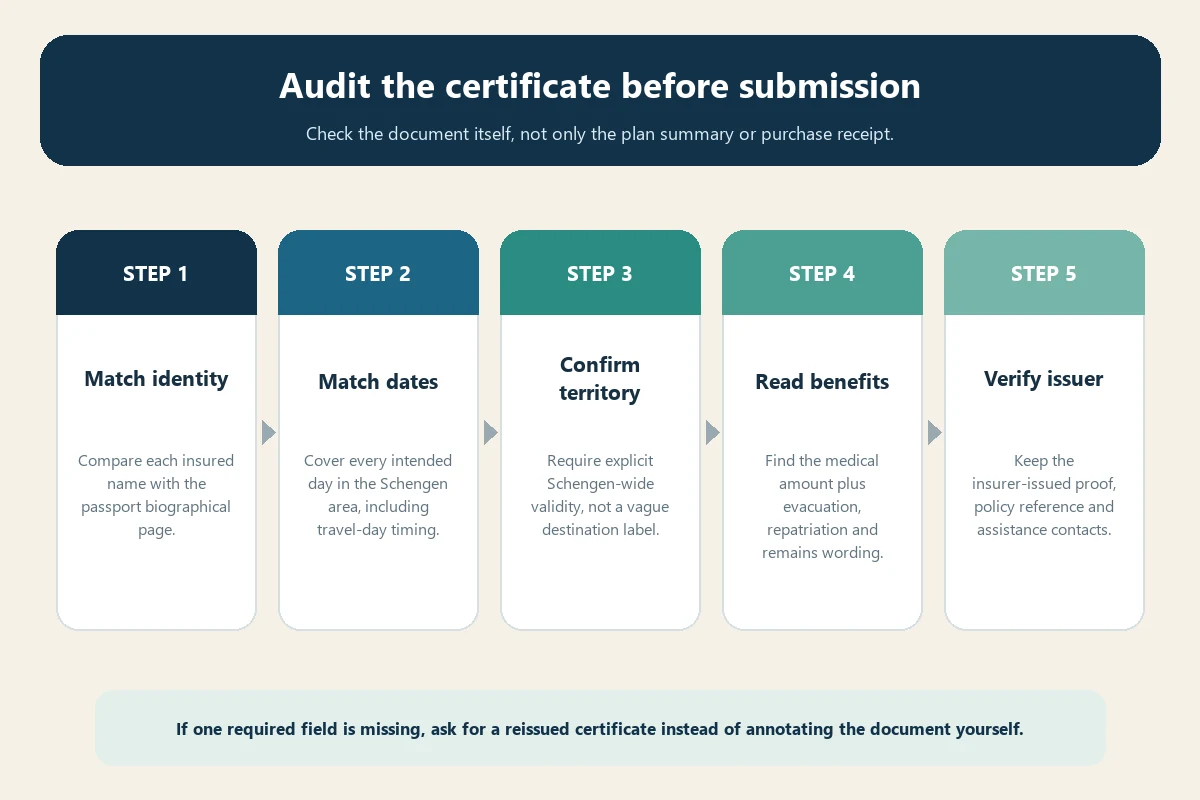
Field-by-field certificate audit
Insured person’s name
The document should identify each covered applicant. Compare spelling, order, spacing and middle names with the passport and visa application. A family policy number is not enough if the certificate does not show who is insured. For a group, confirm that every applicant appears either on the certificate or on an attached insurer-issued schedule.
Coverage start and end dates
The displayed period should include the intended stay in the Schengen area. Check overnight flights, time-zone changes and any transit that enters the area before the main destination. Do not assume that a policy described as “14 days” begins on the correct calendar date. The dates printed on the proof matter.
The Commission handbook says insurance needs to cover the applicant’s stay rather than automatically the entire validity period of the issued visa. A destination checklist may still contain practical instructions about dates or buffers. Use the itinerary submitted with the application and follow that consulate’s current wording.
Territorial validity
Look for an explicit statement that the insurance is valid throughout the Schengen area or all Schengen states. “International,” “worldwide,” “Europe” or one destination country can be commercially broad yet documentary vague. Ask the insurer to state the required territory rather than asking the visa officer to infer it.
Medical coverage amount
The certificate should state the medical amount required by the applicable rule and checklist. Our Europe coverage-limits guide explains why a filing threshold and a prudent trip limit are different decisions; here the task is simpler: find the required amount on the certificate itself. If the proof shows only a generic “covered” label, request a version with the limit stated.
Emergency care and hospital treatment
Look for express coverage of urgent or emergency medical attention and hospital treatment. A broad “health benefits” phrase may leave the reviewer without the required confirmation. The Commission’s application page lists emergency medical care and hospitalization among the required insurance functions.
Medical evacuation and repatriation
The certificate should address medical evacuation or repatriation and repatriation in the event of death, using the terms requested by the destination authority. The German Missions’ sheet is unusually specific: it says medical evacuation, medical repatriation and repatriation of remains must be spelled out. Treat that as a useful example, not a substitute for another consulate’s own checklist.
Deductible, co-pay and payment mechanics
Some consular instructions impose stricter practical expectations than a shopper may infer from the general rule. The German Missions in the US state that no reimbursement, deductible or co-pay is accepted for their applications. Check the relevant authority before relying on a deductible plan. Our Europe travel insurance deductible guide explains how the same cost-sharing label can operate differently across policies.
Issuer and policy reference
Keep the insurer or administrator name, certificate or policy number, and assistance contact visible. If an employer health plan is the underlying coverage, ask the health insurer or plan administrator for the confirmation; an employer’s benefits memo may not be accepted. Retain a contact channel that a consulate or traveler can use to verify the document.
How to fix an incomplete certificate
Do not type missing wording onto the PDF, edit dates, combine logos or write your own certificate. That changes insurer-issued evidence and can create an authenticity problem. Use this correction process instead:
- Identify the exact defect. Mark the missing name, date, territory, amount or benefit in your private checklist.
- Quote the official instruction. Send the provider the relevant sentence or official PDF link, not a third-party summary.
- Request a reissued document. Ask for a new insurer-issued PDF that replaces the incomplete version.
- Recheck every field. A corrected date can introduce a spelling error or change another detail.
- Keep the final version only in the submission folder. Archive older versions elsewhere to avoid uploading the wrong file.
Useful request: “Please reissue my Schengen visa insurance certificate to show my full passport name, coverage dates, validity throughout the Schengen area, the medical coverage amount, emergency hospital treatment, medical evacuation, medical repatriation and repatriation of remains. The application will be filed with [official authority].” Add only fields that the authority actually requests.
If the provider will not issue the needed proof, ask the consulate or visa center whether another document from the same insurer can satisfy the checklist. If it cannot, compare replacement coverage and refund conditions before purchasing again. Do not assume that carrying two incomplete documents will make one complete certificate.
Common document failures to catch early
- A shortened or misspelled name that does not match the passport.
- A purchaser is named, but another family member applying for the visa is absent.
- The coverage ends one calendar day before the itinerary leaves the Schengen area.
- The territory says only one country, “Europe” or “international.”
- The medical limit appears in marketing material but not in personalized proof.
- Repatriation wording omits medical repatriation or repatriation of remains.
- A receipt, employer letter or insurance card is submitted instead of insurer confirmation.
- A certificate is downloaded before a policy amendment and no longer matches the current dates.
- The applicant edits the file rather than obtaining a reissued original.
The official France-Visas FAQ illustrates why the words matter: it describes valid insurance for the whole stay and territory, and lists repatriation, emergency treatment and hospital treatment. Use the authority for your own destination, because document handling and submission format may differ.
Digital copy, printout and appointment packet
Follow the appointment checklist for format and copies. If electronic upload is required, use the original insurer PDF and a clear filename. If paper evidence is required, print the full certificate at readable scale; do not crop footers, schedules or attached pages that identify the insurer or covered applicants.
Carry a practical document packet:
- the final personalized certificate;
- any insurer-issued list of covered travelers;
- the policy or benefit schedule referenced by the certificate;
- the official insurance checklist used for the audit;
- the insurer’s assistance and verification contacts; and
- the receipt, kept as supporting evidence rather than the main proof.
Add this audit to the broader Europe trip insurance checklist so insurance dates, ticket dates and lodging dates are reviewed together. Inconsistent documents can create questions even when each item looks reasonable in isolation.
Final pre-submission check
- Is a Schengen visa actually required for this applicant and trip?
- Was the document issued by the insurer or plan administrator?
- Does every applicant’s name match the passport?
- Do the printed dates cover the intended stay?
- Is Schengen-wide territory stated explicitly?
- Is the required medical amount visible?
- Are emergency care, hospitalization and all required repatriation functions stated?
- Does the certificate meet destination-specific deductible and payment rules?
- Are the issuer, policy reference and contact details present?
- Has the final PDF been checked after every correction?
General educational information, not legal, visa, medical or insurance advice. Visa and document requirements can change and may vary by destination, application location and applicant. Confirm the current checklist with the responsible consulate or official visa authority before purchasing coverage or submitting an application.
Worried the proof may fail? The Schengen travel insurance rejection guide separates an intake problem from a formal visa refusal and gives a document-correction workflow.
Checking the policy window? Use the Schengen travel insurance dates guide to map entry, exit, overnight flights, optional buffers and certificate corrections.
Applying from the United States as a permanent resident? The Schengen insurance guide for US Green Card holders separates passport nationality, consular residence proof and policy eligibility.
Applying as a household? Use the family Schengen insurance file guide to align the shared itinerary while preserving a complete, individual application for every traveler.
Checking the certificate wording? The Schengen repatriation requirement guide separates medical transport from return in the event of death and explains the authorization clauses behind both.
Reviewing the issued documents? Use the Schengen insurance wording checklist to audit identity, dates, territory, medical limits, repatriation and insurer details line by line.