

The ETIAS travel insurance requirement is simple: the official ETIAS application does not currently list an insurance policy or certificate among the information needed to apply. ETIAS is a travel authorization for eligible visa-exempt travelers, not a Schengen visa. Insurance can still be valuable because authorization does not pay medical bills, arrange evacuation or reimburse a canceled trip.
Key takeaways
- ETIAS is not yet operating; the official EU site says it will start in the last quarter of 2026.
- The current application list covers a travel document, personal and travel details, security questions and payment, not proof of insurance.
- Schengen visa applicants follow a different rule that generally requires adequate travel medical insurance.
- A valid ETIAS authorization does not guarantee admission at the border.
- Travelers should decide on medical, evacuation and trip protection from their own risk, health plan and itinerary.
Rule status reviewed August 16, 2026. ETIAS dates and procedures can change. Recheck the official EU pages before paying or submitting information.
Is travel insurance required to apply for ETIAS?
No insurance certificate appears on the official application-information list. The European Union’s What you need to apply page says applicants will need a valid travel document, personal and contact information, travel details, education and occupation details, specified security information and a payment method. It does not ask applicants to upload or declare travel medical coverage.
That answer is narrower than “insurance never matters.” It means insurance is not shown as an ETIAS application condition. Entry rules, carrier checks, visa rules for other travelers, national rules for longer stays and the terms of a private policy remain separate questions.
The Schengen visa insurance requirements guide covers the visa process. U.S. residents should also use the U.S. buying guide when a traveler actually needs visa-compliant proof.
ETIAS is not in operation yet
The official ETIAS homepage says the system will start operations in the last quarter of 2026 and that no action is currently required. It also says the European Union will announce a specific date several months before launch. A site offering to issue a live ETIAS authorization before the official system opens is not the official application channel.
Use only the official EU website or the official mobile application when applications begin. Avoid paying an intermediary merely because a page ranks for “ETIAS insurance” or “ETIAS visa.” ETIAS is not a visa, and an insurance seller cannot issue the authorization.
Who will need ETIAS?
The official Who should apply page lists the United States among visa-exempt nationalities expected to need ETIAS for qualifying short visits. The system covers 30 European countries: the 29 Schengen countries plus Cyprus. Eligibility attaches to nationality and the travel document, with detailed exemptions for certain residents, visa holders, official documents and special statuses.
A person living in the United States may travel on a non-U.S. passport. A U.S. green card does not transform that passport into a U.S. passport. Check the exact document that will be presented to the carrier and border authority. The green-card holder insurance guide explains why residence and nationality must be recorded separately.
| Traveler path | Authorization or visa question | Insurance question |
|---|---|---|
| Eligible visa-exempt short-stay traveler | ETIAS after the system begins | Not listed in the ETIAS application; choose protection based on risk |
| Visa-required short-stay traveler | Uniform or limited-territorial visa | Visa Code insurance evidence generally applies |
| Long-stay student, worker or resident | National visa or permit rules | Destination-specific health or insurance rules may apply |
| EU or other exempt document holder | ETIAS exemption may apply | Practical medical exposure still needs review |
Why travelers confuse ETIAS with Schengen insurance
Both topics concern travel to much of Europe, but they solve different problems. ETIAS screens eligible visa-exempt travelers before a short visit. A Schengen visa is permission sought by a traveler whose nationality or circumstances require the visa. Article 15 of the Visa Code makes adequate travel medical insurance part of the visa file in ordinary cases.
The difference matters for search results. A page describing the €30,000 Schengen visa minimum may be accurate for a visa applicant and still be wrong as an ETIAS application checklist. Conversely, “ETIAS does not ask for insurance” does not erase the visa rule for someone who is not visa-exempt.
Use the territorial coverage guide if a policy must cover a mixed route. ETIAS coverage countries, Schengen membership, European Union membership and a policy’s private definition of “Europe” are not identical.
What the ETIAS application is expected to ask
The current official list includes the applicant’s name, birth information, nationality, address and contact details. It also includes travel-document data, education and occupation, intended travel, criminal convictions, past travel to conflict zones and certain immigration decisions. Some family members and third-party applicants provide additional details.
The application fee is currently stated as €20, with exemptions for applicants under 18, over 70 and certain family members. That payment is an authorization fee, not an insurance premium. Paying it does not create a policy, medical assistance service or cancellation benefit.
The official site warns that ETIAS is linked to the travel document used in the application. A traveler who replaces a passport needs a new authorization. That is another reason to avoid bundling insurance and authorization mentally: an insurance certificate may have its own correction procedure, while ETIAS follows its own passport-linking rule.
Protect the application data as carefully as passport data. The official form will collect identity, contact, travel and security information that an insurance comparison does not need. Confirm the web address before entering details, read the fee as a separate charge and save the official application number. A broker that pressures a traveler to buy a policy in order to “unlock” ETIAS should be treated with caution.
ETIAS approval is not a right of entry
The official What is ETIAS page says a valid authorization does not guarantee automatic entry. Border guards still verify entry conditions. Travelers must carry the same travel document used for the application and comply with passport-validity and stay limits.
This distinction prevents another common mistake: assuming an insurance purchase can cure an authorization or passport problem. A policy does not extend the 90-in-180-day limit, repair a passport mismatch or replace a required visa. Likewise, ETIAS does not pay a hospital or approve a claim.
Why insurance may still be sensible
The U.S. Department of State’s travel insurance guidance says the U.S. government does not pay medical costs for citizens abroad. It recommends checking domestic health coverage and considering short-term medical and evacuation protection. Medicare and Medicaid generally do not pay for care outside the United States.
A traveler may evaluate four different exposures:
- emergency medical bills and deductibles abroad;
- medical transportation or repatriation;
- nonrefundable prepaid trip costs;
- delays, baggage problems or other optional benefits.
Those benefits depend on the contract, not the ETIAS authorization. Compare exclusions, existing-condition provisions, authorization rules, coverage territory and payment procedures. The Europe policy comparison worksheet records the clauses that affect a real claim.
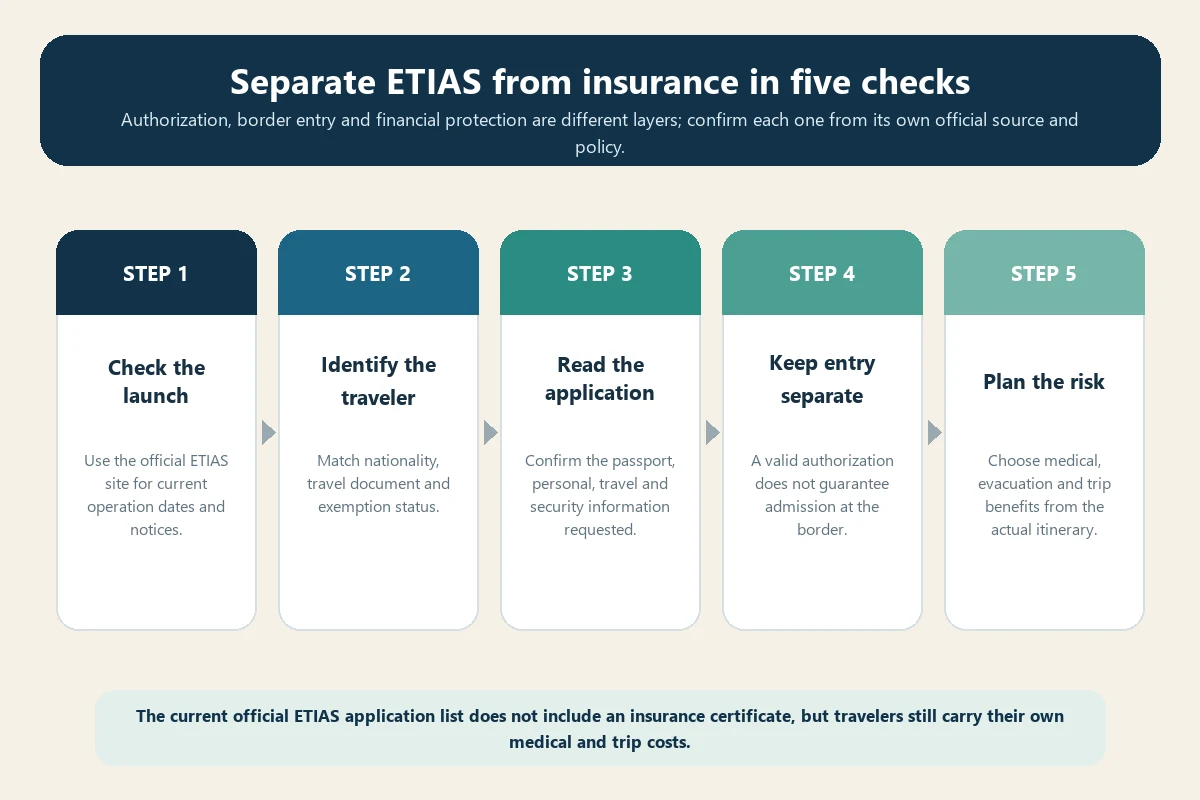
A five-step decision for U.S. travelers
- Check the official launch notice. Do not apply until the EU says the system is operational.
- Identify the passport. Verify whether its holder is visa-exempt, visa-required or covered by an exemption.
- Classify the visit. Confirm destination, purpose and length rather than assuming every Europe trip is a short tourist visit.
- List existing protection. Ask a health plan, card benefit and employer program what they cover abroad.
- Choose any private policy on its merits. Match limits, exclusions and assistance to the traveler instead of buying a product because it says “ETIAS.”
If purchase timing matters, review the Europe insurance timing guide. Some optional benefits depend on purchase date even when the government imposes no insurance deadline.
Red flags on ETIAS and insurance pages
- Claims that ETIAS applications are open before the official EU launch.
- A statement that every traveler must upload a €30,000 policy for ETIAS.
- Language that calls ETIAS a visa without explaining the distinction.
- A checkout that combines an authorization service and policy without clear separate prices.
- A promise that either ETIAS or insurance guarantees border admission.
- A policy recommendation that ignores nationality, health plan, route and trip cost.
Frequently asked questions
Do U.S. citizens need insurance to submit ETIAS?
The current official application list does not include proof of insurance. U.S. citizens should still verify the live requirements when the system opens and make a separate insurance decision.
Does ETIAS replace a Schengen visa?
No. ETIAS is designed for eligible visa-exempt travelers. Travelers who require a visa must follow the applicable visa process.
Does ETIAS include medical coverage?
No. A travel authorization is not an insurance contract and does not pay medical or evacuation expenses.
How many countries will require ETIAS?
The official list currently contains 30 countries. It includes the 29 Schengen members and Cyprus. Verify the list before travel.
Should I buy a policy labeled ETIAS insurance?
Judge the issued contract, insurer, territory, benefits, exclusions and service workflow. “ETIAS insurance” is marketing language, not a separate official policy category.
This educational guide is not legal, immigration or insurance advice. Official procedures and policy terms control.
