

Schengen insurance for US Green Card holders begins with passport nationality, not permanent-resident status. A Green Card proves lawful residence in the United States and can establish where a visa application may be lodged. It does not turn its holder into a U.S. citizen, replace the travel passport or independently decide whether a Schengen visa is required.
Key takeaways
- Check the visa rule for the nationality shown on the passport used for the trip.
- A Green Card is evidence of U.S. permanent residence, not evidence of U.S. nationality.
- As a general rule, a Schengen application is lodged where the applicant legally resides.
- The responsible consulate may require the Green Card to remain valid beyond the planned return.
- Insurance eligibility can depend on U.S. residence, trip origin and return arrangements even when the visa certificate is compliant.
The four-question framework
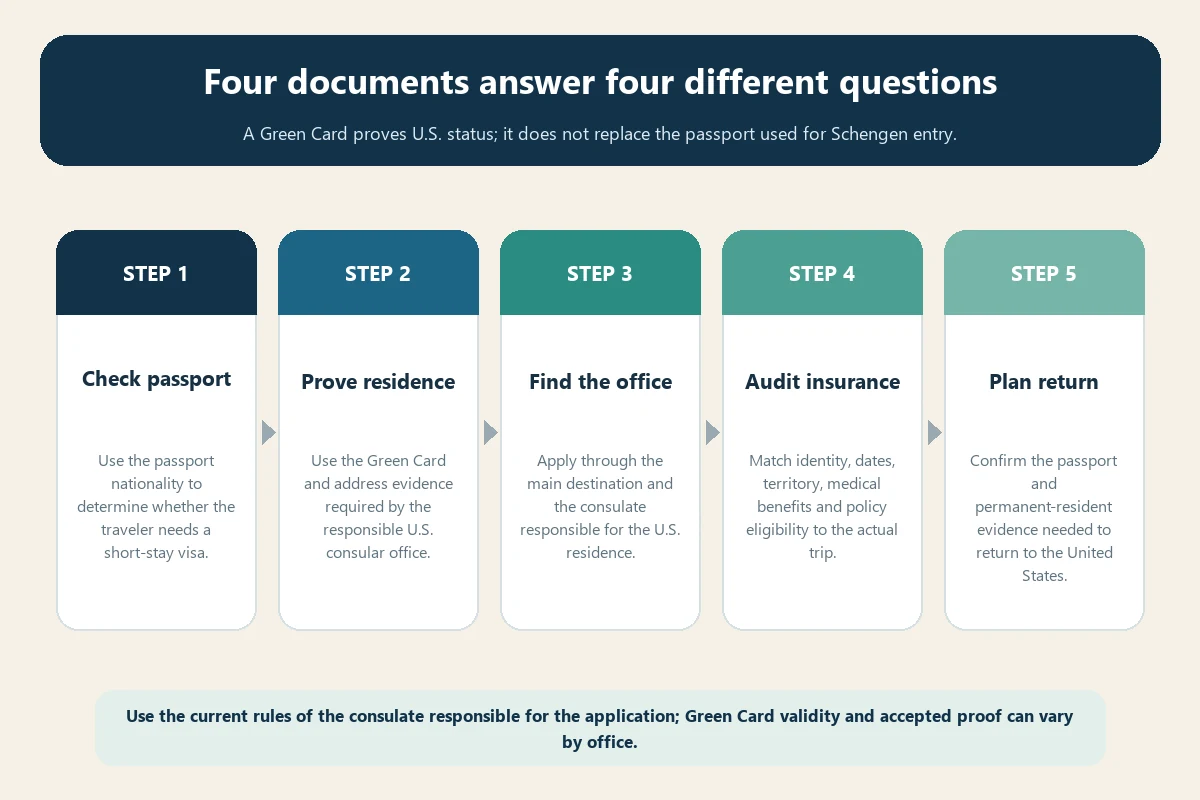
Keep four separate questions in the file:
- Nationality: Which passport will the traveler use?
- Visa status: Does that passport nationality require a short-stay Schengen visa?
- Application jurisdiction: Which consulate is responsible for the applicant’s U.S. residence and main destination?
- Insurance eligibility: Will the selected plan insure this resident, route, trip length and return pattern?
Answering one does not answer the others. This prevents the common but incorrect shortcut “I have a Green Card, so I follow the U.S.-citizen rule.”
Does a Green Card holder need a Schengen visa?
The answer normally follows the traveler’s citizenship and passport. EU Regulation 2018/1806 lists third countries whose nationals are visa-required and those whose nationals are exempt for qualifying short stays. U.S. lawful permanent residence is not a new nationality category in those lists.
For example, a Green Card holder traveling on a passport from a visa-required country generally still needs a short-stay visa, unless a specific exemption applies. A Green Card holder with a passport from a visa-exempt country may follow the visa-exempt route for an eligible short visit. Verify the current consolidated list and the destination authority’s instructions before booking nonrefundable arrangements.
The European Commission’s application page states that citizens of certain non-EU countries must apply and links to the official country list. Our Schengen visa insurance requirements guide then explains what the medical proof must show when the visa route applies.
What the Green Card actually proves
For a Schengen application lodged in the United States, the Green Card can prove legal U.S. residence. It can also help identify the consular district. It does not replace the passport biographical page, and it is not the insurance certificate.
The Spanish Consulate in San Francisco’s Schengen instructions, for example, require applicants to reside legally within its jurisdiction and list an original and copy of the Permanent Resident Card as accepted proof of U.S. legal residence. The same page separately asks for a travel-insurance certificate and says an insurance card is not accepted as proof of coverage.
This separation is useful beyond one consulate:
| Document | Primary role | Does not replace |
|---|---|---|
| Passport | Identity, nationality and international travel document | Green Card or insurance certificate |
| Green Card | Evidence of U.S. lawful permanent-resident status | Passport or Schengen visa |
| Schengen visa | Permission to seek short-stay entry under its conditions | Insurance or proof of funds |
| Insurance certificate | Proof of specified medical cover | Full policy wording or immigration permission |
Where to apply from the United States
According to the European Commission, an applicant generally lodges the application at the consulate with territorial responsibility for the place of legal residence. The destination rule comes first: apply through the country of the main destination, or the first country when stays in several Schengen countries are of equal length. Then use the applicant’s U.S. address to identify the responsible office or provider.
Do not choose a consulate because its appointment calendar looks easier. Keep proof of address and immigration status consistent. A temporary visitor in the United States may not be eligible to apply there. The San Francisco instructions, for example, say B-1/B-2 holders must apply in their country of permanent residence.
Consular districts and outsourcing arrangements change. Use the official site of the main destination immediately before booking the appointment, and save a copy of the checklist used.
Green Card validity can matter to the application
Some consulates state how long U.S. residence evidence must remain valid after the intended Schengen departure. The Spanish Consulate in Washington, for example, says proof of legal U.S. residence must remain valid at least three months beyond the intended Schengen departure.
Do not generalize that example to every office. Check the responsible consulate. If the card is expiring or has been extended by a receipt or temporary evidence, ask which combination is accepted before the appointment. Keep the answer in writing when possible.
Schengen insurance requirements for a visa applicant
When the passport nationality requires a visa, the insurance must meet the Visa Code and the responsible authority’s document rules. The baseline includes adequate medical travel cover for urgent medical attention, emergency hospital treatment and medical repatriation, including death, throughout the relevant Schengen territory for the intended period.
Check the insurer-issued certificate for:
- the applicant’s name exactly as used in the passport and application;
- coverage dates matching the entire intended Schengen stay or transit;
- clear Schengen-wide or otherwise acceptable territorial wording;
- the medical coverage amount;
- urgent care and emergency hospitalization;
- medical repatriation and death-related repatriation wording;
- insurer identity, policy number and assistance contact; and
- any local requirements in the consular checklist.
The German Missions in the United States likewise tell Schengen visa applicants to submit proof covering the entire stay in Europe. Use the authority handling the application as the final documentary source.
Our certificate guide provides a field-by-field audit, while the minimum-coverage guide helps identify a limit that is stated in a misleading or incomplete way.
If the passport is visa-exempt
A visa-exempt traveler is not applying for a Schengen visa and therefore does not need an insurance certificate as a visa-application document. That does not mean medical care abroad is free or that U.S. coverage travels automatically. The traveler should still compare emergency medical and evacuation protection for the actual trip.
The U.S.-to-Europe travel medical guide is useful for benefit questions, but a Green Card holder should not assume that every plan marketed to “Americans” includes all U.S. residents. Read the policy definition of eligible person and residence.
Policy eligibility is separate from visa compliance
A certificate can appear Schengen-compliant while the traveler is ineligible under the contract. Before purchasing, verify:
Residence definition
Does the contract define the insured’s country of residence as the United States? Is a minimum period of residence required? Does a long absence change eligibility? Use the facts, not a mailing address chosen for convenience.
Trip origin and return
Must the trip begin and end in the United States? Can a one-way journey or an already-started trip be insured? A visa certificate’s geographic wording does not answer these contract questions.
Home-country exclusions
If the traveler visits a country of citizenship during the same journey, check whether the contract treats it as a home country or excludes routine care there. This can matter on a multi-country itinerary even when the Schengen segment is covered.
Existing medical coverage
Confirm whether the travel plan pays first or after another health plan, and what documentation is needed. The Green Card itself provides no medical benefit. Use the issued wording to understand deductibles, networks, reimbursement and preauthorization.
The Europe policy comparison worksheet can capture these eligibility rules alongside the medical limits.
Do not forget the return to the United States
Schengen entry and U.S. reentry use different legal frameworks. U.S. Customs and Border Protection’s guidance for lawful permanent residents traveling abroad discusses the Green Card or reentry permit used for return and warns that destination countries may still require a passport. Check Green Card, passport and any reentry-document validity before departure.
Long absences can create U.S. immigration questions that travel insurance cannot solve. If the trip may be extended substantially, obtain qualified immigration advice and current USCIS or CBP guidance before leaving.
A worked document example
Consider a lawful permanent resident who lives in California, holds an Indian passport and plans ten days in France followed by four days in Spain. The passport nationality is the starting point for the visa requirement. France is the longer stay, so the official main-destination rule points to France. The U.S. address determines the responsible application channel. The Green Card proves U.S. legal residence, while the insurance certificate proves the separate medical-coverage requirement.
Now change only one fact: the traveler holds a passport from a visa-exempt country. The Green Card and return documents still matter, but the Schengen visa-application insurance certificate is no longer the same requirement. Optional medical and evacuation protection should still be evaluated based on the contract.
Pre-appointment checklist
- Confirm the exact passport used for travel.
- Check the current EU visa list for that nationality.
- Identify the main Schengen destination.
- Identify the consulate responsible for the U.S. home address.
- Verify Green Card and passport validity under that office’s checklist.
- Confirm policy eligibility for a U.S. resident with this trip origin.
- Audit the insurer-issued certificate against the itinerary.
- Save the full policy, not only the certificate.
- Check the documents needed to return to the United States.
- Recheck official instructions shortly before the appointment and departure.
Add the documents to the Europe trip insurance checklist. For itineraries spanning Schengen and non-Schengen countries, use the multi-country coverage audit as well.
The practical answer
A Green Card holder may need Schengen travel insurance as a visa document when the passport nationality is visa-required. The Green Card proves U.S. residence and can determine where the application is accepted, but it does not decide the visa category. After that legal check, verify the plan’s separate residence and trip-eligibility rules and preserve valid documents for return to the United States.
General educational information, not legal, visa, medical or insurance advice. Nationality lists, consular jurisdictions and accepted residence documents can change. Confirm the current official rules for the passport, main destination and U.S. residence before applying or traveling.
Buying from the United States? Use the Schengen travel insurance from USA guide to verify residency eligibility, certificate fields, payment details, support and refund terms.
Residence and nationality are not interchangeable. Use the Europe insurance requirements by nationality guide to identify the rule attached to the passport, visa type and length of stay.
