

Buying Schengen travel insurance from USA should begin with the applicant’s nationality, U.S. residence status and real itinerary, not a list of brands. A U.S. citizen taking a short visa-free trip has a different document need from a green card holder whose passport requires a visa. Both may want medical and evacuation protection, but only the visa applicant must submit qualifying proof.
Key takeaways
- Schengen visa requirements follow passport nationality and trip facts, not U.S. residence alone.
- Article 15 says applicants should generally obtain insurance in their country of residence.
- Confirm state, residence, age and trip-origin eligibility before paying.
- Preview the certificate fields and full policy, not only the checkout promise.
- Check currency, card fees, support hours, corrections and visa-denial refund terms.
First decide whether insurance is a visa document
A traveler living in the United States can hold a U.S. passport, foreign passport, green card, temporary visa or another status. The need for a Schengen visa follows the travel document and applicable rules. U.S. citizenship does not transfer to a spouse or relative who merely shares the itinerary.
A U.S. passport holder generally does not use short-stay travel insurance as a visa application document for an ordinary visit. Insurance can still protect medical and financial risks. A visa-required passport holder who legally resides in the United States may need a certificate for the application.
The Schengen insurance guide for U.S. green card holders explains that passport nationality and U.S. residence do different jobs. The main Schengen visa insurance guide covers the common document standard.
Why country of residence matters when buying
Article 15 of the EU Visa Code says applicants should, in principle, take out insurance in their country of residence. Where that is not possible, they may seek insurance in another country. It also allows another person to take out insurance in the applicant’s name.
A website accessible from a U.S. browser is not necessarily selling a contract available in every state or to every resident. Confirm the legal insurer, applicant residence, state eligibility, trip origin and destination. A visitor temporarily in America may not qualify as a U.S. resident even if they can enter a U.S. address at checkout.
Use accurate residence information. Claims can examine eligibility later. If a sponsor abroad buys the policy, the applicant must still be the correctly named insured and meet contractual conditions.
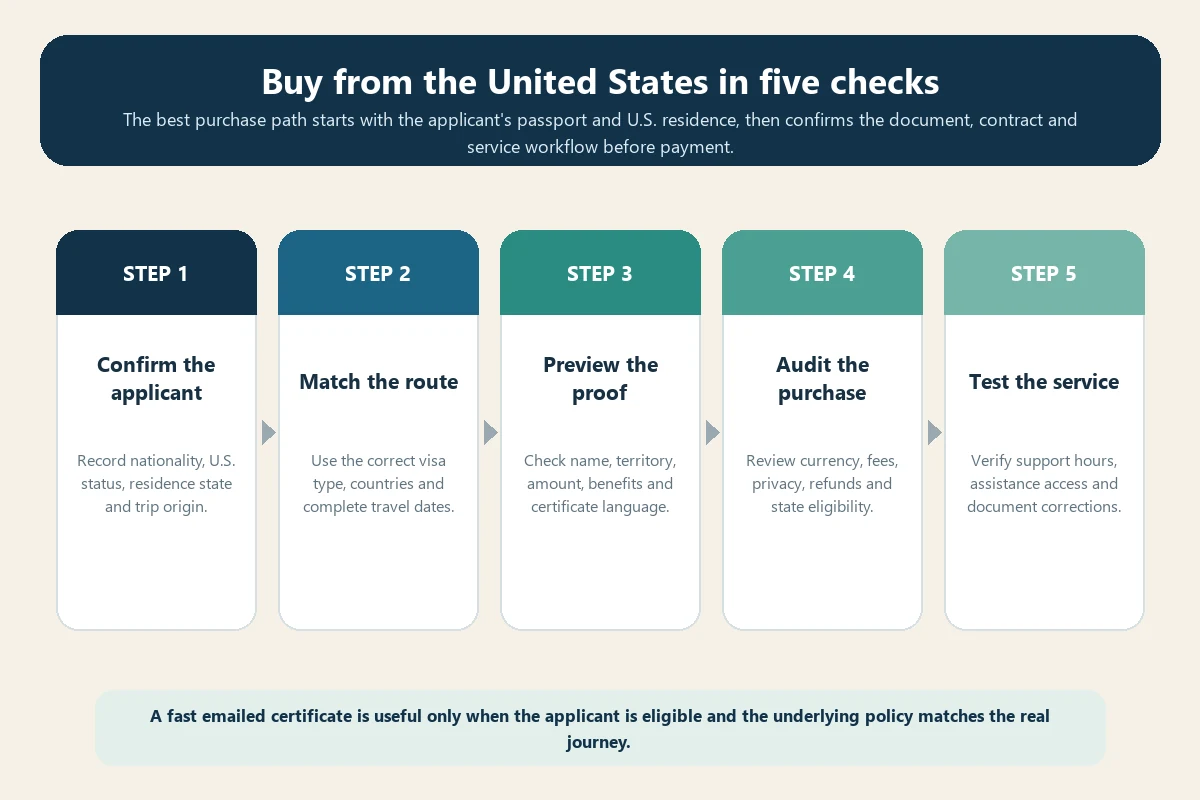
Collect the facts before opening a quote
- passport nationality and expiration date;
- U.S. residence document and state;
- age on purchase and departure dates;
- home country and trip-origin definition;
- all Schengen and non-Schengen destinations;
- departure, first entry and final return dates;
- single-entry or multiple-entry application;
- existing health coverage and medical needs;
- prepaid nonrefundable trip cost;
- activities that may require special cover.
Use one consistent passport name in the quote and application. If the form cannot accept the name correctly, contact the insurer before purchase. A certificate correction after checkout is possible with some sellers, but it should not be assumed.
Audit the certificate before the visa appointment
Ask for a sample or field list. The issued PDF should identify the applicant and display the required territory, dates, medical amount and benefits. The Spanish Consulate in Washington, for example, asks for a certificate showing the applicant’s name, coverage dates and minimum amount. It says an insurance card is not accepted as proof.
The official Netherlands insurance page requires proof that names the insured and covers all Schengen countries for the complete stay, with at least €30,000 for the stated medical services and repatriation.
Open the PDF immediately. Check spelling, birth date if shown, policy number, effective dates, all-Schengen wording, benefits, insurer identity and assistance contact. Use the Schengen certificate audit before printing or uploading.
Convert the €30,000 requirement carefully
U.S.-market policies may display dollars. A consulate can publish an approximate dollar equivalent, but exchange rates move. Choose a medical amount that clearly exceeds the euro minimum rather than relying on a conversion that barely meets it on purchase day.
Do not confuse the medical limit with a deductible, evacuation amount or trip-cancellation benefit. The Schengen minimum-coverage guide explains the relationship between the headline figure, benefits and sublimits.
Compare checkout currency and payment costs
A seller may charge in U.S. dollars, euros or another currency. Record the quoted premium, tax, policy fee and currency before authorizing payment. A U.S. card can add a foreign-transaction fee. Exchange-rate differences can also affect a later refund.
Use a secure checkout and verify the merchant. Do not send full card details by ordinary email. Save the receipt, policy, certificate and terms in the same folder. The person whose card pays can differ from the insured, but refund procedures may send money only to the original payment method.
Check support across U.S. and European time zones
A fast emailed certificate is valuable only if errors can be corrected before the appointment. Find the seller’s document-support hours and the assistance company’s emergency hours. They may operate in different time zones and be separate organizations.
Test the support channel with a non-urgent question. Ask how to correct a name, move dates or add a country. Confirm whether a new PDF is issued and how long it takes. For emergencies, identify a 24-hour number and instructions for international or collect calls.
Read the underlying medical and evacuation terms
The U.S. Department of State’s travel insurance guidance recommends reviewing the countries, trip length, emergency care, medical transportation, current conditions and planned activities. It notes that U.S. Medicare and Medicaid do not pay for medical care outside the United States.
Ask whether the policy is primary or secondary, whether the traveler pays first and how direct billing works. Read existing-condition rules and evacuation authorization. A certificate can be accepted for a visa while an expense remains excluded under the contract.
Use the Europe policy comparison worksheet to record those answers. Do not rank products only by premium.
Visa-denial refunds and date corrections
Before purchase, locate the free-look, cancellation and visa-denial refund clauses. Determine which proof is required, whether the request must arrive before coverage begins and which fees are nonrefundable. The Europe insurance timing guide helps applicants plan purchase and correction dates.
Appointment delays are common. Ask whether effective dates can be moved without canceling the policy. Do not edit a certificate. Obtain a revised document from the insurer and keep the version actually submitted.
Buying from a U.S. insurer versus an overseas insurer
| Question | U.S.-market contract | Overseas contract |
|---|---|---|
| Eligibility | May depend on state residence and U.S. trip origin | May accept applicants from listed residence countries |
| Currency | Often dollars | May be euros or another currency |
| Certificate | Confirm explicit Schengen wording | May be designed for visa proof; still audit fields |
| Regulator | State insurance framework may apply | Foreign regulator and complaint process may apply |
| Support | Convenient U.S. business hours | European hours may align with consular processing |
| Claims | U.S. forms and payment methods may be familiar | Check language, currency and required records |
Neither location is automatically better. Article 15 allows another-country purchase when necessary. The practical choice is an eligible, understandable contract with acceptable proof and usable assistance.
Data and identity safety
Insurance checkout can request passport name, birth date, nationality, address and trip details. Confirm the website and privacy notice before submitting. A quote should not require sending a passport image through an unverified message channel.
Store certificate copies securely. Share only the pages required for the application. If a host or sponsor buys the plan, agree on who retains the policy and who can request corrections.
U.S. purchase checklist
- Confirm visa requirement from passport nationality.
- Verify U.S. residence and state eligibility.
- Map all countries and complete dates.
- Preview required certificate fields.
- Read medical, evacuation and existing-condition clauses.
- Record currency, fees and payment method.
- Test document support and emergency assistance.
- Save refund and date-change rules.
- Download and audit every issued document.
Common buying mistakes
- Assuming every U.S. resident has the same visa requirement.
- Entering a U.S. mailing address without meeting residence eligibility.
- Buying a domestic health add-on that cannot issue Schengen proof.
- Choosing a dollar amount too close to the euro minimum.
- Ignoring non-Schengen stops and personal side trips.
- Waiting until the appointment to open the certificate.
- Confusing a premium refund with trip-cancellation coverage.
Frequently asked questions
Do U.S. citizens need Schengen visa insurance?
Ordinary short visits with a U.S. passport generally do not involve a Schengen visa application, but travel medical and evacuation protection can still be prudent.
Can a green card holder buy insurance in the United States?
Often yes, subject to the policy’s residence and state rules. The visa requirement follows the passport nationality, not the green card alone.
Can a U.S. sponsor buy insurance for someone abroad?
Article 15 permits another person to take out insurance in the applicant’s name. Confirm the applicant’s residence and eligibility before purchase.
Does the certificate need to show dollars or euros?
It must clearly satisfy the required minimum. A dollar amount should remain safely above the euro threshold. Follow the responsible consulate’s current instruction.
How quickly should the certificate arrive?
Many sellers issue it electronically, but timing varies. Buy early enough to inspect and correct the document before the appointment.
This guide provides general buying information, not a product recommendation or legal advice. Verify current visa, state eligibility and policy terms before purchase.
Confused about the new authorization? Use the official-source ETIAS insurance requirement guide to separate application rules from sensible medical and cancellation coverage.
