

Schengen insurance minimum coverage is €30,000 for a short-stay visa applicant, but the number is only one part of the legal test. The insurance must also cover the specified medical and repatriation expenses, remain valid throughout the Schengen area and span the intended stay or transit. A plan showing “€30,000” can still be inadequate if those other conditions are missing or undermined.
Key takeaways
- Article 15 of the Visa Code sets the minimum coverage at €30,000.
- The floor applies to adequate travel medical insurance, not to trip cancellation or total trip cost.
- Required medical and repatriation expenses must be genuinely covered, not hidden behind weak sublimits.
- The policy must be valid throughout the relevant territory and for the intended stay.
- Currency, deductibles, claim recovery and destination-consulate instructions still need separate checks.
The rule in Article 15
The controlling starting point is Article 15 of the EU Visa Code. It requires applicants for uniform short-stay visas to prove that they hold adequate and valid travel medical insurance. The insurance must address expenses connected with medical repatriation, urgent medical attention, emergency hospital treatment or death during the stay.
Article 15 also says the insurance must be valid throughout the territory of the Member States, cover the entire intended stay or transit and provide at least €30,000 of coverage. These are connected conditions. The minimum is not a standalone product specification that makes every plan bearing the number acceptable.
Our Schengen visa insurance requirements guide explains who generally needs to file proof and how the broader rule fits the application. This article focuses only on how to interpret the minimum amount and test whether the policy substance supports it.
What the €30,000 minimum covers
The figure is a medical-insurance floor for the expenses named in the Visa Code. It is not a required trip-cancellation limit, baggage limit, travel-delay benefit or insured trip cost. A comprehensive travel policy may contain those benefits, but they do not replace the medical and repatriation protection required for the visa.
| Policy field | Role in the visa test | What to verify |
|---|---|---|
| Emergency medical care | Required expense category | Eligible urgent treatment is within the stated cover |
| Emergency hospitalization | Required expense category | Inpatient emergency care is not reduced to a token sublimit |
| Medical repatriation | Required expense category | Transport for medical reasons is expressly covered |
| Death-related repatriation | Required expense category | The wording addresses death or repatriation of remains as required |
| Cancellation and baggage | Not part of the €30,000 medical floor | Do not count unrelated benefits toward medical compliance |
The European Commission’s report on travel medical insurance describes the minimum as €30,000 and says claims must be recoverable in an EU Member State. That last point matters: the policy must do more than promise reimbursement in a way that cannot practically support a covered traveler in the area.
Why a €30,000 headline can still fail the test
A single total can conceal how the policy allocates money. The Commission’s Visa Code handbook for consulates warns that a product can artificially inflate inexpensive risks while assigning smaller amounts to hospital treatment or repatriation. It says a policy structured that way can be inadequate even when its listed risks add up to €30,000.
Use the declarations, schedule and certificate together. Check whether:
- one overall medical limit applies to the required expenses;
- hospital treatment has a lower sublimit;
- medical evacuation or repatriation has its own cap;
- repatriation of remains is included or excluded;
- a daily hospital maximum reduces the usable benefit;
- an activity, condition or destination exclusion removes the relevant risk; and
- the displayed amount is per insured person or shared across a group.
A family or group plan deserves special attention. Each visa applicant has to prove adequate insurance. If the paperwork shows only one aggregate pool for several travelers, ask the insurer and the responsible visa authority whether each applicant is demonstrably protected to the required level. Do not divide an aggregate figure yourself and assume the result will be accepted.
Currency: euros, dollars and moving exchange rates
The legal amount is stated in euros. A fixed dollar equivalent is not universal because exchange rates move. A USD limit that exceeds €30,000 today can lose its margin before an appointment or trip. Search results that translate the rule into one exact dollar number can become stale without any change to the Visa Code.
The cleanest certificate states at least €30,000 or says the relevant cover is unlimited. The German Missions in the United States insurance sheet, for example, says the amount must be spelled out or be unlimited. If a US policy states only dollars, ask whether the insurer can issue a Schengen-specific certificate in euros.
If it cannot, do not invent a personal conversion rule. Check the current document instructions of the consulate processing the application and leave a meaningful margin above the threshold. The visa authority, not a comparison website, determines whether the submitted proof is adequate.
Territory is part of minimum coverage
A €30,000 policy limited to one country does not satisfy a rule that calls for validity throughout the Schengen territory. Similarly, “Europe” is a marketing region, not necessarily the same definition as the Schengen area. The certificate and policy should make the required geographic scope explicit.
Check the territorial definition for exclusions, sanctioned destinations and non-Schengen stops. The United Kingdom and Ireland are not Schengen states; European overseas territories can also follow different entry and insurance rules. A policy can cover them commercially, but that does not prove its Schengen validity.
The official France-Visas FAQ is a useful example: it pairs the €30,000 minimum with validity throughout the territory and the duration of the stay. Applicants should use the page for the state and jurisdiction handling their own application.
Dates are also part of the minimum
A large limit does not cure a missing day. Match the start and end dates to the intended stay or transit used in the visa file. Review overnight arrival, border-entry timing, connections that enter the Schengen area and the actual departure from the area.
The Visa Code distinguishes the intended stay from the full validity window of a visa. The Commission handbook likewise explains that insurance need cover the stay rather than automatically every day of a longer visa-validity period. Follow the current consular checklist for practical date instructions and keep the certificate consistent with the submitted itinerary.
Our Schengen insurance certificate guide provides a field-by-field audit and a correction workflow when the printed dates or territory are incomplete.
Deductibles, co-pays and reimbursement mechanics
Article 15 states the minimum amount but does not reduce the entire adequacy decision to arithmetic. A large deductible or a reimbursement-only structure can weaken the protection available when care is needed. The Commission handbook tells consulates to consider whether a high excess calls true coverage into question and whether assistance is available on the spot rather than only after the applicant returns.
Practical rules can be stricter in a particular application jurisdiction. The German Missions’ US sheet says no reimbursement, deductible or co-pay is accepted for its applications. That should not be generalized into a claim about every consulate, but it is a reason to check the responsible authority before buying.
Use our Europe insurance deductible guide to identify whether an excess applies per person, incident, claim or trip. Then compare that structure with the consulate’s current instructions. A zero-deductible label still does not prove direct payment, suitable territory or the required benefits.
Claims must be workable in the Schengen area
The insurer’s location is not the only issue. The Commission’s report and handbook focus on whether obligations can actually be met in a Member State. Review whether the company can authorize care, provide a payment guarantee where available, communicate with European providers and arrange repatriation.
Ask practical questions before purchase:
- Is the emergency assistance line available throughout the trip?
- Can the administrator communicate with a hospital in the destination?
- Can inpatient payment be guaranteed, or must the traveler pay first?
- Who authorizes medical evacuation or repatriation?
- Are claims payable in the required territory and currencies?
- Does the certificate identify the insurer and a verifiable policy number?
These questions also matter beyond visa compliance. Our guide to medical insurance for travel to Europe explains how assistance, direct payment and primary or secondary status affect a US traveler after an emergency.
Minimum legal cover is not automatically enough for the trip
The €30,000 figure is a filing floor, not a personalized recommendation. It does not account for the traveler’s health, trip length, destinations, activities, remote locations or the possible cost of transatlantic medical transport. A plan can satisfy the visa amount yet leave a financial gap in a severe event.
Use the Europe travel insurance coverage-limits guide to size medical protection for the actual trip. Review the separate medical evacuation limit guide when the itinerary includes islands, mountains, cruises or locations far from suitable care.
Do not assume that buying more total coverage fixes missing wording, territory or dates. Compliance and adequacy are two related but distinct decisions:
- Compliance: Does the policy and certificate satisfy the official visa checklist?
- Protection: Are the limits and terms strong enough for this traveler and itinerary?
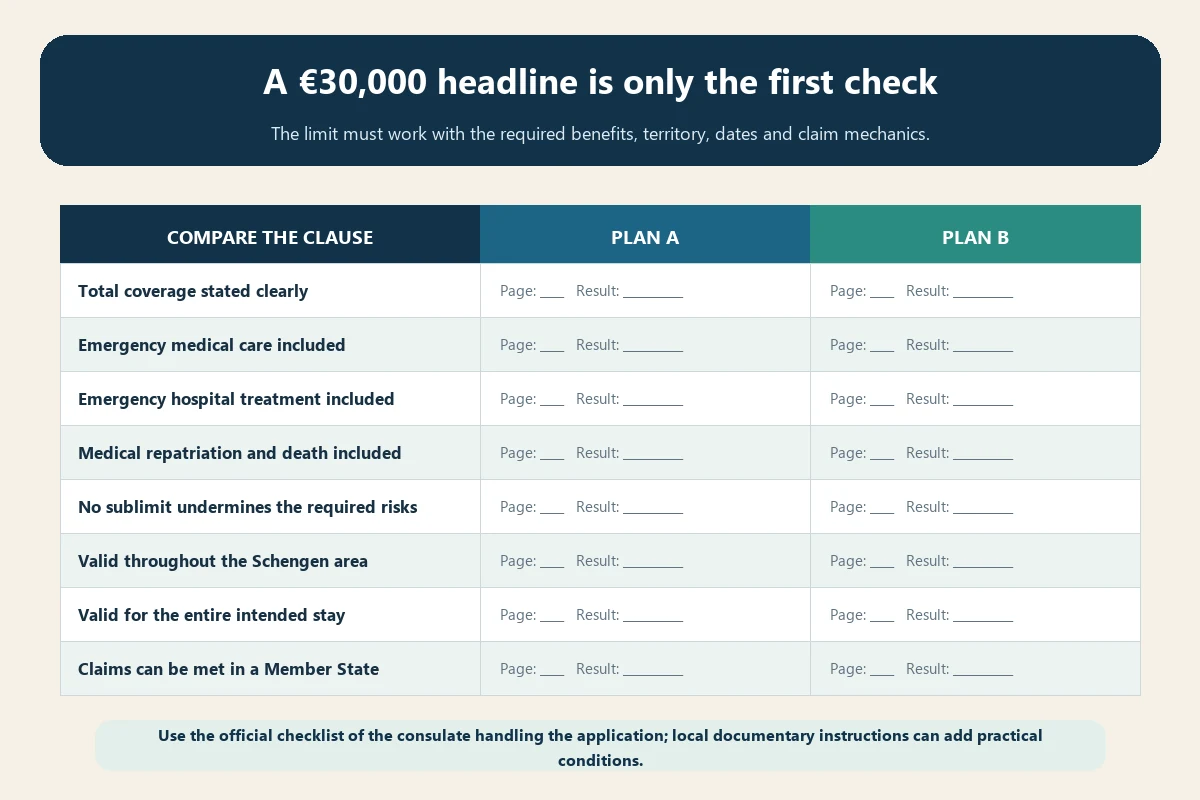
Minimum-coverage review checklist
- Does the proof state at least €30,000 or an accepted equivalent?
- Is the amount available for the required medical and repatriation expenses?
- Do sublimits leave hospital treatment or repatriation materially underfunded?
- Is the amount demonstrably available to each visa applicant?
- Is the insurance valid throughout the Schengen area?
- Do the dates cover the entire intended stay or transit?
- Can claims and assistance be delivered in a Member State?
- Do deductibles, co-pays and reimbursement mechanics meet the destination’s instructions?
- Does the insurer-issued certificate prove the same facts as the policy?
- Has the official consulate checklist been rechecked before submission?
General educational information, not legal, visa, medical, insurance or financial advice. Requirements and consular document practices can change. Confirm the current rules with the consulate or official visa authority responsible for the application.