

A medical evacuation insurance destination is usually defined by medical need and policy wording, not by the traveler’s preferred city. Many contracts start with the nearest adequate or suitable facility. A later transfer to a facility near home, transport home, or a hospital of choice may require stabilization, separate authorization, or an optional upgrade.
This U.S.-focused guide is educational, not medical, insurance, aviation, or legal advice. In an emergency, obtain appropriate local care first. Destinations, definitions, limits, exclusions, and state forms vary; the issued policy, schedule, declarations, endorsements, and assistance instructions control.
Key takeaways
- “Evacuation” does not automatically mean transportation to the United States.
- The nearest facility and the nearest adequate facility can be different places.
- A receiving hospital must normally accept the patient before transfer.
- Transport home may be a later stage after stabilization, not the first destination.
- Hospital-of-choice benefits usually require explicit wording or an elected upgrade.
Reviewed August 16, 2026. Compare the words nearest, adequate, suitable, home, return destination, hospital of choice, and repatriation in the actual contract.
Start with the destination clause
Open the policy and search for Emergency Evacuation, Medically Necessary Transportation, Hospital, Home, Return Destination, adequate, nearest, and choice. Copy the full provision, definitions, exclusions, and any endorsement onto one page.
The medical evacuation limits guide explains why the maximum amount cannot answer the destination question. A large limit is still governed by medical necessity, authorization, and route language.
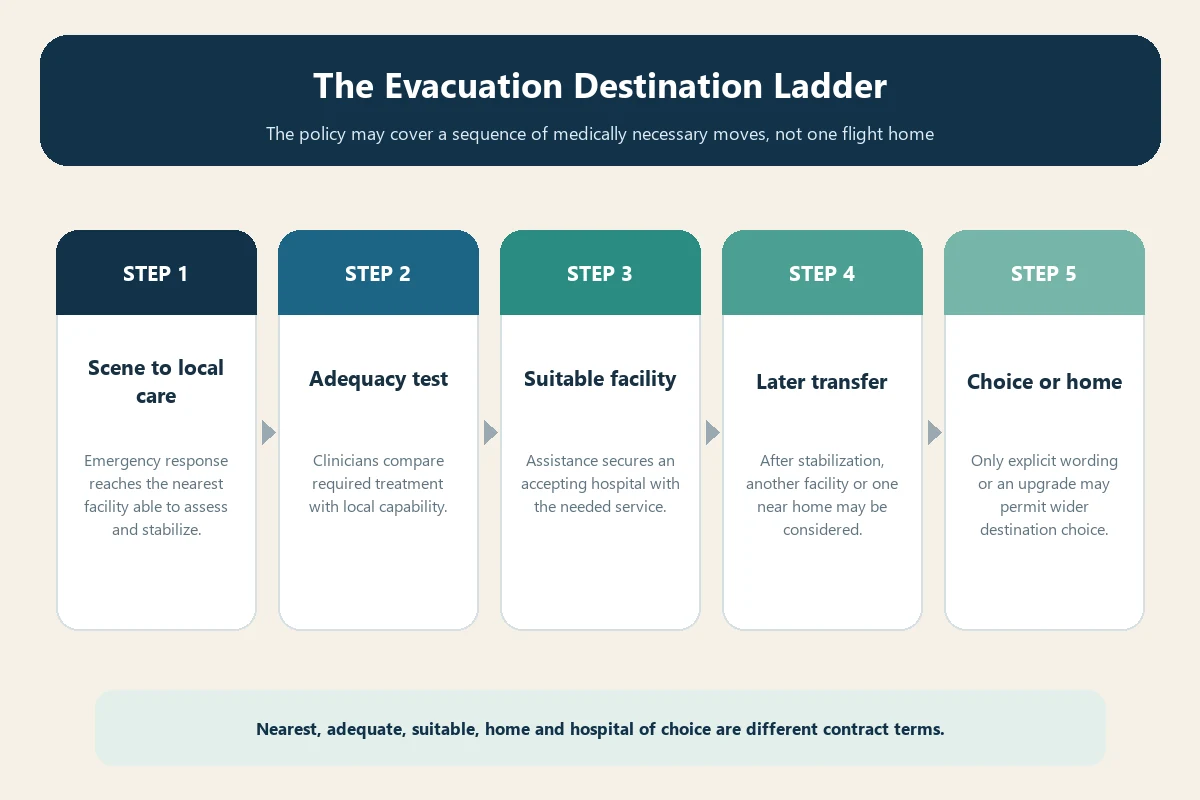
Stage 1: From the scene to local assessment
The first movement may be rescue, local ambulance, boat, helicopter, or other emergency response to a nearby facility. That service can fall under local ambulance, search and rescue, medical expense, or evacuation wording. Do not assume every stage draws from the same benefit.
For remote trips, ask whether rescue from the incident location is covered before medical evacuation begins. The remote-trip evacuation guide separates field rescue, local transport, and interfacility evacuation.
Stage 2: Is local care adequate?
A treating clinician and assistance medical team compare the patient’s required care with the current facility’s capabilities. The issue may be unavailable surgery, imaging, intensive care, blood products, infection isolation, pediatric service, or another specialty.
Severity alone does not set a destination. A very ill patient may need stabilization before movement, while a stable patient may require transfer because a critical service is unavailable. Document the needed treatment and the specific local limitation.
Stage 3: The nearest adequate or suitable facility
“Nearest adequate” generally points to a facility able to provide appropriate treatment, not simply the geographically closest clinic. The assistance team may compare facilities in the same country, a neighboring country, or a regional medical center.
A state-specific Travel Guard policy example defines evacuation to the nearest adequate licensed facility where appropriate treatment can be obtained. It also describes a later movement toward an adequate facility nearest home under specified medical conditions. Other plans can use different stages.
Nearest does not mean cheapest clinic
A suitable destination must be clinically capable and willing to accept the patient. Distance, route, transport risk, visas, entry restrictions, bed availability, language, payment guarantees, and regional medical resources can influence the practical choice.
Ask the assistance team which facilities were considered and why the selected destination meets the policy standard. A transparent clinical and logistical explanation is more useful than assuming the closest airport or lowest quote controlled.
Hospital acceptance is a real gate
A named hospital is not a destination until it has an accepting physician, appropriate service, bed or treatment capacity, and any required financial or administrative clearance. A family can suggest a hospital, but it cannot create capacity.
Record the accepting physician, department, bed status, date and time of acceptance, required deposit or guarantee, and conditions. If acceptance is withdrawn, ask what alternative facility satisfies the same medical need.
Stage 4: A later transfer after stabilization
The first covered destination may provide definitive care, or it may stabilize the patient for a later move. A subsequent transfer could be to a facility with a higher level of care, a hospital near the traveler’s home, or home for recovery, depending on the contract.
A later transfer is not automatic merely because the traveler wants familiar doctors. Ask whether ongoing hospitalization, further medically necessary treatment, or a physician’s certification is required. Also ask whether the benefit uses commercial airfare, a medical escort, stretcher service, or dedicated air ambulance.
Stage 5: Home or a hospital of choice
Some products or upgrades offer a wider destination, such as an adequate facility nearest home or a facility of the insured’s choice. The option can have separate limits, eligibility rules, or additional cost.
A current Travel Guard outline-of-coverage example states that evacuation to an adequate licensed medical facility of the insured’s choice applies only if the upgrade is elected and paid for. That is plan- and state-specific evidence, not a promise about another policy.
“Repatriation” can mean different things
In travel discussions, medical repatriation may mean transporting a living patient toward home. In policy documents, “Repatriation of Remains” usually concerns return of a deceased traveler’s body. Do not rely on the word alone.
The repatriation-of-remains guide covers that separate benefit. For a living patient, search for return home, continued treatment, convalescence, or facility nearest home.
Who chooses the destination?
The attending clinician identifies required care and transport fitness. The assistance medical team evaluates capabilities and options. The insurer or administrator applies the contract. The receiving facility accepts the patient. The transport operator confirms feasibility.
The assistance-line guide distinguishes real-time arrangements from later claim adjudication. Family and traveler preferences can be considered, but they do not override medical safety, hospital acceptance, or policy terms.
What the CDC says about evacuation destinations
The CDC Yellow Book explains that evacuation may move a patient from an area with inadequate care to a hospital delivering definitive care. It advises travelers to consider whether insurance offers transport to home-country facilities or facilities equivalent to those at home.
The CDC also states that the insurance company, rather than the traveler, makes the evacuation decision. Use those points as purchase questions, then verify the exact contractual answer.
What government assistance does not do
The U.S. Department of State’s medicine-and-health guidance says most health plans do not pay to bring a traveler back to the United States by special air ambulance and advises considering evacuation insurance. The government does not pay the medical bill or choose a covered private-insurance destination.
An embassy or consulate may provide information about local doctors and hospitals. That information can support the search, but the assistance and medical teams still need to evaluate suitability and acceptance.
Insurance versus an evacuation membership
Some memberships advertise transport to a home hospital or chosen facility under their service terms. Insurance policies may focus first on the nearest suitable facility. Neither label alone establishes the right destination.
Use the evacuation membership versus insurance guide to compare triggers, service obligations, exclusions, transport fitness, geographic scope, and whether the product pays, reimburses, or arranges.
Pre-existing conditions do not change destination control
A valid exclusion waiver may allow an otherwise eligible pre-existing medical event to be considered. It does not convert a nearest-suitable-facility benefit into a hospital-of-choice benefit.
The pre-existing-condition evacuation guide separates waiver scope from medical necessity, authorization, destination, and fitness to travel. Check each gate independently.
Destination questions to ask before purchase
- Does evacuation begin at the incident scene or only after hospital admission?
- Who decides that local treatment is inadequate?
- How does the policy define adequate or suitable facility?
- Can the destination be in another country?
- When can a patient be transferred toward home?
- Is hospital of choice included, excluded, or available only by upgrade?
- Must the receiving hospital accept before authorization?
- Are rescue, ground ambulance, escort, and commercial-flight arrangements separate benefits?
- What happens if prior authorization is impossible?
Destination questions during an active case
- Ask which clinical service is unavailable locally.
- Request the case number and assistance medical contact.
- Ask which destinations were evaluated and which one was selected.
- Confirm the accepting physician, service, and bed.
- Confirm patient fitness, transport mode, escort, and equipment.
- Ask whether the move is initial evacuation or later transfer.
- Obtain written authorization and any traveler payment responsibility.
- Preserve records if the destination or timing changes.
If the traveler declines the authorized destination
Ask in writing what alternatives remain covered and who bears the additional cost. Declining a medically suitable, authorized transfer can affect benefits or expose the traveler to private transport charges. Obtain medical advice before making the decision.
Bottom line
The medical evacuation insurance destination is a contract and care decision, not a blank ticket home. Trace the ladder from local assessment to the nearest adequate facility, then look for separate language governing later transfer, a facility near home, home recovery, or hospital choice. The strongest plan comparison names who decides, which facility standard applies, what acceptance is required, and whether wider destination rights need an upgrade.
An evacuation estimate is a route, crew and care calculation. Use the medical evacuation cost breakdown to separate field extraction, transfers, aircraft, escort, equipment, positioning legs and destination distance.
An island evacuation is usually a chain, not one flight. Use the remote-island medical evacuation guide to test clinic, dock, runway, boat, aircraft, regional-hospital, weather, and receiving-bed handoffs.
A hospital-to-hospital evacuation needs six aligned gates. Use the international hospital transfer workflow to document medical necessity, unavailable capability, receiving acceptance, fitness, policy authorization, transport handoff, and final claim proof.
Transport to adequate care and transport back to the home country are not the same decision. Use the medical evacuation home-country guide to compare destination wording, medical fitness, transport mode, receiving acceptance, approval, and unused-ticket offsets.
An Asia policy label is not enough for a route with long flights, multiple countries, islands or rural stops. Use the senior travel medical insurance USA-to-Asia route file to verify hospital access, payment order, evacuation, Medicare gaps, medication continuity, age rules and every travel day.