

Medical evacuation membership vs rescue membership is not a reliable comparison until the emergency is divided into stages. Finding a missing person, extracting someone from a field location, reaching the first medical facility, transferring between hospitals, and moving an inpatient toward home can belong to different responders and different contract sections.
Product names are not standardized. A “rescue” program may include medical transport, a “medical evacuation” membership may begin only after inpatient admission, and either can exclude search or unsafe access. This guide is educational, not medical, rescue, insurance, legal, or operational advice. Call local emergency services first.
Key takeaways
- Search and rescue are not the same service.
- Field rescue happens before or at the handoff to medical care.
- Medical evacuation generally follows assessment and clinical need.
- Hospital-of-choice transport can require inpatient admission and stability.
- The agreement—not the product label—defines access, geography, destination, and control.
Reviewed August 16, 2026. Search, rescue, field rescue, accessible, emergency medical transportation, evacuation criteria, inpatient, home country, security event, and transport are provider-specific terms.
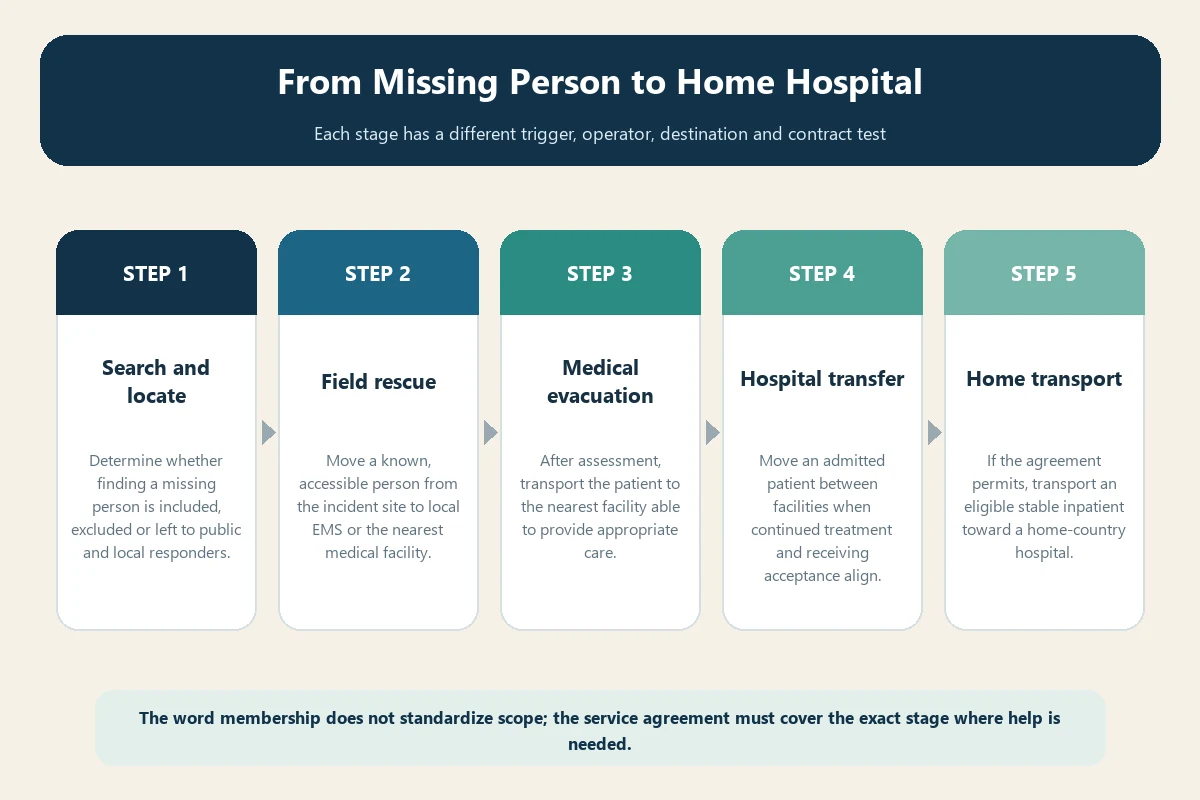
Start with the five-stage chain
- Search and locate: establish where the person is.
- Field rescue: move a known person from danger or an inaccessible setting.
- Emergency medical transportation: move an assessed patient to appropriate care.
- Interfacility transfer: move a patient between medical facilities.
- Home transport: move an eligible patient toward a hospital near or within home territory.
A single incident can use all five, but paying for stage five does not prove coverage for stage one. The membership-versus-insurance guide addresses product structure; this article focuses on where service begins and ends along the incident chain.
Search asks whether anyone must find you
Search is the effort to locate a missing, overdue, submerged, off-route, or unresponsive person whose position is not sufficiently known. It can require public authorities, park or maritime agencies, local teams, dive operators, aircraft, vessels, dogs, technical equipment, or volunteers.
A contract can cover transport after location is known while expressly excluding efforts to search. Ask whether the service needs coordinates, a confirmed incident site, a responder handoff point, or an accessible pickup. A satellite message that says “help” is not the same as a verified location and safe approach.
Field rescue connects the incident site to medical care
Field rescue may move a person from a trail, mountain, vessel, dive site, desert, island, vehicle, or other location to local emergency medical services or the nearest medical facility. It can use ropes, a litter, boat, vehicle, helicopter, or surface transport without being a hospital-to-hospital medical flight.
The mountain rescue coverage guide separates public rescue, technical extraction, ground ambulance, medical evacuation, and later repatriation. That separation is essential when evaluating a rescue membership.
Medical evacuation begins with assessment and destination need
Emergency medical transportation usually begins after a qualified medical assessment establishes that the patient needs movement to appropriate care. The destination can be the nearest facility able to evaluate or treat the condition rather than a home hospital.
The evacuation destination guide explains why the first medical destination differs from later hospital choice. Medical necessity, safe timing, mode, receiving capability, and authorization belong to the medical-transport stage.
Interfacility transfer is another handoff
After initial treatment, a patient may need a higher-level hospital, specialty unit, surgery, rehabilitation pathway, or continued inpatient care. That transfer can require sending records, physician-to-physician acceptance, a bed, safe transport, ground access, border permissions, and a documented provider decision.
The international hospital-transfer guide maps those gates. A rescue membership that ends at the first facility and a transport membership that begins after admission can meet at this boundary without either covering the entire journey.
Home transport is not implied by field rescue
A membership may provide transport toward a home-country hospital after hospitalization and stabilization. Another may stop at the nearest appropriate facility. “Repatriation,” “medical transportation home,” and “hospital of choice” can carry their own conditions, distance tests, product upgrades, or duration thresholds.
Do not infer home transport from the presence of a helicopter, global network, rescue hotline, or large benefit number. Copy the exact destination clause and continued-care requirement.
An official diving example shows the pre-medical boundary
Divers Alert Network’s official rescue-versus-medical-transport explanation distinguishes rescue before formal medical assessment from emergency medical transportation after assessment. It explains that its described evacuation benefit does not include searching for an unknown location or rescuing someone from a place inaccessible to emergency medical services.
That page describes DAN’s programs and should not be generalized to another provider. Its value is methodological: ask where professional medical assessment occurs and which party owns the stage before it.
A member agreement can divide rescue from search
A Global Rescue consumer member-services agreement provides one contract example. It describes local field rescue transport to the nearest medical facility for members meeting the criteria, while stating that services related to searching for members are not included. It separately describes medical transport to a home-country hospital of choice and a paid security upgrade.
This is not a recommendation or a universal definition. It demonstrates why “rescue membership” must be broken into location, access, first destination, later transport, security services, and exclusions.
An inpatient transport membership may start later
The July 2026 MedjetAssist annual rules illustrate a different starting point: current medical transport services turn on inpatient hospitalization, a stated distance from the residence address, medical assessment, stability, and receiving-hospital acceptance. The rules describe provider-arranged commercial escort, dedicated-aircraft, or ground modes.
That structure may add value after hospitalization while leaving search and initial incident-site extraction to local responders or another arrangement. Compare the exact agreement rather than assuming that all memberships overlap from field to home.
Use a service-scope worksheet
| Question | Why it changes the answer |
|---|---|
| Is the person’s location known? | Search may be excluded even when rescue is included. |
| Can responders reach the site safely? | Unsafe or inaccessible regions can defeat service. |
| Has a clinician assessed the patient? | Medical transport can begin after this handoff. |
| What is the first covered destination? | Nearest facility and home hospital are different endpoints. |
| Is inpatient admission required? | Some transport programs begin only after admission. |
| Who selects the mode? | The provider may control aircraft, escort, ground, or timing. |
| Can costs be self-arranged? | Service agreements may refuse reimbursement entirely. |
| Is security extraction separate? | Political or personal threats can require an upgrade. |
Helicopter does not identify the benefit
A helicopter can perform technical extraction, public search and rescue, a ground-to-hospital ambulance flight, an interfacility transfer, or a commercial air-ambulance mission. The aircraft is a mode; it does not tell you the trigger, payer, destination, or contract section.
The helicopter rescue guide shows how to identify the operator and purpose before assigning coverage. Ask for mission records that separate extraction time, medical crew, transport legs, and receiving facility.
Remote geography adds access limitations
Weather, darkness, altitude, sea state, borders, aviation permissions, local law, conflict, communications, and responder availability can make a theoretically covered service impossible. A provider can reserve discretion not to enter an unsafe or inaccessible area.
The remote-islands evacuation guide recommends documenting each island-to-boat-to-airfield-to-hospital handoff. Use the same method for a membership’s geographic boundary.
Price and a large benefit number do not reveal the covered stage
An annual fee, trip fee, stated aggregate, or “no additional transport cost” message does not identify whether search, technical rescue, first medical movement, hospital transfer, or home transport is included. It also does not reveal distance, trip-duration, activity, altitude, latitude, water, vehicle, advisory, pre-existing-condition, age, access, or inpatient restrictions.
Compare agreements with one concrete scenario at a time. Ask what happens if the person is missing but not located; located but beyond local emergency access; assessed at a small clinic; admitted to a capable regional hospital; discharged but unable to fly alone; or stable and accepted by a home hospital. Require the provider to identify the controlling definition and service section for each answer.
Coordination benefits are not the same as funded transport
A hotline may provide information, referrals, monitoring, translation, or coordination without paying the outside responder, rescue team, ambulance, hospital, aircraft, or onward travel. Conversely, an arranged-service benefit may pay an authorized operator but decline costs booked by the member, guide, family, or local authority.
Ask which services are advisory, which are arranged, which are paid directly, which are reimbursable, and which remain the member’s responsibility. Record the emergency number and the sequence for notifying local responders and the membership provider.
High-risk destinations need an independent plan
The U.S. Department of State’s high-risk-area guidance warns that U.S. government help can be limited or unavailable in some destinations. A private membership also cannot make an unsafe region accessible merely because dues were paid.
Before departure, identify local emergency numbers, the trip operator’s emergency action plan, nearest medical facilities, communications, extraction assets, weather limits, expected response times, government advisories, and an exit route that does not depend on one provider.
Medical-expense coverage remains separate
A rescue or transport membership may arrange movement without paying the emergency department, surgery, intensive care, medication, physician, deductible, or ongoing treatment. The CDC Yellow Book travel-insurance chapter recommends planning for both health care and evacuation resources.
Compare travel medical insurance, domestic health coverage abroad, evacuation benefits, memberships, activity coverage, operator arrangements, and public services as separate layers. A complete transport chain can still end at an unfunded hospital bill.
Prepare an incident-stage evidence file
- Last known location, tracking data, and witness report
- Emergency calls, responsible public agency, and incident number
- Search operator, field-rescue operator, and pickup coordinates
- Medical assessment, diagnosis, and first facility
- Membership number, agreement version, and case number
- Provider authorization and stated service stage
- Receiving physician, bed, route, and mode
- Self-arranged-cost instructions and written denials
- Aircraft, vessel, ambulance, and hospital records
- Timeline, receipts, unused credits, and handoff proof
The practical conclusion
Medical evacuation membership versus rescue membership is not a contest between two standardized products. It is a gap analysis across search, field extraction, first medical transport, hospital transfer, home transport, and sometimes security evacuation.
Draw the chain for the actual trip. Then require a written answer for who locates, who reaches, who medically assesses, who transports, where each stage ends, who controls the mode, and what happens when access is unsafe or costs are arranged independently. The uncovered stage—not the most impressive product label—is the risk to solve.
