

Travelers searching for a pre existing condition stability period in travel insurance often encounter three different concepts presented as if they were interchangeable. They are not. A policy may define a named stability period, use a look-back definition that examines recent medical events, or require a traveler to be medically able to travel when buying time-sensitive coverage. Understanding which test appears in the actual U.S. certificate is more important than adopting a definition from an article written for another country.
This guide explains the distinctions, the medical changes that may matter, and the documents to compare. It is educational rather than legal, medical, or coverage advice. Policy forms vary by insurer, state, plan, coverage, and edition, so only the certificate and endorsements issued for a specific purchase control.
What a stability period generally means
In ordinary language, a medical condition is stable when there has been no meaningful deterioration or change for a stated amount of time. A policy that formally uses a stability clause may define stability through events such as new symptoms, a physician visit, investigation, hospitalization, treatment, a prescription change, or a recommendation for care. The required duration and list of events come from that contract.
However, “stability period” is especially common in Canadian travel insurance materials. U.S. travel insurance certificates often express a similar underwriting boundary through a definition of pre-existing condition and a numbered look-back period instead. A U.S. traveler should therefore not import a Canadian 90-day or 180-day stability rule into a U.S. plan. The correct question is: what term, dates, and medical events does this particular state-approved certificate use?
The National Association of Insurance Commissioners advises consumers to understand a travel policy’s limitations and exclusions. The NAIC’s travel insurance market-conduct guidance further calls for clear disclosure of a pre-existing condition exclusion, any waiver availability, and the applicable definition. That makes the definition page—not a generic stability slogan—the right starting point.
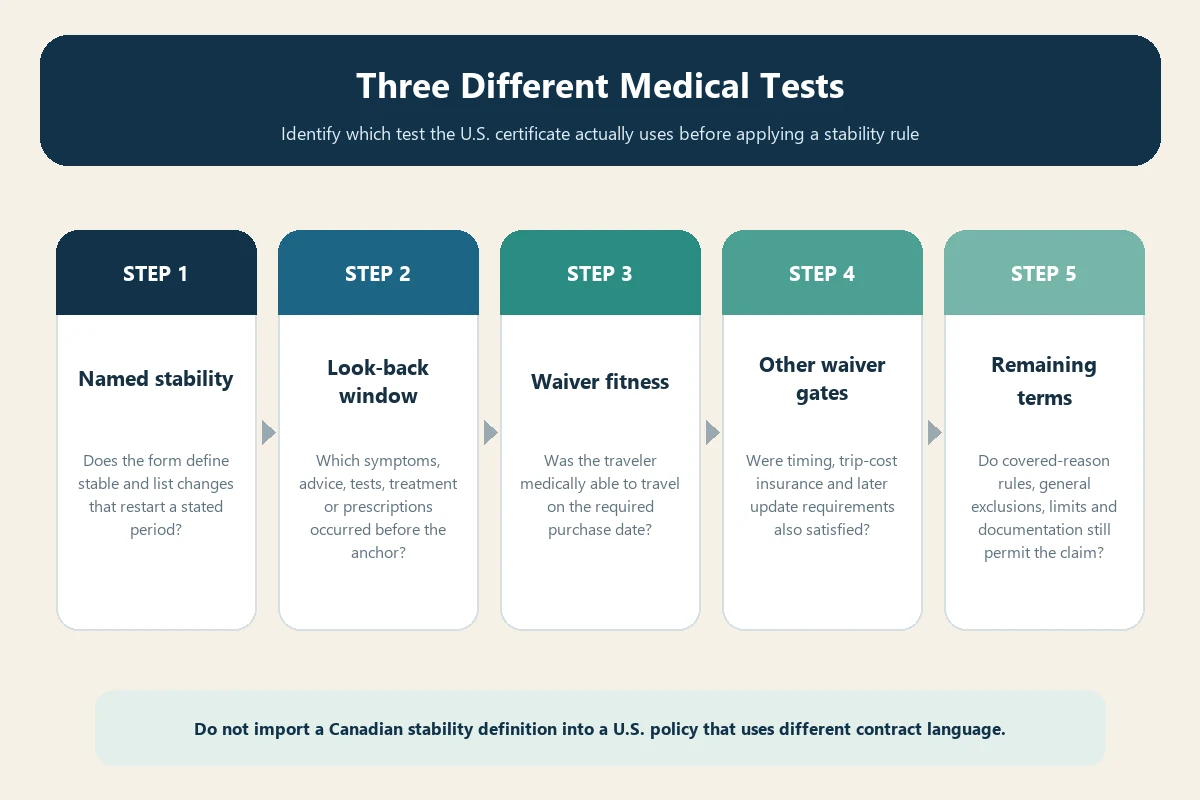
Stability clause, look-back period, and fitness to travel
These three tests can point to some of the same medical facts, but they answer different contractual questions.
1. A named stability clause
A named stability clause asks whether a condition remained unchanged according to the policy’s definition for a specified period. It may treat certain events as evidence that the condition was not stable. If this language exists, copy the definition and every cross-reference exactly; do not substitute a doctor’s everyday use of the word “stable.”
2. A pre-existing condition look-back definition
A look-back definition asks whether specified symptoms, care, advice, tests, treatment, or medication activity occurred during a window before an anchor date. A condition can feel controlled to the traveler yet satisfy a broad definition because a relevant event occurred within the window. Conversely, a longstanding diagnosis may fall outside a particular definition when there were no listed events during the reviewed dates—subject to all other terms.
Our guide to the pre-existing condition look-back period explains the structure. The related guide to travel insurance pricing with medical conditions shows why the medical definition is only one part of a plan comparison.
3. A medically-able-to-travel waiver requirement
Some plans offer a waiver of the pre-existing condition exclusion if every stated requirement is met. One requirement may be that the insured is medically able to travel when the coverage is purchased. That is a separate eligibility gate, not a synonym for a 60-day or 180-day stability period. Other gates can include buying within a deadline after an initial trip payment, insuring required trip costs, and updating coverage when costs change.
The current Travel Guard Washington sample certificate illustrates time-sensitive waiver language that includes medical fitness and trip-cost conditions. The Allianz Washington sample plan uses its own definition and waiver structure. These examples should be read as demonstrations of variation, not as promises about another issued policy.
Medical change matrix: events that deserve attention
The following matrix is a review tool. An event matters only as the applicable wording says it does, but marking these events helps prevent omissions.
| Medical event | Why it may matter | Evidence to keep |
|---|---|---|
| New or worsening symptom | Some definitions examine symptoms even before diagnosis. | Dated notes, messages, symptom log, visit records |
| Unscheduled clinician visit | May show advice, examination, or a change in condition. | Appointment summary, assessment, discharge instructions |
| Test ordered or pending | Investigation or recommended care may be listed in the definition. | Order, result, referral, follow-up plan |
| Medication started, stopped, or dose changed | Many forms scrutinize prescription changes, sometimes with narrow exceptions. | Old and new prescriptions, pharmacy history, clinician rationale |
| Hospitalization or emergency care | Strong evidence of recent treatment or deterioration. | Admission and discharge records, bills, test results |
| Routine refill with no change | Some forms expressly treat unchanged medication differently; others may not. | Prescription history and the exact exception wording |
| Planned follow-up or procedure | Ongoing or expected care may be distinct from an unforeseen emergency. | Care plan, referrals, scheduled appointment |
For ongoing prescriptions, see our guides to chronic medication and travel insurance and travel insurance for prescription medication. If treatment is intended to continue during the trip, review the separate issues in coverage for continuation of treatment. Planned care and an unexpected medical emergency do not necessarily receive the same treatment under a policy.
Four scenarios that show why the labels matter
A controlled diagnosis with no recent changes
Lena has diabetes, uses the same medication and dosage, attends only routine appointments, and has had no new symptoms for a year. She may describe the condition as stable. A policy review still requires the actual definition: does a routine appointment count, is unchanged medication expressly excluded from the trigger, and what are the anchor dates? She should not assume that good control either guarantees or defeats coverage.
Our guide to travel medical insurance for diabetes covers practical concerns such as supplies, prescriptions, emergency coordination, and benefit limits in addition to the pre-existing condition analysis.
A recent dose increase with improved symptoms
Andre’s dose was increased six weeks ago, and he now feels better. Clinically, his physician may consider him well controlled today. Contractually, a prescription change inside the look-back window may still be relevant if the definition lists it. If a named stability clause is used, the change might restart its clock. If Andre seeks a waiver, a separate medical-fitness requirement may also apply.
This is why the traveler’s own conclusion—”I am stable now”—cannot replace policy analysis. The correct sequence is to record the change, locate the exact provision, confirm the date boundary, and ask the insurer for a written response if uncertainty remains.
A new test with no confirmed diagnosis
Sofia has an abnormal result shortly before buying coverage, and her physician orders further testing. She has no diagnosis and expects the result to be benign. Depending on the wording, symptoms, tests, advice, or recommended care may be considered even without a final diagnosis. She should disclose requested information accurately and retain the order, result, referral, and follow-up schedule.
The same principle can apply to cardiac evaluations. Travelers can use our heart-condition travel insurance guide to identify emergency-medical and assistance questions, but the issued certificate remains controlling.
A traveler buys within the waiver deadline but is not cleared to travel
Marcus purchases a plan three days after his first trip deposit, apparently inside the advertised time-sensitive period. The day before purchase, however, his physician tells him not to take the trip until a new problem is evaluated. Meeting the purchase deadline alone may not satisfy a waiver if the form also requires him to be medically able to travel at purchase.
He should review all eligibility gates together using our pre-existing condition waiver guide. A deadline is only one part of the test, and a waiver does not transform every medical event into a covered loss.
How to compare plans without confusing the three tests
Create a three-column worksheet for every candidate plan. In column one, copy any named stability language. In column two, copy the pre-existing condition definition, look-back duration, and anchor date. In column three, copy every waiver requirement. If a column is absent, write “not found” rather than filling it with a rule from another policy.
- Confirm the state form and edition. Ask for the certificate and endorsements that would be issued for your residence and trip.
- Locate defined terms. Search for pre-existing condition, look-back, stable or stability, medically able to travel, treatment, and prescription.
- Build a dated medical timeline. Include symptoms, advice, tests, appointments, treatment, medication changes, and pending care.
- Calculate each deadline. Record the trip deposit date, policy purchase date, waiver deadline, cost-insurance requirement, and update deadline.
- Check the entire contract. A favorable pre-existing condition result does not erase general exclusions, coverage limits, covered-reason requirements, or documentation duties.
- Save written answers. Keep the quote, certificate, endorsements, receipts, trip invoices, and insurer communications together.
The insurer’s consumer guide to pre-existing medical condition travel insurance and Allianz’s explanation of existing medical condition coverage offer useful examples of insurer terminology. Use them to locate questions, then verify every answer against the actual plan document.
Stability does not answer every coverage question
Even when a condition falls outside a look-back definition or an exclusion is waived, a claim still must satisfy the policy’s other terms. The loss may need to be unforeseen, medically necessary, documented, and caused by a covered reason. Deductibles, benefit caps, emergency-assistance procedures, exclusions for particular activities, and rules concerning travel against medical advice may apply.
The CDC Yellow Book guidance on travel insurance encourages travelers to understand the limits of domestic coverage abroad and to plan for medical care and evacuation needs. That planning is broader than a pre-existing condition clause: it includes destinations, provider access, payment arrangements, evacuation logistics, and the traveler’s current medical needs.
The practical takeaway for U.S. travelers
Do not ask only, “How long must my condition be stable?” Ask whether the U.S. certificate uses a named stability clause at all, what its pre-existing condition definition examines, and whether a waiver has a separate medical-fitness test. Then map the exact policy language to a dated, documented medical timeline.
Travelers who need a complete purchasing sequence can follow our guide to getting travel insurance with pre-existing medical conditions. The goal is not to force every policy into one familiar label. It is to identify the contract’s actual tests before purchase, preserve evidence, and avoid relying on a stability rule that may belong to a different product or country.
Feeling stable and meeting a policy definition are different tests. Use the travel insurance controlled condition guide to compare symptoms, treatment, medication events, look-back wording and waiver requirements.
A symptom-free interval does not answer a recurrence claim by itself. Use the travel insurance recurring condition guide to map earlier episodes, recent treatment, the later flare-up and the issued policy wording.
