

Travel medical insurance continuation of treatment is an ambiguous phrase. It can mean treatment already scheduled before departure, follow-up after a new covered event abroad, care after the policy’s trip dates or simply extending the insurance itself. Those situations do not share one coverage answer.
This guide helps U.S. travelers classify expenses and compare certificates. It does not decide whether travel is medically appropriate, change a treatment plan or guarantee that care abroad is available.
Key takeaways
- Separate planned ongoing care from a new unexpected illness or injury.
- Classify recurrence, treatment complication, stabilization and follow-up with dated clinical facts.
- Do not confuse a benefit period with renewal or extension of the policy.
- Check travel-for-treatment, pre-existing-condition, routine-care and already-required-treatment exclusions.
- Coordinate clinical continuity and payment even when the travel plan does not cover the scheduled care.
Reviewed August 16, 2026. Coverage and medical suitability depend on individual facts and the issued certificate; obtain clinical advice and written insurer clarification.
Classify the treatment before reading benefits
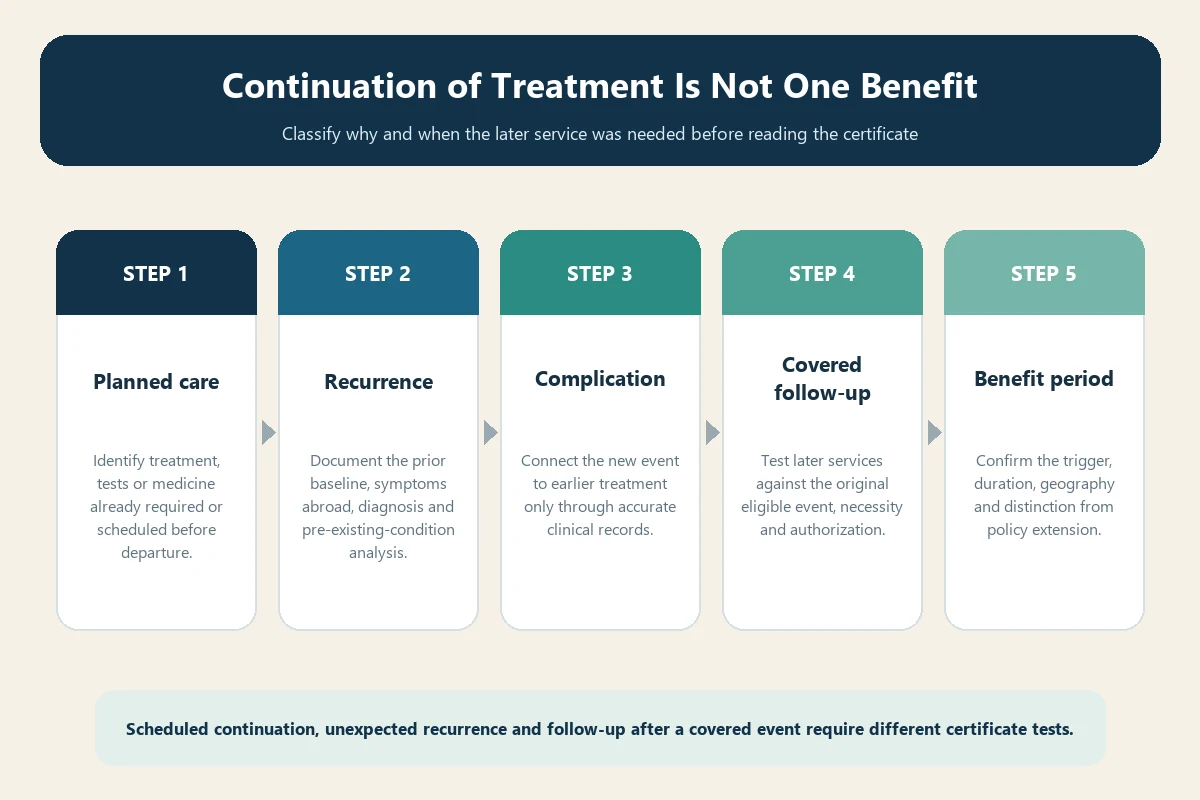
Place the expense into one of six groups: treatment already required before departure, routine monitoring, an unexpected recurrence, a complication of earlier care, follow-up after a new covered event, or care received during a stated benefit period after the trip.
Do not use “continuation” as the diagnosis. The clinical record should show what happened and why the service was needed.
Planned treatment is usually not an unexpected event
A pre-booked infusion, dialysis session, therapy visit, dressing change, surveillance test or medicine administration is known before travel. Short-term travel medical insurance is generally designed around unexpected eligible illness or injury, not financing an established treatment schedule.
Confirm the exact certificate. A current IMG sample contract, for example, excludes treatment or medication that was already required to continue during the trip. That is one policy example, not a universal rule.
Search for more than “pre-existing condition”
Planned care can be excluded by language about routine treatment, maintenance, scheduled services, travel for treatment, elective care or care required before departure even when a general pre-existing-condition waiver exists.
Search the certificate for required, recommended, scheduled, continued, maintenance, routine, follow-up, elective, medical tourism and purpose of travel.
Build a dated treatment timeline
List diagnoses, symptoms, procedures, admissions, clinician advice, scheduled appointments, prescriptions and dose changes. Add the policy purchase date, effective date, departure, event, first treatment and return.
The pre-existing-condition look-back guide helps connect medical facts to the certificate without assuming every chronic condition is handled identically.
Distinguish an unexpected recurrence
A recurrence can be sudden and clinically urgent while still relating to a known condition. Coverage depends on the pre-existing-condition definition, any valid waiver, stability language, exclusions and the facts at purchase and departure.
Document the prior baseline, onset abroad, symptoms, first contact, diagnosis and treatment. Avoid labeling the event “new” when the medical record says recurrence.
Test a waiver against every remaining exclusion
A qualifying waiver can remove a general pre-existing-condition exclusion under its stated conditions. It does not necessarily create coverage for scheduled treatment, medical tourism, routine care or travel against medical advice.
Use the waiver eligibility checklist and ask which exclusions remain operative after the waiver applies.
Classify a complication of earlier treatment
A complication can occur after a procedure or medicine administered before the trip. The certificate may connect the new expense to excluded prior care, or it may evaluate the event under separate complication wording. Clinical causation matters.
Keep records from the original treatment and the clinician abroad. Do not infer causation from timing alone.
Separate a new unrelated illness or injury
A traveler receiving ongoing care can still develop an unrelated infection, fracture or other event. Apply the certificate to the new diagnosis and services without assuming the ongoing condition excludes everything.
The primary care coverage guide helps document the first evaluation and referral path abroad.
Follow-up after a covered event is a separate question
If an eligible illness or injury begins during the trip, the initial visit may lead to repeat examination, imaging, medicine or therapy. Ask whether later care is covered, for how long, in which geographic area and only while the policy remains active.
The follow-up care guide provides an event-to-service timeline for later treatment.
Read the benefit period carefully
Some certificates define a benefit period for eligible treatment after the original event, potentially including limited care after the traveler returns home. The period can begin from injury, diagnosis, first treatment or another trigger.
A benefit period does not extend coverage to a new illness after the policy ends. It also does not remove the original event’s exclusions, limits or medical-necessity requirements.
Do not confuse benefit period with policy extension
Renewing or extending a policy changes the insurance dates according to its rules. It may not cover a condition that began before the extension, and a lapse can create a new pre-existing-condition problem.
Ask whether extensions are guaranteed, require health questions, preserve the original deductible and recognize claims already in progress.
Routine monitoring usually needs another payer
Regular laboratory work, surveillance imaging, specialist review and preventive checks are planned services. Arrange payment through the domestic or international health plan, self-pay agreement or another appropriate program rather than assuming emergency travel coverage.
The health insurance abroad guide helps identify domestic-plan gaps and payer order.
Ongoing medicine follows its own rules
A routine refill or dose is different from medicine prescribed for a new eligible event. Carry enough lawful medicine plus a delay buffer when clinically appropriate. Confirm storage, customs and transit rules.
The chronic medication guide separates planned supply, loss, replacement and emergency treatment.
Physical therapy can follow multiple paths
Therapy scheduled before the trip is ongoing planned care. Therapy recommended after an eligible injury abroad is follow-up, but it can still face a dedicated exclusion, visit limit, authorization rule or policy end date.
The physical therapy coverage guide provides a service-specific decision framework.
Understand travel for medical care
Traveling primarily to obtain a procedure or treatment is medical tourism, even when leisure activities are added. Standard travel medical insurance may exclude travel for the purpose of receiving medical advice or care.
CDC’s medical tourism guidance recommends planning accreditation, records, complications, financing and follow-up. It does not promise insurance coverage.
Do not travel against clinical advice
Some certificates exclude a trip taken against a physician’s advice or when the traveler is not medically fit. Ask the treating clinician about the itinerary, access to care and treatment schedule. Keep accurate documentation.
Do not request a generic “fit to fly” letter that conceals planned care. The insurer can ask for the underlying medical record.
Plan continuity even when insurance excludes it
Clinical continuity and insurance eligibility are different. Coordinate records, medicine, treating-clinician contacts, destination providers and a return-home plan. Determine who will pay each scheduled service.
CDC’s current chronic illness guidance recommends early planning, a clinician letter, adequate medicine and destination-care research.
Check provider capability and deposits
Confirm that the destination facility can deliver the required treatment and respond to complications. Ask about records, language, scheduling, infection control, accessibility, deposits and accepted payment methods.
The direct billing guide explains why a provider relationship does not guarantee cashless planned care.
Use emergency benefits for eligible emergencies
If the traveler develops an urgent problem, contact local emergency services and the assistance center when safe. The later claim is tested against the diagnosis, timing, pre-existing-condition rules, exclusions and medical necessity.
CDC’s travel insurance chapter advises verifying coverage, preauthorization, pre-existing-condition terms and up-front payment before travel.
Evaluate evacuation separately
An inability to continue planned care at the destination does not automatically qualify for medical evacuation. The certificate can require an eligible emergency, clinical necessity, insurer coordination and transfer to the nearest adequate facility.
The medical evacuation guide explains authorization, stabilization and receiving-facility rules.
Build a service-by-service claim file
Keep the policy, declarations, purchase timing, pre-trip records, treatment schedule, clinician advice, event notes, authorizations, itemized bills and proof of payment. Identify which services were planned and which followed the unexpected event.
Do not submit a combined clinic invoice without explaining each service. A claim examiner needs the clinical and financial chronology.
Compare common treatment scenarios
| Service | Classification | Primary certificate test |
|---|---|---|
| Infusion booked before departure | Planned continuation | Required or scheduled treatment exclusion |
| Unexpected unrelated infection | New illness | Illness benefit and exclusions |
| Problem caused by prior procedure | Treatment complication | Prior-care and complication wording |
| Repeat imaging after covered injury | Follow-up | Benefit period, necessity and authorization |
| Care after policy end | Post-trip or expired coverage | Benefit-period trigger and geographic terms |
Questions to ask before purchase
- Does the certificate exclude treatment already required or scheduled during the trip?
- How does it define travel for the purpose of medical treatment?
- Can a waiver affect planned-care exclusions, or only the general pre-existing-condition clause?
- What benefit period applies after an eligible event?
- May covered follow-up continue after return home, and where?
- How are policy extensions and conditions that begin before extension handled?
- What authorization and records are required for later services?
Bottom line
Travel medical insurance continuation of treatment is not a single benefit. Planned care, recurrence, prior-treatment complications, new illness, follow-up and post-trip care must each be classified and tested against the issued certificate.
Arrange clinical continuity and financing before departure even when the travel plan excludes scheduled services. For an unexpected event, preserve the timeline and link every later service to the correct benefit, authorization and coverage period.
