
Travel medical insurance for diabetes must be tested against the traveler’s history, the specific event abroad and every service claimed. A policy can treat diabetes as a pre-existing condition, offer a qualifying waiver, provide only a narrow acute-onset benefit, or exclude related treatment. Insulin supply, device failure and an unexpected complication may follow different clauses.
This guide supports insurance comparison and travel preparation for U.S. residents with Type 1 or Type 2 diabetes. It does not recommend a dose, storage method, fitness decision or treatment plan. Review those questions with the treating clinician and manufacturer instructions.
Key takeaways
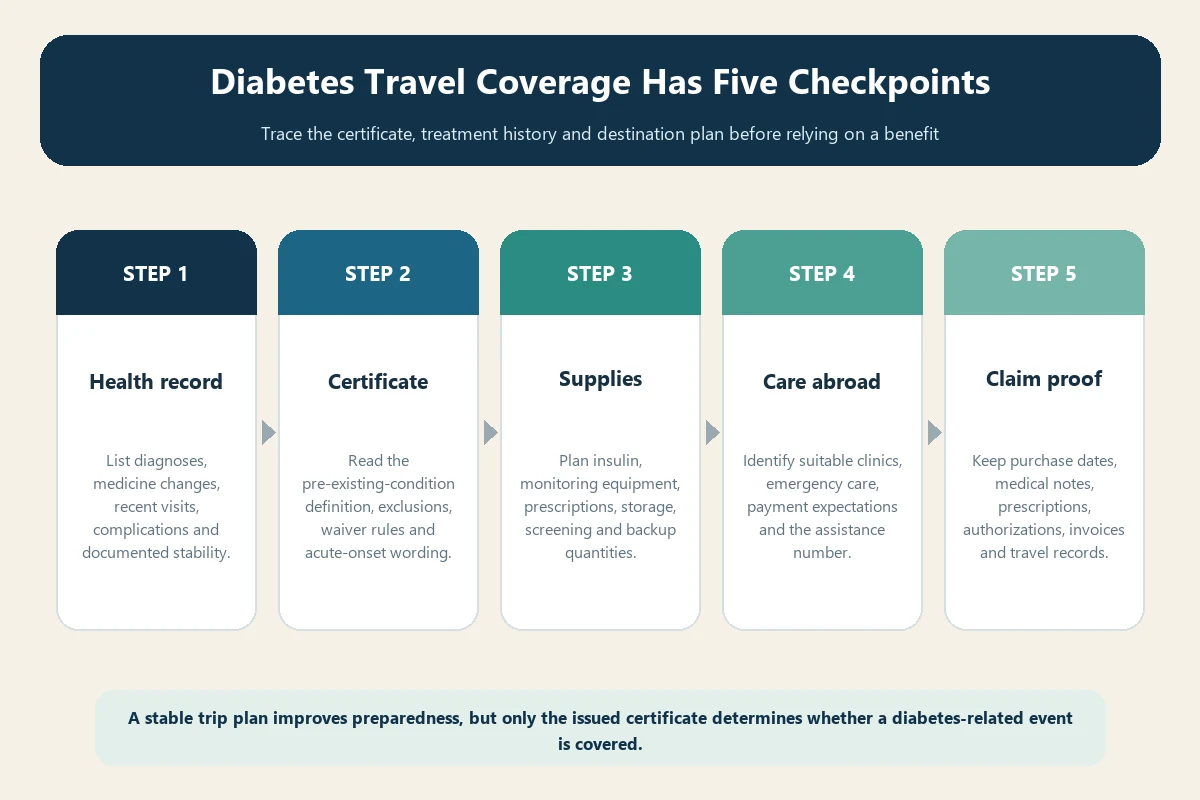
- Build a dated look-back history of symptoms, tests, visits and medicine changes before comparing policies.
- Classify routine insulin and supplies separately from emergency treatment for an unexpected complication.
- Ask whether pump, continuous glucose monitor and meter loss, failure or replacement fall under medical, baggage or equipment terms.
- Verify temperature control, power, transit-country and airline rules without assuming insurance pays for spoiled supplies.
- Keep clinician letters, generic medicine names, device details, treatment records and itemized receipts together.
Reviewed August 16, 2026. Policy forms and health needs change; verify the issued certificate and obtain individualized clinical guidance before travel.
Build a six-risk diabetes worksheet
Create rows for routine medicine, testing supplies, device failure, loss or theft, an acute complication and medical evacuation. Add the likely certificate section, exclusion, maximum, authorization rule and backup plan for each. This prevents one broad sales answer from being applied to unrelated costs.
The travel medical benefits guide explains why a named emergency benefit is only the beginning. Diabetes-related costs still have to pass definitions, pre-existing-condition wording and eligible-expense rules.
Map the pre-trip medical timeline
List clinician contacts, laboratory tests, urgent care, hospitalizations, symptoms, insulin changes, new medicines and device changes during the certificate’s look-back window. Include treatment recommended even if it was postponed. Use records rather than memory.
The look-back period guide turns common definitions into dated questions. Do not assume a routine refill is irrelevant until the actual wording is read.
Do not confuse clinical control with contract stability
A clinician may consider diabetes well managed while a policy still classifies it as pre-existing. Another form might focus on recent treatment, symptoms or changes. There is no universal market-wide stability period for diabetes travel insurance.
Ask the insurer which facts matter under the quoted form and save the response with the form number. Never delay necessary care or medicine adjustment to fit an insurance rule.
Evaluate a pre-existing-condition waiver
A waiver may remove the general pre-existing-condition exclusion when all eligibility requirements are met. Purchase timing, medical ability to travel, insured trip costs and later trip-cost updates can matter. A waiver does not automatically change routine-care, equipment or diagnosis-specific exclusions.
Use the waiver evidence checklist to preserve dates and receipts. Ask the insurer to identify exactly which clause is waived.
Review any acute-onset benefit separately
Some travel medical certificates provide a limited acute-onset benefit instead of a full waiver. The event may need to be sudden, unexpected and treated immediately. Age, maximum, evacuation and symptom requirements can narrow the benefit.
Do not infer eligibility from the phrase “acute complication.” Copy the full definition and test a concrete scenario against it.
Plan routine insulin and medicine supply
Daily medicine required before departure is usually a planned expense, not an unexpected travel event. Bring the lawful trip quantity plus a permitted delay buffer. Ask the domestic insurer or pharmacy about vacation overrides well before departure.
The chronic medication guide separates ordinary supply, a newly prescribed drug, loss and a flare-up. Use one row for each rather than submitting a mixed pharmacy receipt.
Prepare injection and monitoring supplies
List syringes, pen needles, lancets, strips, sensors, transmitters, chargers, batteries and backup meter supplies. Carry them in hand luggage when permitted. Ask the clinician for a letter explaining the medicines, equipment and need for sharps.
CDC’s current sick-abroad guidance specifically advises travelers who require regular injections, including insulin, to carry their supplies and a healthcare-professional letter.
Design a temperature-control plan
Follow the specific product’s storage instructions and the treating professional’s advice. Identify transport containers, permitted cooling materials, refrigerator access and a backup if hotel power fails. Do not place critical medicine where it can freeze or become inaccessible.
An equipment or baggage benefit may not reimburse medicine damaged by improper storage. Ask how accidental temperature damage is classified and what proof would be required.
Test pump and CGM failure
A failed pump, sensor or transmitter can create three costs: replacement hardware, replacement consumables and medical care needed because delivery or monitoring stopped. Check durable-medical-equipment, medical-supply, baggage and emergency-treatment clauses separately.
Carry the backup method recommended by the diabetes care team. Insurance is not an operational substitute for a safe failure plan.
Separate loss, theft and malfunction
A stolen kit may be a baggage claim. A device that stops working may be a warranty or equipment issue. A resulting diabetic emergency may be a medical claim. Preserve the police or carrier report, device error record, replacement invoice and clinical notes as distinct evidence.
The prescription medication guide applies the same separation to lost medicine and new treatment. Assistance locating a pharmacy does not guarantee reimbursement.
Define an acute diabetes-related event
Document symptom onset, glucose readings when available, action taken under the clinician’s plan, first request for help and first medical treatment. The overseas clinician should record the diagnosis, objective findings, medical necessity and treatment.
Do not ask a clinician to label an event for insurance purposes. Accurate medical documentation is more defensible and safer for subsequent care.
Test each emergency service
Separate physician care, laboratory tests, intravenous treatment, prescription drugs, ambulance, emergency department and hospitalization. Apply deductible, coinsurance, service sublimits and the overall medical maximum to each.
The policy limits guide helps model a full episode. A high headline maximum can still contain small equipment or prescription caps.
Check authorization and assistance rules
Emergency care may allow notice as soon as reasonably practical, while planned follow-up or transfer may require advance approval. Save the assistance number offline and record representative, time, reference number and instructions.
Authorization can help coordinate care without guaranteeing final claim payment. Ask which records the claims team requires.
Plan medical evacuation realistically
A serious complication in a remote location may require transport to the nearest adequate facility. Confirm whether diabetes-related events can qualify after applying the pre-existing-condition rule, who decides medical necessity and whether transport home is ever included.
The medical evacuation limits guide explains why eligibility and insurer control matter as much as the dollar maximum.
Check destination medicine and device rules
Verify every destination and transit country. Carry original packaging, prescriptions and a clinician letter using generic names. Check airline and security requirements for liquids, sharps, batteries and medical devices.
The U.S. Department of State medicine guidance recommends extra supply, original packaging and confirmation with foreign embassies because a medicine legal in the United States can be restricted abroad.
Identify destination care before departure
Research hospitals, pharmacies and clinicians capable of managing diabetes complications. Ask the assistance center about language support and direct-billing options. Confirm access on weekends, remote segments and cruise ports.
The CDC Yellow Book’s chronic illness guidance recommends preparing four to six weeks ahead, carrying extra medicine and obtaining a clinician letter that lists conditions, doses and equipment.
Prepare for up-front payment
Foreign facilities may require a deposit or full payment. Carry an emergency payment method within the traveler’s means and ask whether the plan can issue a guarantee of payment. Keep itemized invoices and payment proof.
The health insurance abroad guide helps compare domestic and travel coverage. If the travel plan is secondary, another insurer’s explanation of benefits may be required.
Build a claim file by event
For a medical episode, collect the diagnosis, onset, readings, treatment, prescriptions, itemized bills, payment proof and authorization. For loss, collect the loss report and replacement receipts. For device failure, retain manufacturer or technician evidence when available.
The claim documentation guide provides a ledger. Do not mix routine supply with emergency expenses on an unexplained total.
Apply current consumer guidance
NAIC’s current travel insurance guidance advises buyers to ask whether prior approval is required and whether pre-existing conditions are excluded. Apply those questions to each row of the six-risk worksheet.
The exact issued certificate is stronger evidence than a comparison-site badge, AI summary or generic promise that diabetes is “covered.”
Run a complete pump-failure scenario
Imagine a traveler’s pump fails during a remote segment. A backup method is used, but symptoms later require a clinic, testing and a new prescription. Test replacement hardware, consumables, the medical event, pre-existing-condition wording, authorization, transport and return-home follow-up separately.
The scenario reveals what a simple “yes” answer hides. It also identifies costs the traveler must be prepared to self-fund.
Ask these questions before buying
- How does the form define a pre-existing condition for diabetes?
- Is a qualifying waiver or acute-onset benefit available?
- Are routine insulin and monitoring supplies excluded as ongoing care?
- How are pump, CGM and meter loss, failure and replacement classified?
- Which acute complications and services can be eligible?
- Does medical evacuation apply after the pre-existing-condition test?
- Which authorization, payment and secondary-coverage rules apply?
- What documents are required for medical, baggage and equipment claims?
Make the final diabetes coverage decision
Select a plan only after a realistic scenario passes the look-back definition, waiver or acute-onset wording, eligible services, equipment terms, exclusions, authorization and limits. Obtain written answers tied to the exact form.
The complete plan combines appropriate clinical preparation, lawful extra supplies, equipment backups, destination care, emergency contacts and claim-ready evidence. Travel insurance is one financial layer within that system.
An insulin pump or CGM trip plan must protect therapy, insulin, sensors, power, connectivity, and a clinician-approved backup. Use this senior insulin pump and CGM travel insurance guide to verify screening, storage, device loss, delays, pre-existing conditions, and claims.
