

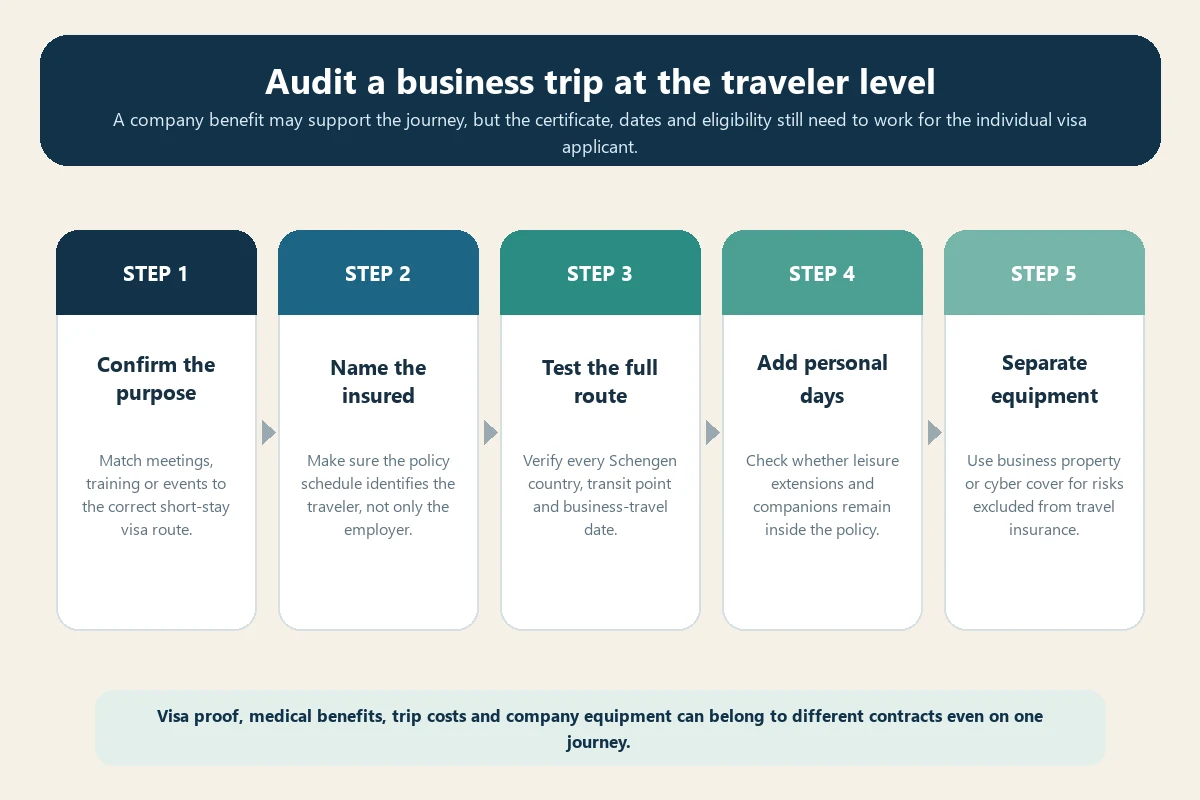
Schengen insurance for business travelers must work at the individual-applicant level, even when an employer arranges and pays for the trip. A company medical program, corporate card benefit or blanket travel policy may be useful, but the visa file still needs acceptable proof in the traveler’s name. The policy must also cover the actual countries and dates, including any personal days added to the business itinerary.
Key takeaways
- Confirm whether the activity fits a short-stay business visa or needs separate work authorization.
- An employer policy should produce a certificate that names the applicant and states the required coverage.
- Corporate medical, trip-cost, equipment and cyber risks may sit in different contracts.
- Personal side trips and companions can fall outside employer-paid coverage.
- Frequent travelers should check per-trip limits and carry fresh proof for every journey.
Begin with the purpose of the business trip
Meetings, negotiations, training, a conference and hands-on paid work are not always treated alike. The U.S. Department of State’s business travel and work abroad guidance tells travelers to research the visa required for the specific work and destination. An insurance certificate cannot correct an immigration category that does not permit the planned activity.
For a short-stay business visa, the common Schengen medical-insurance framework usually applies. The official Netherlands business-trip checklist, for example, separates the company invitation, accommodation, financial evidence, travel reservation and medical insurance. Its insurance proof must be in the applicant’s name, valid in all Schengen countries for the complete stay and show at least €30,000 for the listed medical needs.
Use the Schengen visa insurance requirements guide for the shared baseline. Then follow the current checklist of the authority handling the actual application.
Why “covered by work” is not enough
Corporate travel programs are built for administration. They may insure all eligible employees under one master contract, activate only after an approved booking, or require the employer to submit claims. That structure can still provide strong benefits. The visa question is narrower: can the traveler present clear, recoverable proof that satisfies the official checklist?
Ask the employer’s travel or benefits team for the certificate that will be issued. It should identify the insured traveler, destination territory, effective dates, medical amount and relevant benefits. A generic letter saying employees are covered worldwide may omit the fields a consulate needs. A wallet card is also not a substitute when the checklist calls for a certificate.
Run the document through the Schengen insurance certificate audit. If the corporate administrator cannot produce usable proof, the traveler may need a separate policy for the visa and journey.
Article 15 and the professional-situation exception
Article 15 of the EU Visa Code sets the short-stay travel medical requirements. It also says an adequate level of insurance may sometimes be presumed because of an applicant’s professional situation. The example given is particular professional groups, such as seafarers, who already have travel medical coverage through their work.
That paragraph is not a blanket exemption for every business traveler. Unless the responsible authority confirms otherwise, prepare qualifying evidence. Holders of diplomatic passports have a separate exemption in Article 15, but an ordinary employee on a client visit should not infer diplomatic or professional status from a company booking.
Separate four kinds of business-trip protection
| Protection | Main job | Frequent gap |
|---|---|---|
| Travel medical | Emergency treatment, hospitalization and covered assistance abroad | No clear individual visa certificate |
| Trip cost | Covered cancellation, delay and interruption expenses | Employer has refundable rates, while personal purchases are uninsured |
| Business property | Laptops, samples, tools and other company assets | Travel baggage limits exclude or restrict professional equipment |
| Cyber and liability | Data incidents or business liabilities | Ordinary travel insurance does not replace corporate specialist cover |
Do not expect a Schengen medical certificate to insure a stolen work laptop. Read the baggage definition, per-item limit, business-use exclusion and unattended-property clause. The U.S. State Department advises business travelers to discuss protection of information and devices with their employer. That is an operational and security task, not merely a baggage claim.
Map the complete itinerary, including personal days
A common business trip includes two nights of meetings followed by a weekend in another country. The employer policy may end when the approved business segment ends. A corporate booking system may also omit a separately purchased train, hotel or flight. Compare the policy’s trip definition with the complete real journey.
Create a day-by-day table with departure from the United States, Schengen arrival, meetings, personal extension, transit and final return. Use the Schengen insurance dates guide for overnight flights. If several countries are involved, use the multi-country coverage audit to test the full route.
A companion may be outside the company plan even when sharing every booking. A spouse’s nonrefundable costs and health coverage should be reviewed independently. The business traveler and companion can need different contracts, certificates and claim paths.
Check how the employer policy becomes active
Some company policies cover any authorized business journey. Others require booking through a named agency, use of a corporate card or written travel approval. A leisure extension may be covered only for a limited number of days. Ask these questions:
- Who is eligible: employees, contractors, interview candidates and companions?
- What event starts and ends an insured business trip?
- Must transport or accommodation be paid through a specific system?
- Are personal days, remote work and side trips included?
- Does a return home or change of work location end coverage?
- Who receives claim payments, the traveler or employer?
- Can the administrator issue a current certificate for a visa appointment?
Save written answers with the policy wording. A benefits summary can help orient the traveler, but the master policy and certificate control eligibility and claims.
Self-employed travelers and contractors
A consultant or contractor may travel at a client’s request without becoming eligible for the client’s employee policy. Confirm which party is responsible for insurance before accepting a booking. The business-visa file may also require a contract, tax record or other evidence of commercial relations. Keep that evidence separate from the medical certificate, and insure personally purchased transport or hotels when no company program covers them.
Emergency medical and evacuation questions
The U.S. Department of State’s health-abroad guidance says the U.S. government does not pay medical bills overseas and that deposits may be required. It also notes that many health plans do not pay for air-ambulance evacuation back to the United States.
Ask whether the corporate plan is primary or secondary, whether direct billing can be arranged and when assistance must authorize care. Read the evacuation destination definition. Many policies transport to the nearest suitable facility, not the hospital preferred by the traveler or employer. The primary medical coverage guide explains the claims sequence.
Frequent travelers and multiple-entry visas
A frequent-flyer policy may run for a year while limiting each journey to a shorter number of days. It may also count personal extensions differently from company travel. Check maximum consecutive days, total annual days, territory and renewal date.
For multiple-entry visa applications, Article 15 focuses submitted insurance proof on the first intended visit and requires acknowledgment of the need for later-trip coverage. The multiple-entry insurance guide explains that lifecycle. Carry a current certificate on every later trip rather than relying on an old application copy.
Business travel file checklist
- Passport and correct business-visa checklist.
- Company or event invitation with traveler, purpose and dates.
- Employer letter and financial arrangements where required.
- Insurance certificate in the applicant’s name.
- Full medical and evacuation policy wording.
- Written confirmation of leisure-day and side-trip coverage.
- Separate business-property and cyber procedures.
- Assistance contact stored online and offline.
Use the Europe policy comparison worksheet when a separate personal plan must fill employer-program gaps. Compare functions rather than paying twice for benefits already present.
Common mistakes
- Assuming employment automatically creates an Article 15 exemption.
- Submitting a general HR letter without an individual insurance schedule.
- Covering meeting dates but not travel and transit days.
- Adding a personal weekend without checking the employer policy’s trip definition.
- Treating a medical policy as equipment or cyber insurance.
- Failing to insure a companion who is not a company-plan member.
- Using an annual certificate after the policy renewed or the employee became ineligible.
Frequently asked questions
Does an employer letter replace Schengen travel insurance?
Not by itself. It can support the business purpose or describe a company plan, but the authority may still require evidence showing the applicant and the mandated medical details.
Does every business traveler need a Schengen visa?
No. Nationality, residence, trip length and activity determine the route. A visa-exempt traveler can still need medical protection and the correct permission for the planned work.
Can the company buy the policy?
Yes. Article 15 allows another person to take out insurance in the applicant’s name. The traveler must still be eligible and clearly identified.
Are personal days covered by corporate travel insurance?
Sometimes, but duration and activity limits vary. Obtain written confirmation for the exact extension, countries and companion arrangements.
Will Schengen insurance cover a work laptop?
Do not assume so. Baggage sections often have low per-item limits and restrictions on professional equipment. Check the contract and the employer’s property cover.
This article provides general travel and insurance information, not legal or coverage advice. Verify current visa instructions and employer-plan terms before departure.