

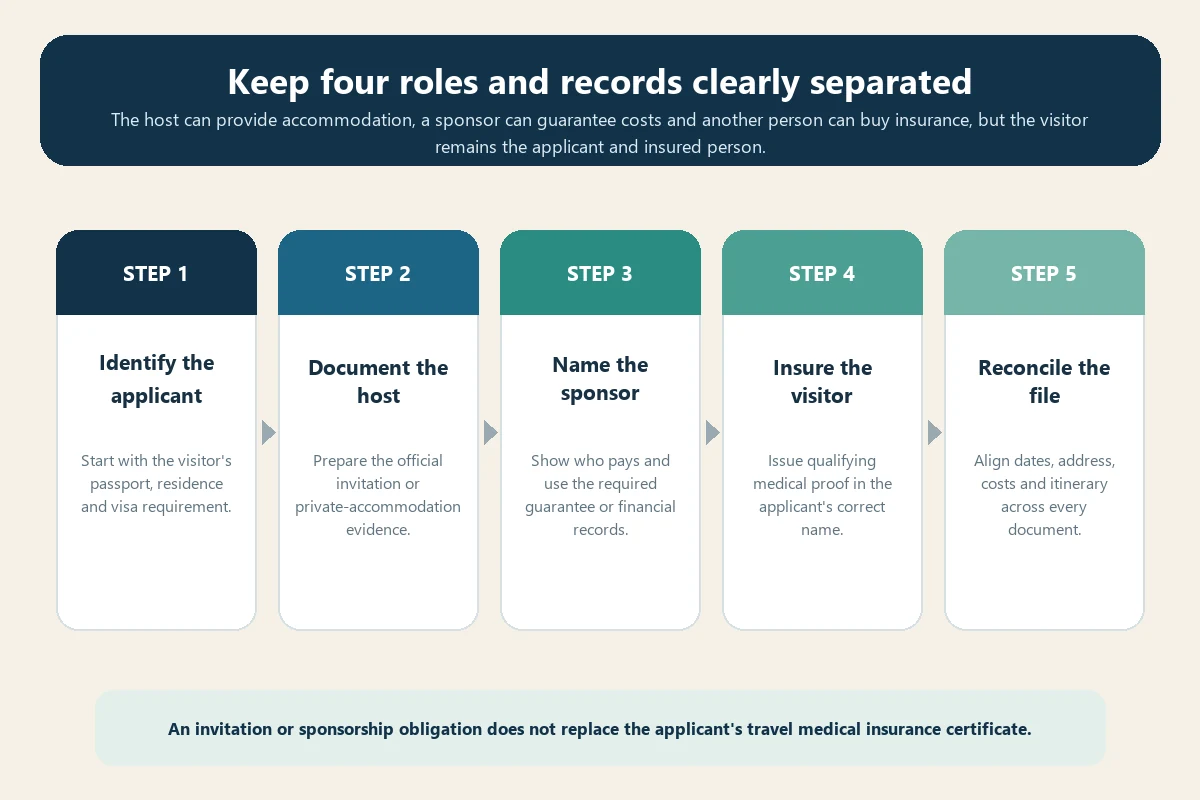
Schengen insurance for invitation visa visits remains the applicant’s medical evidence, even when a host provides accommodation or guarantees costs. An invitation letter, sponsorship form and insurance certificate answer different questions. The safest file identifies who is visiting, who is hosting, who is paying and who is insured, then keeps the names, dates and address consistent across every document.
Key takeaways
- The visitor applies for the visa; the host cannot replace the applicant’s form and evidence.
- Invitation, private accommodation, financial sponsorship and insurance can involve different roles.
- Another person may buy the insurance, but the certificate should identify the applicant.
- Sponsorship does not automatically replace the required travel medical proof.
- Dates, address, payer and itinerary should tell one consistent story across the file.
Understand the four roles in an invitation-based visit
Begin with four labels:
- Applicant: the traveler who submits the visa application.
- Host: the person or organization receiving the visitor.
- Sponsor: the person who guarantees some or all trip costs when required.
- Policy buyer: the person who pays for the insurance contract.
One individual can hold several roles, but that is not required. A friend may host the visitor, a parent in the country of residence may pay the trip costs and the visitor may buy the insurance. Write the names beside each role before collecting documents.
The official Netherlands invitation guide makes the central distinction clear: the friend or family member who needs a visa must apply for it. The host can support the application, but does not become the applicant.
What the invitation letter proves
An invitation supports the purpose and circumstances of the visit. Depending on the country, it may identify the parties, relationship, address, travel dates and reason for travel. It may be an ordinary signed letter or part of an official form. Private accommodation can require legalization or a municipal procedure.
The Netherlands family-and-friends checklist requires a completed proof of sponsorship and/or private accommodation form in relevant cases. It also separates that record from the travel reservation, financial evidence and travel medical insurance.
Switzerland uses its own official process. The Swiss State Secretariat for Migration FAQ says authorities may ask private or business visitors for a host-issued invitation. It describes a declaration of sponsorship as a guarantee of costs. Applicants must therefore use the destination’s current format rather than copying a template from another country.
What financial sponsorship proves
A sponsor demonstrates that required costs can be covered when the applicant does not show sufficient personal means. The guarantee can address subsistence, medical expenses or repatriation under the country’s form. Its legal duration and financial threshold can be broader than the insurance period.
Do not infer that a signed sponsorship form eliminates travel medical insurance. On the Dutch checklist, sponsorship and insurance appear as separate document sections. The sponsor may face liability for costs while the applicant must still show a qualifying policy.
The official Netherlands sponsorship guide says a sponsor acts as guarantor for costs relating to the stay, medical care and repatriation. It also describes when that guarantee ends. The insurance policy has its own benefits, exclusions and claims process. Both documents can be required because they serve different legal and financial functions.
Who may buy the travel medical policy?
Article 15 of the EU Visa Code says another person may take out insurance in the name of the applicant. A host or sponsor can therefore arrange and pay for the policy. The common coverage conditions still apply.
The critical phrase is “in the name of the applicant.” The certificate should identify the visitor who is insured. The host’s name can appear as purchaser or policyholder, but it should not leave the insured identity ambiguous. Confirm that the visitor meets age, residence and trip-origin eligibility rules.
The official Dutch insurance page says a sponsor in the Netherlands may take out insurance for the visitor. It also says the policy schedule must show the traveler is covered, all Schengen countries, the full stay and the required medical benefits.
Build the insurance certificate around the visitor
Request the exact document that will be submitted. Check:
- the applicant’s full passport name;
- the complete required coverage period;
- validity throughout the Schengen area;
- at least the required medical amount;
- emergency treatment, hospitalization and repatriation;
- insurer and assistance contact details;
- policy or certificate number;
- eligibility under the underlying terms.
Use the Schengen insurance certificate audit to review those fields. The minimum-coverage guide explains why the headline amount should be read with the benefits and sublimits.
Reconcile dates across the invitation file
Compare the invitation, accommodation, flight reservation, application form and insurance certificate. The intended entry and exit should agree unless a genuine reason is documented. If the host offers accommodation for only part of the visit, show where the applicant stays on the other nights.
An insurer may need to reissue the certificate after flights or appointment dates change. Do not edit a PDF manually. The Schengen insurance dates guide helps account for overnight flights, transit and the last day in the area.
The family relationship can also affect supporting records. A visitor staying with a sibling may need proof of relationship. A friend may need a different explanation of the connection. Follow the authority’s checklist instead of adding personal documents without purpose.
Visits that include more than one host or country
If the traveler will stay with one friend and later visit relatives elsewhere, build a continuous accommodation record. Identify the main destination under the official rules and show each address for the relevant dates. The insurance should remain valid across the complete Schengen route. One host’s invitation proves only the stay it actually describes; it should not be stretched to cover hotels, a second household or dates for which that host has no responsibility.
Who pays the premium and who receives a refund?
When the host purchases the policy, record the cancellation and refund terms before payment. If the visa is refused, the insurer may require an official refusal letter and may refund only the original payer. Some fees or elapsed coverage can be nonrefundable.
Ask what happens when the appointment is moved, the invitation dates change or the visitor withdraws. Confirm whether the effective dates can be shifted. A low premium is not helpful if the document cannot be corrected. The Europe insurance timing guide provides a purchase sequence.
A practical applicant-host handoff
| Record | Usually prepared by | Final check by applicant |
|---|---|---|
| Visa application | Applicant | Name, purpose, dates and signature |
| Invitation | Host | Relationship, address and visit period |
| Private accommodation | Host under destination procedure | Official form, legalization and address |
| Sponsorship | Sponsor | Payer, guarantee scope and required income proof |
| Insurance | Applicant, host or sponsor | Applicant named and all medical fields visible |
| Travel reservation | Applicant or payer | Itinerary matches every supporting document |
Share files through a secure method. The host should retain the records they may need at the border, while the applicant carries the appointment originals and copies. Both should know the insurer’s assistance number.
Invitation visit versus family application
An invitation-based visit describes the purpose and accommodation for a traveler visiting someone. A family application refers to several relatives applying to travel together. The situations can overlap, but the organization differs. When several applicants are involved, use the family visa insurance file guide to create a separate evidence set for each person.
For one visitor, keep attention on the applicant-host-sponsor distinction. For a household, multiply the individual checks rather than placing every certificate in one undifferentiated folder.
Common invitation-file mistakes
- Assuming an invitation letter is also an insurance guarantee.
- Naming the host on the policy while omitting the visitor as insured.
- Showing accommodation dates that conflict with the flight or insurance dates.
- Using a generic invitation template when the destination requires an official form.
- Failing to show who pays when the sponsor and host are different people.
- Submitting a bank card or insurer app screen instead of a certificate.
- Buying before checking refund and date-change rules.
Frequently asked questions
Does the host need to buy the visitor’s insurance?
No. The applicant can buy it, or another person can arrange it in the applicant’s name. The policy and certificate must still satisfy the official requirements.
Does a sponsorship form replace travel medical insurance?
Do not assume so. Official checklists can require both because a sponsor’s guarantee and an insurance contract serve different purposes.
Should the host’s address appear on the insurance certificate?
Only if the insurer or authority requires it. The essential issue is correct applicant identity, dates, territory and benefits. Other documents establish accommodation.
Can insurance cover several invited visitors?
A group contract can cover several people, but each applicant should be clearly identifiable. Separate certificates may simplify individual review.
What if the host pays only accommodation?
State that arrangement accurately. The applicant or another sponsor may prove the remaining costs. Do not make the invitation promise expenses the host will not cover.
This guide offers general document and insurance information, not legal advice. Invitation, sponsorship and visa procedures can change; verify the current official checklist for the responsible authority.