

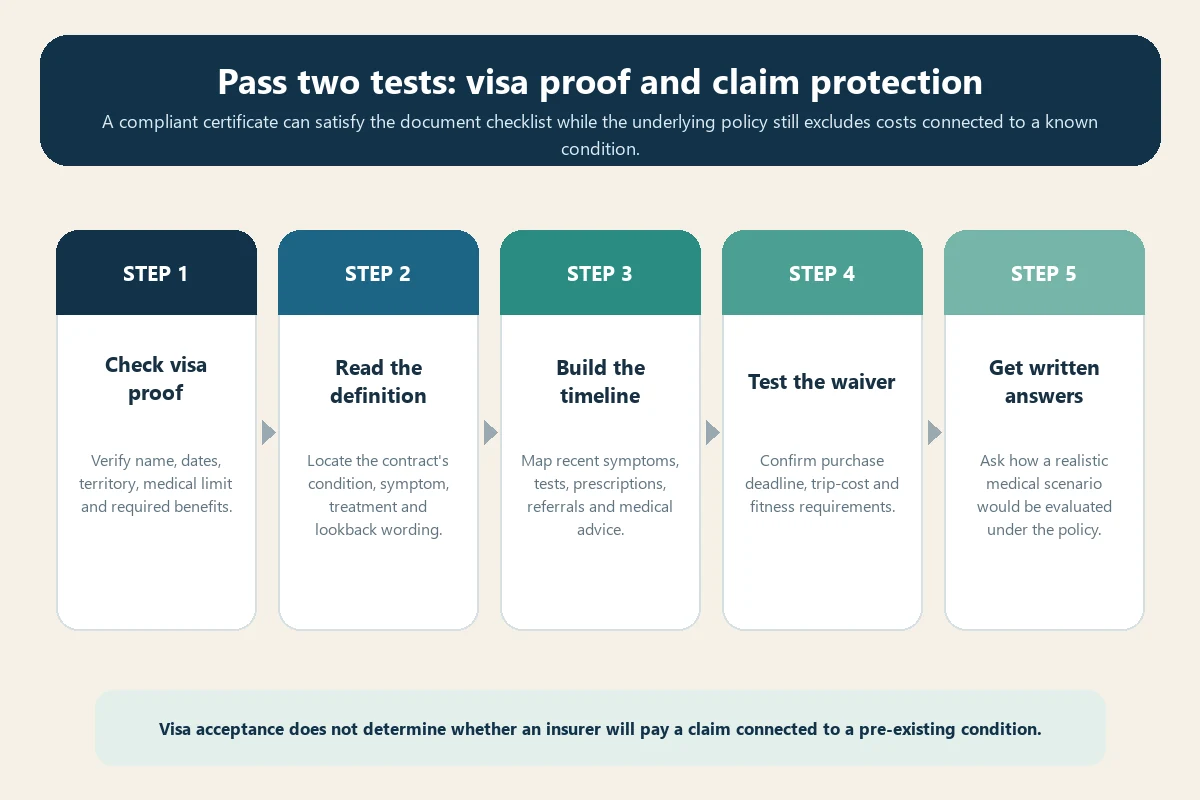
Schengen insurance for pre existing conditions involves two separate tests: whether the certificate satisfies the visa document rule and whether the policy will pay a claim connected to the traveler’s medical history. A plan can pass the first test and fail the second. Applicants should audit the official visa fields, then read the condition definition, lookback period, exclusions, waiver and claim procedure.
Key takeaways
- Visa compliance does not guarantee coverage for a known medical condition.
- The contract’s definition controls; a stable condition can still be pre-existing.
- Lookback periods review symptoms, treatment, tests, prescriptions and medical advice.
- A waiver may remove an exclusion only when every timing and eligibility condition is met.
- “Acute onset” is a narrow defined benefit, not a synonym for full coverage.
Pass the visa-certificate test first
Article 15 of the EU Visa Code requires adequate and valid travel medical insurance for uniform-visa applicants. It describes the required territory, period, €30,000 minimum and benefits involving urgent care, hospitalization, repatriation and death.
The provision does not say that every known condition must be covered. Consulates evaluate adequate and recoverable insurance under the rule, but an accepted document does not interpret every exclusion in a future claim. The official Netherlands insurance page focuses on the insured person, Schengen-wide validity, complete stay, medical amount and stated benefits.
Use the Schengen visa insurance requirements guide to verify the baseline. Check the certificate audit for name, dates, territory and visible benefits. Then begin a separate claim-coverage review.
Why certificate acceptance and claim coverage differ
A certificate is a summary. It normally does not display every exclusion, definition or condition. The policy wording governs whether a specific expense is covered. An applicant with a heart condition may submit a certificate showing €50,000 of emergency medical coverage, yet the contract may exclude losses caused by symptoms or treatment during a stated lookback period.
Do not ask only, “Is this Schengen compliant?” Ask two questions:
- Will the responsible visa authority accept the issued proof for this application?
- How would the policy evaluate a realistic event related to the traveler’s health history?
The first answer comes from the official checklist and certificate. The second comes from the full policy, endorsements and written explanations from the insurer.
Read the policy’s definition word by word
Policies define pre-existing conditions in different ways. The definition can include a diagnosed illness, an undiagnosed symptom, treatment, a medical consultation, a prescribed test or a medication change. It may examine the insured traveler, a traveling companion, a family member or another person whose health could trigger cancellation.
Highlight these terms:
- Condition or sickness: determine whether symptoms count before diagnosis.
- Treatment: check whether routine visits, advice or refills qualify.
- Lookback period: identify the exact days before the controlling date.
- Stability: locate rules for symptoms, tests, dosage and recommended care.
- Foreseeable event: read how known risk affects cancellation and medical claims.
- Excluded person: identify whose medical history is examined.
The lookback-period guide explains the calendar mechanics. Do not replace the policy’s words with an insurer representative’s broad summary.
Build a factual health timeline
Privately list recent symptoms, diagnoses, appointments, emergency visits, tests, referrals, medication starts, dose changes and recommended procedures. Add the policy purchase date and departure date. The goal is not to diagnose coverage. It is to identify which facts require a precise question.
A traveler who feels well can still have a pre-existing condition under the contract. A routine medication adjustment can fall inside the definition. Conversely, an unrelated injury abroad may be covered even when the traveler manages a chronic illness. Causation and policy wording matter.
Answer application questions accurately. Hiding medical facts can create a separate misrepresentation issue. Send only information needed through a secure channel and retain the written response.
Waivers can remove an exclusion, subject to conditions
A pre-existing condition waiver does not make every loss covered. It typically removes a named exclusion when purchase timing, trip-cost and eligibility rules are satisfied. Conditions can include buying within a short period after the initial deposit, insuring the full prepaid nonrefundable cost and being medically able to travel on the purchase date.
The NAIC travel-insurance market standards tell reviewers to examine whether consumers receive information about pre-existing condition exclusions, waiver availability, waiver circumstances and policy definitions. That reinforces a practical point: the exclusion and waiver should be disclosed and read before purchase.
Use the pre-existing condition waiver guide to verify timing and continuing obligations. Save proof of the first deposit, every added trip cost and the policy purchase.
Do not confuse acute onset with comprehensive coverage
Some visitor medical policies advertise coverage for the acute onset of a pre-existing condition. This is a defined benefit with strict triggers. It may require a sudden, unexpected event, immediate treatment, a physician’s recommendation and an age or amount limit. Chronic worsening, routine care or a known recurrence can be excluded.
Read the exact definition and sublimit. Ask for a worked example based on the traveler’s condition without asking the salesperson to provide medical advice. If the response is only “emergencies are covered,” request the contractual section supporting that answer.
Compare five possible policy outcomes
| Policy structure | What it may mean | Required check |
|---|---|---|
| Full exclusion | Claims caused by a defined prior condition are not covered | Who and what facts fall inside the definition? |
| Waiver | The exclusion is removed when stated conditions are met | Purchase deadline, trip cost and fitness requirements |
| Acute-onset benefit | Narrow emergency protection subject to a separate definition | Trigger, age, limit, timing and exclusions |
| Stable-condition cover | Coverage may depend on no relevant change during a stated period | How symptoms, tests and prescriptions affect stability |
| Underwritten cover | The insurer evaluates disclosed medical history | Decision, exclusions, premium and written endorsement |
These structures are not equivalent. Compare the policy that actually applies to the traveler, state of purchase, residence and trip. The medical-condition insurance guide provides a broader shopping framework.
Travel health planning still matters
The CDC’s travel insurance and medical evacuation chapter notes that specialized coverage can be especially useful for travelers with existing medical conditions. Insurance is only one part of planning. Carry enough medication, know generic names, confirm destination restrictions and identify appropriate care.
The U.S. Department of State’s health-abroad guidance says travelers are responsible for overseas medical bills and that deposits may be required. Ask whether the policy can arrange direct payment, whether the traveler pays first and how quickly assistance must be contacted.
Discuss fitness to travel and contingency planning with a qualified clinician. An insurer can explain contract terms but cannot replace medical advice.
Questions to send the insurer in writing
- Which policy definition of pre-existing condition applies?
- What date begins the lookback period?
- Do symptoms without diagnosis count?
- Does a routine refill or dose change affect eligibility?
- Is a waiver available, and what is every condition?
- Does the policy use an acute-onset or stability definition?
- Would a described emergency related to the known condition be excluded?
- Does any medical sublimit differ from the certificate’s headline amount?
- What records are required for a claim?
- Can the answer be confirmed in a policy endorsement or written explanation?
Do not request a guarantee that no reviewer can responsibly make before a claim. Seek clarity about the clause and realistic facts. Save the response with the full contract version.
Medical claim document file
Carry the certificate, policy, assistance number and concise medical information. Retain purchase receipts, booking records and waiver evidence. If care occurs, collect the clinician’s report, diagnosis, itemized bill, proof of payment, prescriptions and any assistance authorization.
Follow the notice deadline. Ask the provider for records before leaving the country if possible. A claim administrator may request earlier medical records to apply the lookback definition. Review the authorization scope and respond accurately.
Common mistakes
- Assuming an accepted visa certificate means the condition is covered.
- Reading only the €30,000 headline and not the exclusion.
- Using the everyday meaning of “stable” instead of the contract definition.
- Buying after a waiver deadline and expecting an exception.
- Insuring only the first deposit while later nonrefundable costs remain undeclared.
- Treating acute-onset language as full existing-condition coverage.
- Failing to disclose requested medical information accurately.
Frequently asked questions
Does Schengen visa insurance have to cover every pre-existing condition?
The Visa Code states the common medical, territory, time and amount requirements. Claim coverage for a known condition depends on the policy’s definitions and exclusions. Follow any additional instruction from the responsible authority.
Can a visa be issued if the policy excludes a condition?
Visa decisions belong to the authority. An accepted certificate does not promise claim payment. Applicants with a specific consular instruction should obtain evidence that matches it.
What is a lookback period?
It is a contract-defined period before a controlling date during which the insurer reviews medical facts such as symptoms, treatment, tests or medication changes.
Does a waiver cover routine care abroad?
Not necessarily. A waiver generally removes a pre-existing condition exclusion for otherwise covered losses. Routine or planned care can remain outside the policy.
Should the medical condition appear on the visa certificate?
Normally the certificate summarizes the insured person, dates, territory and benefits rather than private diagnoses. Follow the authority’s requirements and protect medical privacy.
This article is educational and is not medical, legal or insurance advice. Policy terms and visa instructions vary; consult the responsible authority, insurer and clinician for the traveler’s situation.
