

Schengen insurance for retirees needs more than a search for the largest medical limit. A useful policy must accept the traveler’s age, address relevant health history, last for the real itinerary and match the correct immigration route. A short European visit follows one framework. A retirement residence or other stay beyond 90 days may require country-approved health insurance under national rules.
Key takeaways
- Separate short Schengen travel from a national retirement or residence application.
- Medicare usually provides little or no coverage outside the United States, subject to limited exceptions.
- Age limits can affect eligibility, price, benefits, renewal and trip-duration options.
- Existing-condition rules depend on contractual definitions and timing, not everyday language.
- Long stays require careful review of per-trip limits, extensions and resident health-insurance rules.
Choose the travel or residence route first
A U.S. retiree taking a vacation of up to 90 days is usually planning a short stay. Nationality determines whether a visa is required, but medical protection still deserves attention. A traveler planning to live in one country for six months or a year normally needs a national visa or residence route. The EU Immigration Portal points people staying beyond 90 days to national requirements.
For a short-stay visa application, the Schengen visa insurance requirements guide explains the common travel medical baseline. For residence, open the official page for the destination and exact category. Do not assume that a policy described as Schengen compliant will satisfy a resident health-insurance condition.
Spain’s non-working residence visa instructions demonstrate the distinction. They require public or private health insurance from an entity authorized to operate in Spain, with coverage comparable to the public health system. The page says travel insurance is not accepted. Other countries and categories may use different standards.
What Medicare does outside the United States
The official Medicare travel page says Medicare usually does not cover health care outside the United States. It describes limited situations involving Canada, travel between Alaska and another state, or a foreign hospital closer to a U.S. residence. Those exceptions should not be treated as general European coverage.
Medicare also warns that travel insurance does not necessarily include health insurance. Read restrictions carefully. Some Medicare Supplement policies provide foreign-travel emergency benefits. The official Medigap overview identifies plans that may include this benefit. The member must still verify the plan, deductible, percentage, lifetime maximum and the time window after leaving the United States.
Make a written benefits record before buying another policy. Note what Medicare, Medigap, employer retiree cover or a private plan pays abroad. Then compare the uncovered needs. A card in a wallet is not proof that European treatment will be paid.
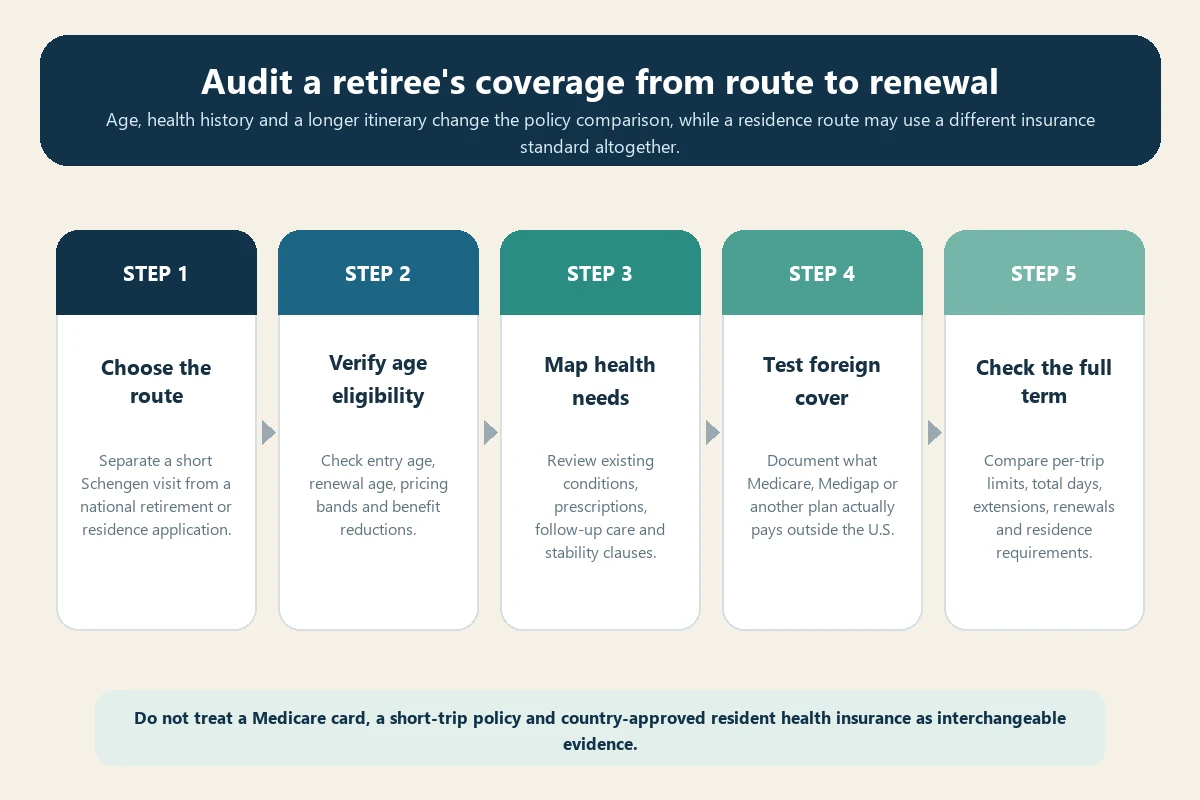
Age limits have several forms
A policy may be available to older travelers yet change after a particular birthday. Check each of these clauses:
- Maximum age at purchase: the traveler may become ineligible before the planned booking date.
- Age at departure: eligibility may be tested when the trip begins rather than when the policy is bought.
- Benefit reduction: medical, evacuation or cancellation limits may decrease in older bands.
- Trip-duration cap: the maximum insured journey can become shorter at higher ages.
- Renewal age: a long-stay plan may not renew after a specified age.
- Premium band: a birthday before departure can change the rate or require new underwriting.
Ask the insurer which date controls every age test and obtain the answer in writing. The senior travel insurance age-band guide provides a comparison method. Travelers seeking higher medical protection can also use the senior medical insurance guide for Europe.
Existing conditions require a definition-by-definition audit
A stable condition in ordinary conversation may not satisfy an insurer’s stability rule. Policies can look back over a stated period before purchase or departure. A medication change, new symptom, test, referral or recommended treatment may affect eligibility. The result depends on the exact contract and facts.
Build a private timeline of diagnoses, recent appointments, medication changes, pending tests and planned procedures. Do not send unnecessary medical detail to a seller, but answer application questions accurately. Ask how the policy defines treatment, symptom, change and stability. If uncertainty remains, request a written coverage explanation.
The pre-existing condition lookback guide explains the mechanics. Some policies offer a waiver when the plan is purchased within a defined period and other conditions are met. Review the waiver eligibility checklist before that deadline passes.
Prescription and routine-care planning
Emergency medical insurance is not designed to refill every routine prescription or manage ongoing care. Speak with treating clinicians before departure. Carry a medication list with generic names, doses and relevant allergies. Confirm destination rules for controlled substances, refrigeration needs and permissible quantities through official sources.
For a longer stay, identify a local physician, pharmacy and method for transferring records. Ask whether routine monitoring, specialist visits and chronic prescriptions are included in the resident plan. If they are excluded from a travel plan, budget for them separately rather than assuming every medical expense is covered.
Compare short-trip policies for the risks that matter
| Policy area | Retiree-specific test | Evidence to save |
|---|---|---|
| Emergency medical | Do age or condition sublimits reduce the advertised maximum? | Benefits schedule and age endorsement |
| Evacuation | Who decides medical necessity and destination? | Evacuation clause and assistance number |
| Existing conditions | What lookback, stability or waiver rules apply? | Definitions and waiver confirmation |
| Trip duration | Does the maximum cover every day away from home? | Policy period and per-trip limit |
| Return home | Does a brief return terminate or reset coverage? | Home-country and trip-definition clauses |
| Claims | Is preauthorization required except in a true emergency? | Claims procedure and contact record |
Use the Europe policy comparison worksheet to place these answers side by side. A high limit is valuable only when the traveler, event, country and complete trip meet the policy conditions.
Long trips expose duration and renewal traps
An annual multi-trip plan may cover many journeys but limit each one to 30, 45 or 60 days. A single-trip plan may allow a longer journey yet impose a hard maximum. Some contracts do not permit extensions after departure. Others require an extension before the original period ends and do not cover events that have already occurred.
Record the maximum consecutive days, aggregate annual days, home-return rule and renewal date. Test the itinerary against all four. If the trip approaches a boundary, use the insurance extension guide before departure. Do not rely on an assumed grace period.
Immigration time is separate. The Schengen short-stay calculation still applies even when an insurance policy lasts longer. Insurance cannot authorize an overstay. A national residence permit may allow mobility elsewhere in Schengen, but its health plan may remain country-focused.
Emergency assistance should be usable in practice
Save the assistance number in each traveler’s phone and on paper. Confirm whether the service operates at all hours and whether collect calls, an app or an online portal are required. Ask when preauthorization is needed, how direct payment works and what records must be collected if the hospital demands payment.
Travel companions should know the policy number, allergies, medications and emergency contacts. A concise medical summary can help when the insured person cannot explain. Protect sensitive information, but do not make it inaccessible during an emergency.
Retiree insurance file checklist
- Passport-name certificate and correct dates.
- Full policy wording, benefits schedule and exclusions.
- Written age-eligibility and renewal confirmation where needed.
- Existing-condition or waiver confirmation.
- Medicare, Medigap or retiree-plan foreign coverage details.
- Assistance and claims contacts stored online and offline.
- Medication list, clinician contact and relevant medical summary.
- Official national visa insurance checklist for a residence application.
If a certificate is needed for a visa, audit the identity, territory and dates with the Schengen insurance certificate guide. Carry a fresh copy rather than an unreadable screenshot.
Frequently asked questions
Does Medicare cover a medical emergency in Europe?
Usually not. Medicare describes only limited foreign-care exceptions. A Medigap plan or another policy may provide some foreign emergency coverage, but the member must verify the specific contract.
Is travel insurance accepted for a European retirement visa?
Not always. Some national routes require comprehensive health insurance from an approved provider and expressly reject ordinary travel insurance. Follow the destination’s official category page.
Can a traveler over 75 or 80 obtain Schengen insurance?
Policies exist for many older ages, but eligibility, benefits, price and maximum duration vary. Compare the actual age clauses and confirm which date controls.
Will a policy cover an existing heart condition or diabetes?
It depends on the definitions, recent medical history, stability rules and any waiver. Do not assume that “emergency coverage” includes every event related to an existing condition.
Should a couple buy one policy?
A joint purchase can be convenient, but each traveler must meet eligibility and be clearly identified. Benefits, medical histories and claims are still evaluated under the contract for each insured person.
This guide is educational and does not provide medical, legal or insurance advice. Verify current government requirements, Medicare benefits and policy terms before travel or a residence application.
