

Schengen insurance for family visa application files should be organized as one shared journey plus one complete evidence set for every applicant. A family may buy one group policy and attend a coordinated appointment, but each adult and child remains an individual applicant. Names, passport details, insurance certificates, forms and supporting records must work when reviewed separately.
Key takeaways
- Create an individual checklist and folder for each traveler, including every child.
- A parent or another person may arrange insurance, but the evidence must identify the applicant.
- Shared travel dates should match across forms, reservations and certificates.
- Minor applications can require parent signatures, consent and custody documents.
- Audit every PDF independently before merging the family appointment file.
A family application is a set of individual applications
The harmonized Schengen visa application form records one applicant’s identity, passport, journey and signature. It contains specific handling for minors and a signature by the person exercising parental authority or legal guardianship. A family booking does not replace these individual forms.
Official consular instructions reinforce this structure. The Spanish Consulate in Washington Schengen page states that each applicant completes the application form and explains signature handling for minors. It also asks for an insurance-company certificate that identifies the applicant and relevant coverage.
Start with the Schengen visa insurance requirements guide for the common baseline. Then use the responsible consulate’s current checklist for every family member’s nationality, age and circumstances.
Can one person buy insurance for the whole family?
Often, yes. The consolidated EU Visa Code says another person may take out insurance in the applicant’s name. The required conditions still apply. A parent can therefore pay or arrange a group policy, but payment ownership and insured identity are different concepts.
Before purchasing, list every traveler exactly as shown in the passport used for the application. Check name length, hyphens, suffixes and multiple surnames. Add birth dates and passport numbers if the insurer uses them. After issue, open each certificate and verify that no child was omitted and no name was shortened into ambiguity.
A single family certificate can be usable when it clearly lists all insured people and the authority accepts that format. Separate certificates can make individual review easier. Ask the insurer what it produces and compare the sample with the consular instruction before paying.
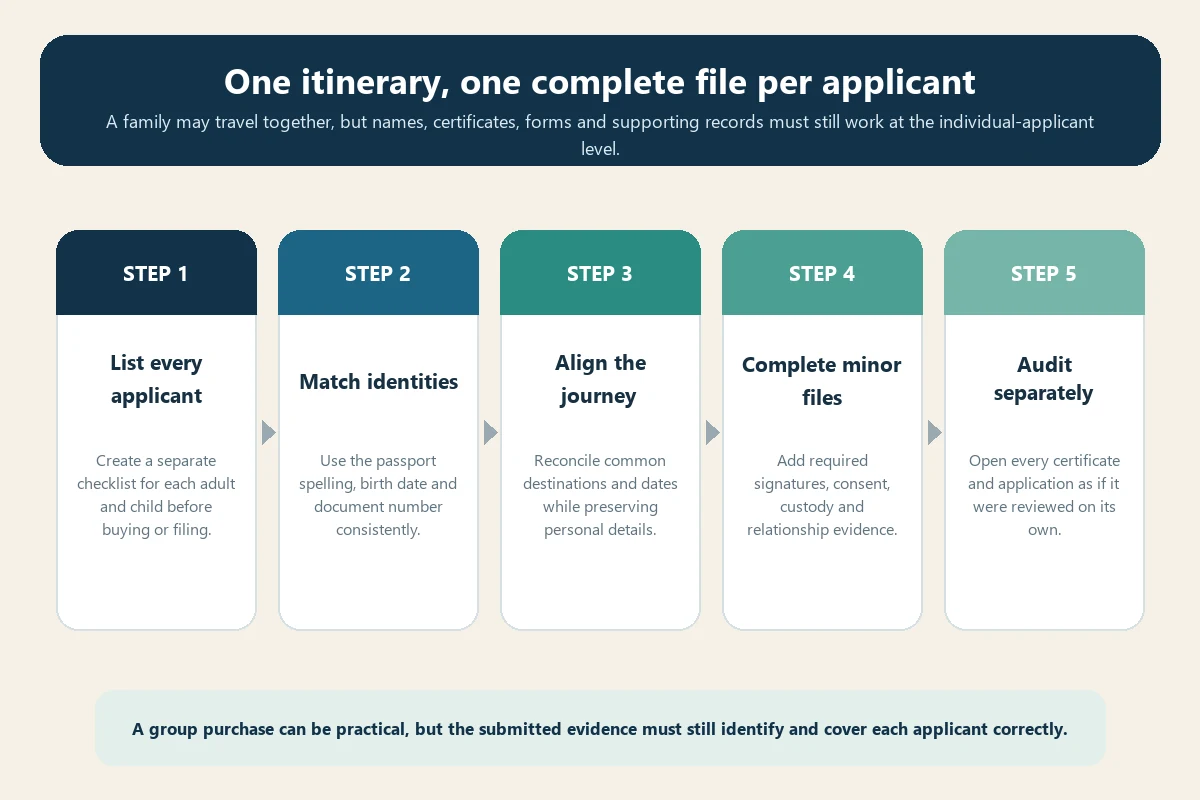
Build a family application matrix
Create one row per applicant and one column per required document. This exposes missing evidence without mixing personal files.
| Check | Adult 1 | Adult 2 | Each child |
|---|---|---|---|
| Passport and copies | Own valid document | Own valid document | Child’s own valid document |
| Application form | Individual form and signature | Individual form and signature | Individual form with required guardian signature |
| Insurance evidence | Named and covered | Named and covered | Named and covered |
| Financial evidence | Own or documented sponsor path | Own or documented sponsor path | Parent or sponsor evidence as instructed |
| Minor documents | Not applicable | Not applicable | Consent, relationship or custody records if required |
Use a neutral identifier, such as initials plus birth month, in the working matrix. Keep passport numbers in the secured final file rather than a widely shared planning sheet. The objective is consistent organization without creating unnecessary identity risk.
Align the shared itinerary without copying mistakes
Family members usually share flights, accommodation and destinations. Their application forms should therefore tell the same trip story. Compare intended entry, final exit, main destination, first-entry country, accommodation and inviting person. If one traveler will arrive later or leave earlier, document that real difference instead of forcing identical dates.
Insurance dates should cover the required period for each applicant. An infant added after the original booking may need a new certificate. A parent staying longer for work may need different dates. Use the Schengen insurance dates guide to handle overnight flights and non-Schengen connections.
Names must also align. Compare the passport, form, flight record, accommodation booking and insurance certificate character by character. Do not manually edit a PDF to correct a mistake. Ask the airline, hotel or insurer to reissue its record.
Insurance certificate checks for every person
- Open the document and locate the insured person’s full name.
- Confirm the policy or certificate number is readable.
- Match the start and end dates to that person’s itinerary.
- Verify the territory and required Schengen-wide validity.
- Locate the medical limit and required benefits.
- Check the insurer, assistance contact and claims information.
- Confirm there is no exclusion that makes the traveler ineligible.
The Schengen insurance certificate audit provides a field-by-field version of this process. The minimum-coverage guide explains why a headline number should be checked alongside benefits and sublimits.
Special handling for children and consent
A child is not covered for visa purposes simply because a parent is insured. The child should appear as an insured person, with the correct birth date and travel period. Check any family-policy definition of dependent child, including age, residence and full-time student conditions.
Minor applications can require signatures from both parents, notarized consent when one parent does not travel, birth certificates or custody evidence. The exact requirements depend on the authority and family situation. The official form and consular checklist control. Do not assume one country’s consent format is valid for another.
If parents share custody or use different surnames, allow extra time for official copies and translations. Organize the documents in the child’s folder, even when the same consent relates to several siblings. Each file should still be understandable on its own.
Different passports within one family
A household can contain U.S. citizens, permanent residents and relatives of other nationalities. Visa requirements follow each traveler, not the family’s shared address. One person may be visa-exempt while another requires a Schengen visa. A dual citizen may travel on a passport that changes the route.
Create a nationality and travel-document column in the matrix. Use the Schengen insurance guide for U.S. green card holders when residence in America and passport nationality differ. The dual-citizen insurance guide helps keep the chosen passport consistent across booking, application and insurance evidence.
Do not submit unnecessary applications for visa-exempt relatives. Still consider medical and evacuation protection for the entire family. A visa obligation and a prudent coverage decision are related but distinct.
Compare group and individual policies
| Question | Group or family policy | Individual policies |
|---|---|---|
| Certificates | May list everyone on one document or issue separate proofs | One clear certificate per traveler |
| Dates | Most practical when all travelers share the exact trip | Easier when arrivals or departures differ |
| Eligibility | Dependent definitions and age limits may apply | Each plan can match personal eligibility |
| Benefits | Limits may be per person, per family or per policy | Benefits are normally easier to attribute |
| Changes | One itinerary change can affect the shared contract | One person’s change can remain isolated |
Ask whether limits are per insured person or shared across the policy. Confirm how cancellation applies if one family member becomes ill and whether existing-condition rules are tested for the affected person, every traveler or a non-traveling relative. Use the Europe policy comparison worksheet to record these definitions.
A two-pass quality check before the appointment
In the first pass, review each applicant vertically. Open that person’s passport copy, form, photograph, insurance proof, financial evidence and supporting documents. Confirm the file is complete without relying on another folder.
In the second pass, review the family horizontally. Compare the common travel dates, destination, accommodation, transport and sponsor story across every form. Investigate differences. Some are correct because the itineraries differ; others reveal a data-entry error.
Finally, follow the authority’s appointment and submission method. The official France-Visas FAQ, for example, describes a group feature that helps prepare related applications. It does not turn the applicants into one legal form. Country procedures can differ.
Common family application mistakes
- Assuming “family plan” means every child appears on the certificate.
- Using a parent’s name as policyholder without listing each insured person.
- Copying one application and leaving another traveler’s passport details behind.
- Giving every person identical dates when one itinerary actually differs.
- Filing minor consent documents only with a parent’s application.
- Printing a summary page that omits territory, benefits or insurer details.
- Editing certificates or reservations instead of requesting corrected originals.
Frequently asked questions
Does each child need Schengen travel insurance?
Each visa applicant must meet the applicable insurance requirement. A child can be covered under a family contract, but the evidence should identify and cover that child correctly.
Can one certificate cover the whole family?
It can be suitable when every applicant is clearly listed and all required details are visible. Confirm the document format with the responsible authority and request separate certificates if individual proof is clearer.
Can a parent sign a child’s visa application?
The harmonized form provides for a person with parental authority or a legal guardian to sign for a minor. Consular instructions can require additional signatures or consent records, so use the current checklist.
What if one parent does not travel?
The application may require consent, custody or relationship evidence. Requirements depend on the destination and circumstances. Obtain official documents early and follow translation or notarization instructions.
Should visa-exempt family members buy insurance?
They may not face the same documentary obligation, but medical and evacuation protection can still be valuable. Compare coverage for the real traveler and itinerary rather than buying only for the appointment.
This article provides general organization and insurance information. It is not legal or coverage advice. Confirm current forms, minor requirements and policy terms with the responsible consulate and insurer.
Hosting family or friends? The Schengen invitation-visa insurance guide separates the invitation, sponsorship, accommodation and the applicant’s named medical evidence.
