

A Schengen travel insurance extension is a contract change, not an immigration decision. If a trip will continue beyond the current coverage end date, contact the insurer before the policy expires, identify the extra days, and obtain written proof of the new period. Separately confirm that the traveler is legally permitted to remain. Extending insurance does not extend a Schengen visa or erase an overstay.
Key takeaways
- Start the extension request before the current policy ends; eligibility after expiry may be different or unavailable.
- Map the new Schengen exit date and the complete return journey before asking for more days.
- Ask whether the issuer will endorse the current policy, renew it or require a new contract.
- A new policy may not create continuous cover and cannot normally insure a loss that is already known.
- Visa extension and insurance extension are separate processes handled by different decision-makers.
First, identify which “extension” you need
Search results mix three different situations. A traveler may need more insurance days because a voluntary itinerary changed. A covered disruption may trigger an “extension of stay” benefit inside the policy. Or the traveler may need official permission to remain after a visa validity or authorized-stay limit. One event can involve more than one path, but approval in one path does not approve the others.
| Extension | Who decides | What it changes |
|---|---|---|
| Policy endorsement | The insurer under the contract | Dates or other terms on the existing policy |
| New or renewed policy | The insurer after a new eligibility review | Creates a separate period of insurance |
| Visa or authorized-stay extension | The competent Member State authority | Immigration permission, if the legal conditions are met |
| Extension-of-stay benefit | The insurer during claim assessment | May reimburse specified extra costs after a covered event |
Do not ask an insurer whether an overstay is lawful, and do not expect an immigration authority to interpret an insurance endorsement. Send each question to the responsible decision-maker and keep the answers in writing.
When a Schengen visa can be extended
Article 33 of the EU Visa Code provides for extension of an issued visa’s validity or authorized stay where the competent authority accepts force majeure or humanitarian reasons that prevent departure. It also allows an extension for serious personal reasons, subject to the rule and fee stated there. The authority is the one in the Member State where the third-country national is present when applying.
Those are official immigration standards, not ordinary trip-preference rules. The traveler should contact the competent local authority before the permitted stay ends and follow its current evidence requirements. The European Commission’s Schengen visa guide explains the short-stay framework and directs travelers to the relevant national authorities.
Insurance may be part of the evidence or practical preparation for a lawful extended stay, but buying more days alone has no immigration effect. If the original problem is only an insurance date error, use the Schengen insurance dates guide instead of assuming the visa itself needs modification.
Start with an uncovered-days calculation
Write down the current policy end date, the revised final Schengen exit date and the arrival-home date. Include overnight flights, new connections and any non-Schengen side trip. Then identify exactly which local calendar days would otherwise be uninsured.
This calculation prevents two errors: requesting an extension that still ends too soon, and buying a new plan whose trip definition does not match a journey already in progress. The long-stay and backpacker trip-length guide explains why a policy year and a maximum insured trip are not the same thing.
Read the current policy before contacting the insurer
Search the issued certificate and full wording for “extension,” “renewal,” “maximum trip duration,” “period of insurance,” “home country,” “trip,” “known event” and “effective date.” The quote page is not enough. The contract may permit a date change, permit it only before departure, allow a renewal while abroad, or provide no extension right at all.
Use the travel insurance policy-reading guide to trace definitions into exclusions and benefit schedules. Pay special attention to:
- the last moment an extension request can be made;
- the maximum number of consecutive travel days;
- whether the insured must be medically fit and free of a pending claim;
- whether the journey must begin and end at the insured’s residence;
- whether a waiting period applies to a new contract;
- which benefits continue without interruption;
- territorial exclusions or travel-advisory conditions; and
- how a renewal date affects a trip already underway.
These points are policy-specific. Do not convert a restriction found in one insurer’s terms into a universal Schengen rule.
Questions to send the insurer in writing
- Can this exact policy be extended while the insured is already abroad?
- What is the latest request time relative to the current end date?
- Will the change be an endorsement, a renewal or a new policy?
- What are the new effective date and time, including the time zone?
- Will coverage be continuous with no uninsured gap?
- Does the existing trip exceed a consecutive-day or aggregate-day limit?
- Do any new exclusions, waiting periods or benefit resets apply?
- Is a known illness, delay, strike or other event excluded from the added period?
- Will the issuer provide a revised Schengen certificate?
- What premium, documentation and payment deadline apply?
Contacting the assistance line may be useful, but assistance and claims teams can have different roles. The assistance-versus-claims guide shows how to document calls and obtain the contract decision from the right team.
Extension, renewal or replacement?
Endorsement of the existing policy
An endorsement changes the current contract. This can be the cleanest record when it is allowed, because the policy number and history remain connected. Confirm that the endorsement changes both the actual period of insurance and the certificate; a customer-service email without a revised contract record may not be enough.
Renewal
A renewable travel medical product may permit an additional period, but renewal can still introduce new terms or maximum durations. Ask whether benefits, deductibles and exclusions reset and whether an illness that began during the first period remains covered. “Renewable” does not automatically mean identical or uninterrupted.
Replacement with a new policy
A new purchase can be necessary when the original issuer will not extend. It also presents the greatest continuity questions. The traveler is already abroad, the trip has already begun, and a medical or travel event may already be known. Confirm eligibility for post-departure purchase, any waiting period, the definition of a pre-existing or known condition, and whether the plan is acceptable for the intended Schengen evidence.
The Europe insurance timing guide explains why purchase date and coverage start are different. Never leave a gap based on the assumption that payment makes every benefit immediate.
Known events cannot be made unknown
Suppose a traveler receives a diagnosis, misses a connection, learns of a strike or is already stranded before asking for more coverage. An extension or new plan may cover genuinely new events during an added period, but it should not be represented as protection for a loss that has already happened or become foreseeable. Disclose the circumstances accurately and ask the insurer for a written interpretation.
The U.S. Department of State’s international travel checklist recommends reviewing what a policy does and does not cover and notes that the U.S. government does not pay travelers’ medical bills abroad. That is a reason to act early, not a reason to overstate what a late purchase can fix.
Medical necessity and an extension-of-stay benefit
Some policies contain a benefit that can pay specified lodging, transport or other costs when a covered illness or injury prevents the scheduled return. This is a claim benefit, not an automatic extension of every policy section. It may require medical certification, prior authorization, a daily limit and a maximum number of extra days.
Ask four separate questions: Is the underlying event covered? Does the extension-of-stay benefit apply? Does medical coverage itself continue? And has the traveler obtained any required immigration permission? A “yes” to one does not answer the others.
Territory and route changes
A longer trip may add countries or change the return route. Check whether the revised itinerary stays inside the insured territory and whether travel advisories or sanctions affect cover. The Europe country exclusions guide provides a destination-by-destination audit method.
For visa evidence, Article 15 still requires the relevant Schengen territorial scope and the required medical risks. A revised certificate should state the new dates and applicable territory clearly. Use the certificate correction checklist and never annotate the insurer’s PDF yourself.
What cannot be repaired after expiry
After the current policy ends, the issuer may no longer permit an endorsement. A replacement policy may begin only after a delay or may exclude circumstances connected to the ongoing trip. There can also be an evidentiary gap between two certificates. This is why the safest operational rule is to begin the request while the original contract is active and before the need becomes a claim.
If expiry has already occurred, be precise with the insurer: state the current location, original departure date, expired date, revised return date and any known medical or travel event. Ask what protection can legally and contractually begin now. Do not backdate documents or describe coverage as continuous unless the issuer confirms it.
Extension file to keep offline
- Original policy and certificate
- Revised itinerary and uncovered-days calculation
- Written extension request sent before expiry
- Insurer response and payment receipt
- Endorsement, renewal or new policy wording
- Reissued certificate with new dates
- Assistance and claims contacts
- Any visa-extension application and official decision
- Medical documentation or carrier notices, where relevant
Run the final documents through the Europe trip insurance checklist. The target is not simply “more days”; it is a lawful stay, a valid contract, accurate proof and no unexplained coverage gap.
The safest sequence
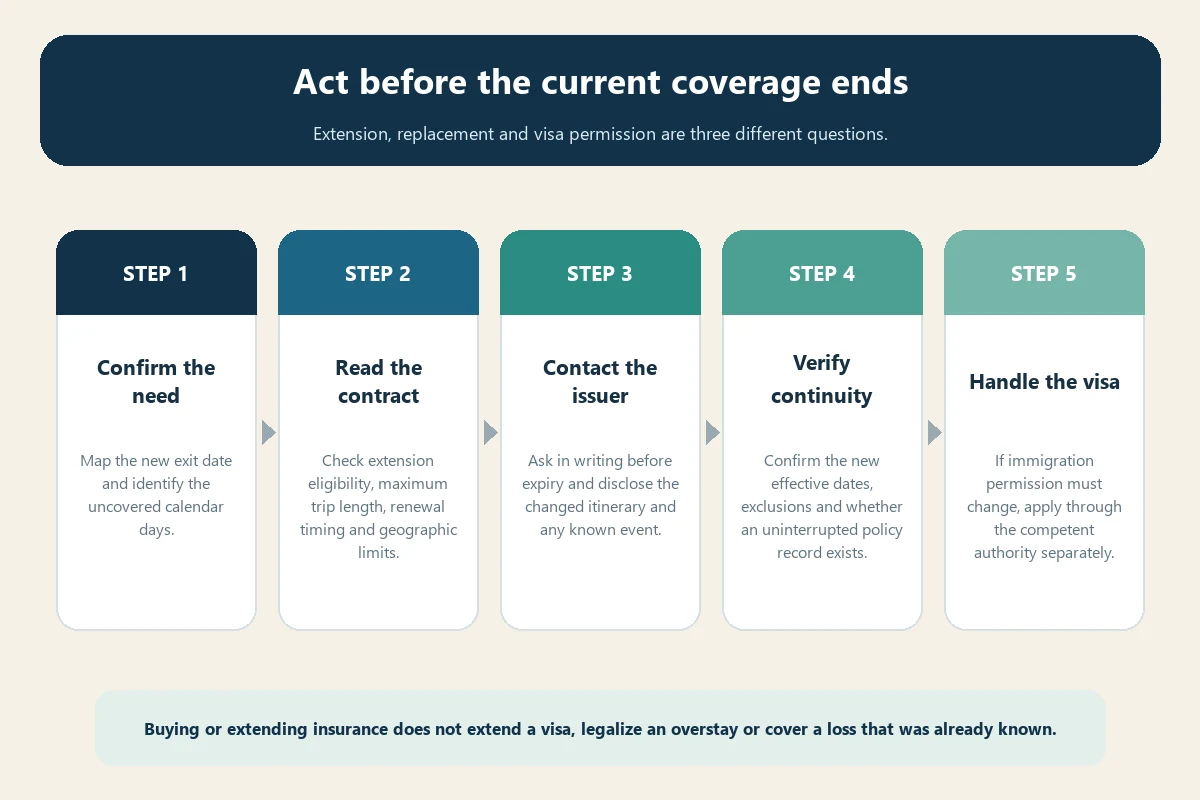
Calculate the revised journey, read the current contract, contact the issuer before expiry, obtain written confirmation, verify the new certificate, and address visa permission separately with the competent authority. If a new policy is the only option, treat waiting periods, known events and trip-origin eligibility as open questions until the issued wording answers them.
General educational information, not legal, visa, medical or insurance advice. Policy-extension rights and visa procedures vary. Contact the insurer and the competent Member State authority before the current policy or permitted stay ends.
Staying beyond a short visit? Use the long-stay European visa insurance guide before assuming the standard Schengen travel-policy rules govern a national application.
