
How long a travel insurance claim takes depends on when the file becomes complete, not on the day you submit it. Some states set outer limits: Texas, for example, gives an insurer 15 business days to acknowledge a claim and 15 business days after receiving everything it needs to decide, extendable by 45 days with a stated reason. Elsewhere the standard is “reasonable promptness.” The practical goal is to know which stage the claim is in, what is missing, who owns the next action, and which deadline is still running.
Key facts
- Texas requires an insurer to acknowledge a claim within 15 business days and decide within 15 business days of receiving all needed items.
- That Texas decision deadline can be extended by 45 days only if the insurer tells you why it needs more time.
- The NAIC model act treats failing to acknowledge claim communications with reasonable promptness as an unfair claims practice.
- "Received" and "complete" are different statuses; ask for the date the file became complete and one itemized missing-document list.
- Appeal, proof-of-loss, supplier, and legal deadlines keep running while a status question is pending.
- Approval and payment are separate steps; confirm the amount, payee, and trace information before treating the claim as finished.
A disciplined follow-up log creates evidence without flooding the administrator with duplicate files. Confirm submission, completeness, assignment, pending issues, expected next step, and the written decision. Escalate based on facts and applicable requirements, not an arbitrary online promise.
Key takeaways
- “Submitted,” “received,” “assigned,” “complete,” and “under review” are different statuses.
- Ask for a precise missing-document list and the date the file became complete.
- Use one claim number and a dated communication log.
- Do not reset the workflow with duplicate claims or repeated unsorted uploads.
- Appeal, proof, supplier, and legal deadlines continue while status questions are pending.
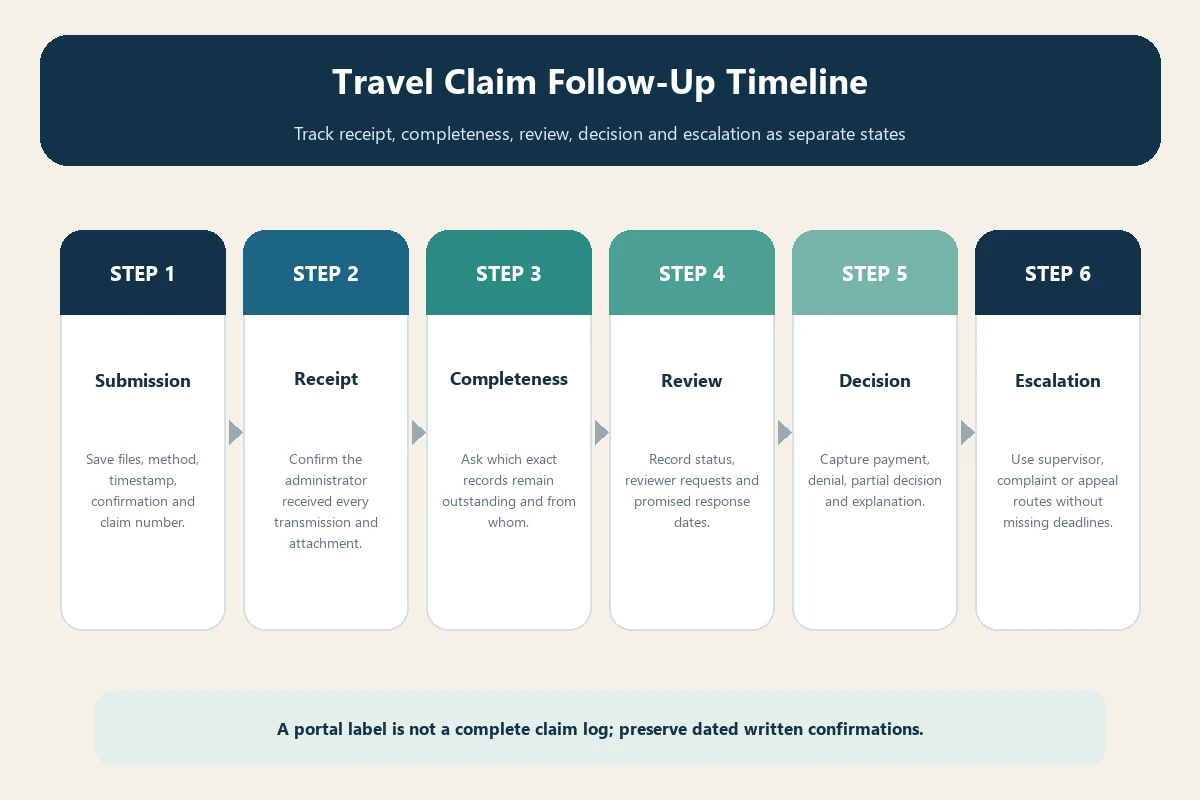
The five stages of a travel insurance claim, starting with submission confirmation
Immediately after filing, save the portal receipt, claim number, uploaded filename list, timestamp, email confirmation, or postal tracking. Verify that the claim is attached to the correct insured, policy, trip, and benefit. One event can require separate medical, interruption, baggage, or evacuation lanes.
A successful file upload does not necessarily mean the claim form was accepted or readable. Download the submission summary and reopen representative files when the portal permits it.
Stage 2: receipt versus completeness
“We received your claim” means the carrier has a file. “Complete” means it believes the current evidence is sufficient to evaluate, though new questions can arise. Ask whether the file is complete for each benefit and, if not, request a single itemized list.
For every requested record, note who must provide it: claimant, doctor, airline, hotel, another insurer, translator, police, or assistance company. Record the request date and expected delivery.
Stage 3: assignment and active review
Ask whether an adjuster or examiner is assigned, which team handles the benefit, and how to reference the file. Complex claims may move between intake, medical review, fraud review, subrogation, payment, or supervisory teams. A transfer is not necessarily a denial.
Request the next action rather than a vague “any update?” Useful questions are: Which issue is being evaluated? Is any document unreadable? Are you waiting for another party? What event will move the file forward?
Stage 4: decision
A final decision should be in writing and identify approved, denied, pending, or partially paid lines. Check the policy provisions, calculation, appeal instructions, and payment method. If one benefit is paid while another is pending, ask whether the claim remains open.
Use our partial payment audit to reconcile the amount. Do not interpret a portal status of “closed” without obtaining the written determination.
Stage 5: payment delivery
Approval and payment are separate steps. Confirm the amount, payee, ACH account, check address, direct provider, issue date, and trace information. Be alert to phishing messages requesting new banking details. Verify changes through the official number or authenticated portal.
If a check is lost or stale, ask about stop-payment and reissue procedures. If a provider was paid directly, obtain the provider ledger before paying the same balance yourself.
Build the status log
Use columns for date, channel, representative, claim number, benefit, current status, missing item, responsible party, promised action, due date, confirmation, and next follow-up. Attach each message and call reference. Keep facts concise.
The log should distinguish the assistance case from the insurance claim. Our assistance line versus claims guide explains why emergency coordination does not always open every reimbursement benefit.
Set a reasonable follow-up cadence
Follow the administrator’s stated service window and applicable state requirements. After submission, confirm receipt promptly. After providing requested records, confirm they were matched to the file. Follow up when a promised date passes or the status changes without explanation.
Daily contacts rarely speed an ordinary review and can create conflicting messages. Long silence is also unhelpful. Use dated, purposeful contacts and ask for a response date.
Ask completeness questions
- Is every upload readable and assigned to the correct benefit?
- What exact document or fact remains outstanding?
- When was the file considered complete?
- Is the carrier waiting for a third party or internal reviewer?
- Can another benefit be decided while that item is pending?
- What is the next step and expected response date?
- Does any claim, appeal, or legal deadline require action now?
Why a travel insurance claim takes longer than expected: third-party delays
Airlines, cruise lines, hotels, doctors, police, translators, and health plans can delay a file. Provide proof that the record was requested, the current status, and alternative evidence. Ask whether the insurer can contact the party directly or proceed conditionally.
Do not wait for a final supplier refund before opening the claim. Use our supplier refund statement guide. For missing purchase records, use the alternative evidence workflow.
Medical review delays
Medical claims may require itemized bills, translations, clinical records, physician forms, prior records, EOBs, or an independent review. Ask which medical question is unresolved and whether the authorization has been sent to the provider.
Confirm that the provider responded and which pages arrived. A signed authorization is not proof the insurer received the chart. Protect privacy and do not send unrelated records merely to make the file larger.
Other insurance delays
Secondary claims can wait for Medicare, Medicare Advantage, employer coverage, or another insurer. Submit the first payer claim promptly and obtain an EOB or formal decision. Tell the travel adjuster the submission and expected response dates.
If the first payer cannot process the expense, ask what noncoverage proof the travel insurer accepts. Waiting for another payer does not automatically extend the travel policy deadline.
Portal problems
Capture error messages, filenames, file sizes, date, time, browser, and claim number. Try the approved alternative channel and contact support. Do not create a new claim merely because one upload failed unless instructed.
Large PDFs can be truncated or separated. Use an index and stable filenames. The organization method in our claim documentation guide makes follow-up more precise.
Duplicate uploads and version control
When replacing a document, label it “corrected” with the date and explain what changed. Do not upload five files called “receipt.pdf.” Maintain a manifest with filename, page count, document date, and purpose.
Ask the administrator to disregard a superseded version rather than deleting evidence from your own archive. Preserve the original and correction trail.
What to do when a travel insurance claim is taking too long
Send a concise message quoting the prior reference number and promised action. Ask whether the file is complete, what prevented the action, and the revised date. Escalate to a supervisor when repeated promises pass without a substantive response.
Do not threaten litigation or regulators in the first status message. State the chronology and request a specific action.
Internal escalation
Ask for a supervisor, claims manager, or complaint team when status is inconsistent, records are repeatedly lost, the file is inactive without explanation, or a deadline concern is ignored. Provide a one-page timeline and the requested resolution.
Separate service complaints from coverage appeals. A service escalation asks for processing or communication; an appeal challenges a decision. Use our appeal guide after a final adverse decision.
State insurance department complaint
State insurance departments handle complaints under their authority. The relevant regulator can depend on the insurer, policy, state, and transaction. Use the carrier’s legal name and NAIC number and locate the department through the NAIC directory.
Provide the certificate, claim confirmation, complete status log, requests, responses, and specific processing issue. A complaint does not guarantee payment, substitute for an appeal, or pause legal deadlines.
Maintain all deadline clocks
Status follow-up does not replace notice, proof of loss, appeal, supplier, health-plan, or legal-action deadlines. Keep them on one calendar. Our claim deadline guide explains the separate clocks.
When a deadline is near, submit the protective document through the required channel even if the adjuster has not answered a status question.
Keep the file after payment
Retain the certificate, submitted documents, decisions, payment trace, provider ledgers, refund statements, and status log after the claim appears finished. A supplier can issue a later refund, another health plan can reprocess an expense, a check can fail, or the insurer can request reconciliation.
Store the archive according to the sensitivity and retention needs of the claim. Medical records, passports, bank data, and death documents need stronger access controls than ordinary travel confirmations. Record when a file may be securely destroyed, but do not delete it while an appeal, recovery, tax, estate, provider, or legal issue remains open.
Sample follow-up message
Please confirm receipt and readability of the documents uploaded on [date] for claim [number] and benefit [type]. Please identify any outstanding item, the date the file became complete, the current review stage, and the next expected action. The attached one-page index lists the files and prior reference numbers.
FAQ
How long should a travel claim take?
There is no universal period. Use the insurer’s written timeframe, file completeness, state requirements, and claim complexity.
Should I call every day?
Usually a purposeful cadence tied to promised dates is more useful. Document each contact and escalate repeated unexplained delays.
What does “closed” mean?
Ask for a written line-by-line decision. A portal label may mean paid, denied, administratively closed, or transferred.
Does a regulator complaint stop my appeal deadline?
Do not assume so. Preserve every contractual and legal deadline independently.
Bottom line
Effective claim follow-up is a controlled audit trail. Confirm receipt and completeness, identify the current stage and next owner, follow promised dates, preserve version control, and escalate with a concise chronology. Never let a status request replace a proof, appeal, or legal deadline.
Sources
- NAIC — Unfair Claims Settlement Practices Act
- NAIC — Travel Insurance Model Act
- NAIC — State Insurance Departments
- New York DFS — File a Complaint
- California Department of Insurance — Getting Help
- Washington OIC — File a Complaint
Reviewed August 16, 2026. This article is general educational information, not a guaranteed processing timeline or legal advice. Requirements vary by insurer and jurisdiction.
Sources and further reading
- Insurance companies must meet deadlines to respond to Texas claims — Texas insurers have 15 business days to acknowledge a claim, 15 business days after receiving what they need to decide, and may extend that deadline by 45 days if they explain why (intro paragraph and key facts 1-2).
- Unfair Claims Settlement Practices Act — Section 4 lists as unfair claims practices failing to acknowledge pertinent claim communications with reasonable promptness, failing to affirm or deny coverage within a reasonable time after completing the investigation, and failing to promptly give a reasonable explanation for a denial (intro 'reasonable promptness', key fact 3, escalation section).
- Insurance Departments — The NAIC directory is where a consumer finds their state insurance department and files a complaint (State insurance department complaint section).
