

Travel insurance for Croatia from USA trips should account for island access, ferry disruption, medical payment and the possibility of transfer to a mainland facility. A Dubrovnik or Zagreb city break differs sharply from an itinerary that combines Split, Hvar, Korčula and small coastal ports on separate tickets.
Key takeaways
- Map every island, ferry, private boat, rental car and neighboring-country segment before choosing coverage.
- Distinguish local ambulance or boat transport from medical evacuation and repatriation.
- Check whether providers may require upfront payment and how the insurer arranges assistance.
- Use carrier passenger rights first and private insurance only for eligible unrecovered losses.
- Inspect boating, diving, scooter and adventure-activity exclusions instead of relying on a broad destination label.
Planning information reviewed August 16, 2026. Ferry schedules, routes, entry rules, local services and policy terms can change; confirm them for the booked trip.
Turn the Croatia route into an insurance map
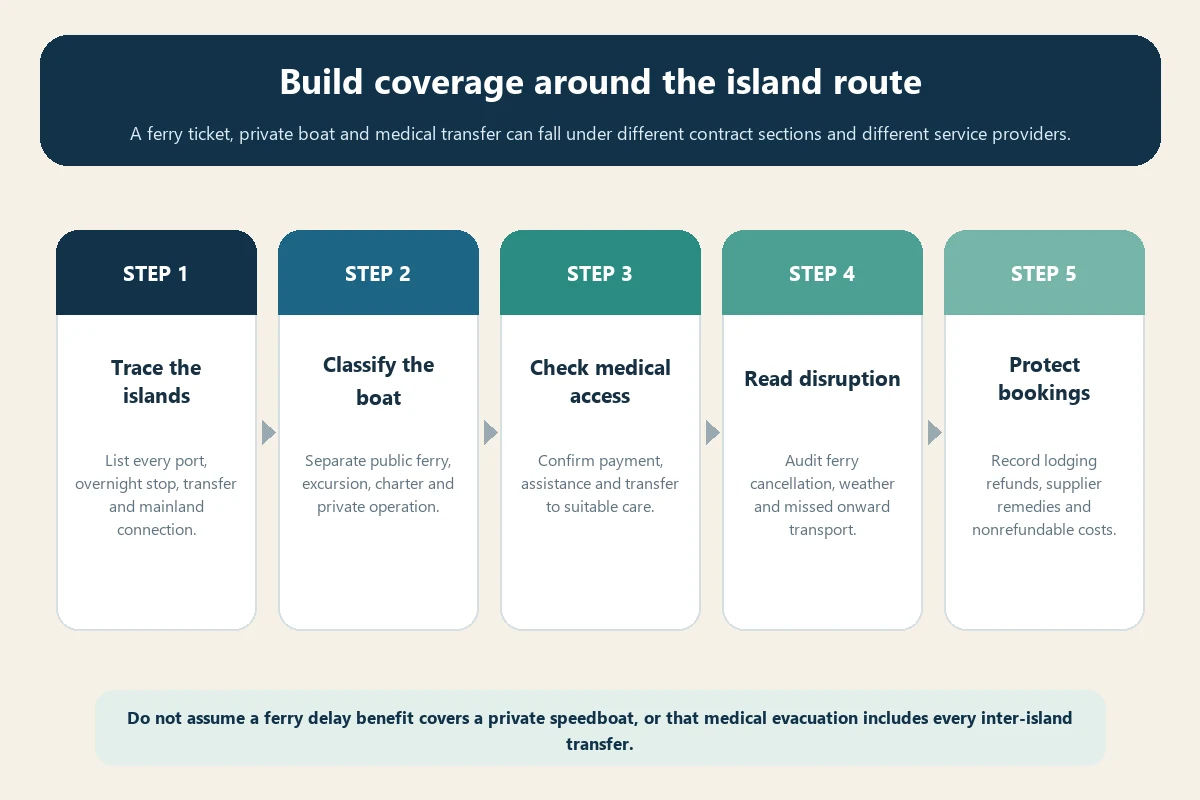
Write one line for every travel day: U.S. departure, arrival airport, mainland stay, ferry port, island, private excursion, border crossing and return. Note whether each connection is a through booking or a separate contract. Add the last practical ferry or bus of the day and any hotel that becomes unusable if a sailing is canceled.
Now add activities. Swimming from a beach, scuba diving, sailing, kayaking, cliff jumping, hiking, cycling and renting a scooter can be treated differently. A policy with strong medical coverage can still exclude the activity, operator or vehicle involved in a claim.
If the trip also includes Montenegro, Bosnia and Herzegovina, Slovenia or Italy, use the multi-country Europe insurance guide and verify every country by name.
Do not confuse entry rules with personal protection
Many U.S. citizens make short tourist visits to the Schengen Area without applying for a traditional visa, subject to current rules. Other travelers may require a visa and formal insurance proof. Passport, nationality, residence, purpose and duration determine the procedure.
Croatia’s Ministry of Foreign and European Affairs publishes an official travel medical insurance page for visa applicants. A person who needs proof should follow the current Croatian or responsible consular checklist and compare it with the Schengen insurance requirements guide.
For a visa-exempt U.S. tourist, private insurance can still transfer medical, evacuation, cancellation, interruption or baggage risk. It does not guarantee admission and should not be purchased from an inaccurate claim that every U.S. visitor has the same legal requirement.
Medical care and upfront payment
The U.S. Department of State’s Croatia travel information says medical facilities generally do not accept U.S. health insurance and may require cash or upfront payment. It also notes that ambulance service is not widely available outside major cities and recommends coverage for medical evacuation.
Ask the current U.S. health plan whether emergency treatment abroad is covered, how out-of-network care is reimbursed and which documents are required. Then ask the travel insurer whether its medical benefit is primary or secondary, whether it can issue a payment guarantee and how it selects a provider.
Carry a payment method and contingency reserve. “Direct billing available” can depend on the facility, time, diagnosis and authorization. The primary medical coverage guide explains coordination, but payment order does not force a Croatian provider to extend credit.
Island treatment and mainland transfer
“Evacuation” is not one universal promise. A local ambulance may take a patient to an island clinic. An emergency boat or helicopter may transfer the patient to a larger facility. Medical evacuation under a policy may mean transport to the nearest suitable hospital chosen through the assistance service. Repatriation may mean a later medically necessary return to the United States.
Ask where the benefit starts, who decides medical necessity and whether assistance preauthorization is required. Look for separate limits on ambulance, search and rescue, emergency evacuation, repatriation and transport of remains. A high medical maximum does not prove every transport function is included.
For urgent danger, contact local emergency services first. Croatia’s official information and State Department materials identify 112 as the general emergency number and 194 for emergency medical assistance. Once the situation is stable, call the insurer, open a case and record the instructions.
The medical repatriation guide separates nearby transport, medically necessary evacuation and return home.
Ferry cancellation and passenger rights
Weather, operational decisions and schedule changes can affect island routes. Start with the operating carrier. The European Union’s official ship passenger-rights guide explains assistance, rerouting, reimbursement and compensation under qualifying conditions, including important exceptions.
Travel insurance is separate. A trip-delay benefit usually requires a covered reason, a minimum delay and receipts. A missed-connection benefit may require common-carrier involvement and can distinguish one protected journey from separate self-built tickets. Trip interruption addresses defined events after departure and is not automatically triggered by every canceled sailing.
| Island disruption | First response | Insurance test |
|---|---|---|
| Carrier cancels a ferry | Request official cause, rerouting or refund | Covered reason, delay threshold and unrecovered expenses |
| Late ferry misses a flight | Contact both carriers and preserve timings | Connection definition and reasonable replacement transport |
| Private excursion returns late | Contact the operator and onward carrier | Whether the boat/operator qualifies under the policy |
| Traveler is medically unable to sail | Seek care and assistance authorization | Medical interruption and documentation requirements |
The Europe ferry insurance guide explains ticket type, delay evidence and overnight-cost planning.
Private boats, sailing and water activities
A scheduled passenger ferry is not the same as a private speedboat, bareboat charter or skippered excursion. Policies may define common carrier narrowly. Private-vessel cancellation or a missed onward connection may not fit a common-carrier delay benefit.
For sailing, verify whether the insured is a passenger or crew, who operates the vessel, the distance from shore and any licensing requirement. For scuba diving, check depth, certification, supervision and decompression rules. For kayaking, jet skiing or other water sports, find the exact covered-activity list and safety-equipment conditions.
Do not infer insurance from an operator’s waiver. Ask what liability or accident cover the operator holds and what it excludes. Your private policy is a separate contract. Keep the activity booking, operator name, route and written insurer clarification.
Scooters, rental cars and road transfers
A scooter or car introduces liability and vehicle-damage questions beyond travel medical insurance. Verify the license class, local law, helmet requirement and rental agreement. A travel policy can exclude injuries arising from an unlicensed or prohibited vehicle even when it covers emergency medical care generally.
Rental-vehicle damage protection may exclude scooters, motorcycles, tires, glass, undercarriage or certain roads. Third-party liability is another product. Credit-card collision protection can require the full rental charge on the card and may exclude certain vehicle classes or countries.
The Europe road-trip insurance guide separates collision damage, liability, roadside help, personal medical coverage and trip interruption.
Cancellation and interruption for an island route
Calculate the prepaid, nonrefundable amount for each ferry, hotel, tour, charter and flight. Flexible reservations should not be counted as unrecoverable loss. Keep the supplier’s cancellation terms in force at booking.
Standard trip cancellation covers only reasons defined by the policy. A forecast, fear of poor weather or a change of preference is not automatically covered. Severe weather may be covered only when it produces the specified consequence, such as a qualifying common-carrier cessation, destination uninhabitability or another stated trigger.
After departure, trip interruption can cover eligible unused arrangements and additional transport for a covered reason. It does not guarantee that every rebooking choice will be reimbursed. Contact assistance before making an expensive change when safe and practical.
Exclusions that matter on the Adriatic
Review existing medical conditions, alcohol, reckless conduct, sports, diving, boats, scooters, remote locations, weather, known events, government restrictions and failure to use required safety equipment. Check whether a sports add-on changes the benefit limit or only removes one exclusion.
Territory also matters. A day trip across a border or into non-Schengen territory can fall outside a narrow contract even when sold as part of a Croatia holiday. The Europe country-exclusions guide shows how to read geographic, sanctions and event restrictions separately.
Build a claim file while traveling
For medical care, collect the diagnosis, medical report, itemized invoice, prescription and proof of payment. Save the assistance case number and any authorization. For an island transfer, request the transport or rescue report and document the origin, destination and medical reason.
For a ferry event, keep the original ticket, carrier notice, stated cause, actual departure or cancellation time, refund decision and replacement receipts. Photograph departure boards when appropriate, but obtain written carrier evidence as well. For a theft, collision or activity incident, follow the policy’s police or operator-report rules.
Ask carriers and suppliers for available refunds before claiming the residual loss. The travel insurance claim guide provides a chronological file structure.
Compare Croatia plans line by line
- all travel dates, islands, ports, transit countries and side trips;
- emergency medical maximum, deductible and existing-condition rules;
- provider payment, direct billing and reimbursement procedure;
- local ambulance, rescue, evacuation and repatriation definitions;
- ferry delay, missed connection and common-carrier wording;
- sailing, diving, kayaking, scooter and hiking activity terms;
- cancellation, interruption and severe-weather triggers;
- assistance authorization, claim deadline and appeal process.
Compare the full policy issued for the purchaser’s U.S. state, not only a quote screen. Save the certificate, schedule and contract version. If the route changes, recheck dates, territory, trip cost and activities before departure.
Frequently asked questions
Is travel insurance mandatory for every U.S. tourist visiting Croatia?
Not as a universal private-insurance rule for every short U.S. tourist. Travelers who require a Schengen visa can face formal proof requirements. Verify the current entry procedure for the specific passport and trip.
Will travel insurance pay for any canceled ferry?
No. Carrier rights apply first, while insurance requires a covered cause, timing conditions, eligible expenses and documentation. Known events and certain routes or boats may be excluded.
Does evacuation mean transport directly to the United States?
Usually not automatically. Many policies first provide medically necessary transport to the nearest suitable facility. Repatriation home is a separate defined decision.
Are private boat excursions treated as common carriers?
Not necessarily. Read the policy definition and inspect the operator and booking. A private charter can fall outside a benefit written for scheduled public transport.
Does a sports rider cover scuba diving and scooters?
Only if the exact activity and all licensing, depth, supervision, vehicle and safety conditions are included. A generic rider title is not enough.
This article is educational and is not legal, medical or insurance advice. Official authorities, responders, carriers, providers and the issued policy control.
