
Travel insurance earthquake flight cancellation coverage depends on what the earthquake did to the booked trip. A reported magnitude does not prove that an airport closed, a hotel was damaged, or an airline canceled. The relevant consequence may instead be a temporary inspection, rail shutdown, blocked access road, utility failure, terminal evacuation, aftershock restriction, or supplier closure.
This U.S. guide connects the authoritative source event, local shaking, immediate safety action, inspections, facility and carrier status, policy wording, supplier remedies, and remaining expense. It is educational, not emergency, geological, structural, aviation, legal, medical, or insurance advice.
Earthquake flight coverage at a glance
- Protect people first and follow evacuation or inspection instructions.
- Save the event ID, origin time, location, revisions, and local intensity.
- Separate shaking from confirmed damage, closure, and carrier action.
- Preserve safe alternatives, refunds, credits, and actual arrival.
- Test purchase timing and the exact issued policy trigger.
- Claim only eligible expense remaining after supplier recovery.
Reviewed August 17, 2026.
Magnitude and local shaking are not the same
The U.S. Geological Survey’s magnitude and intensity explanation distinguishes the earthquake’s magnitude from shaking intensity at a particular place. Distance, depth, geology, and construction can make local effects vary.
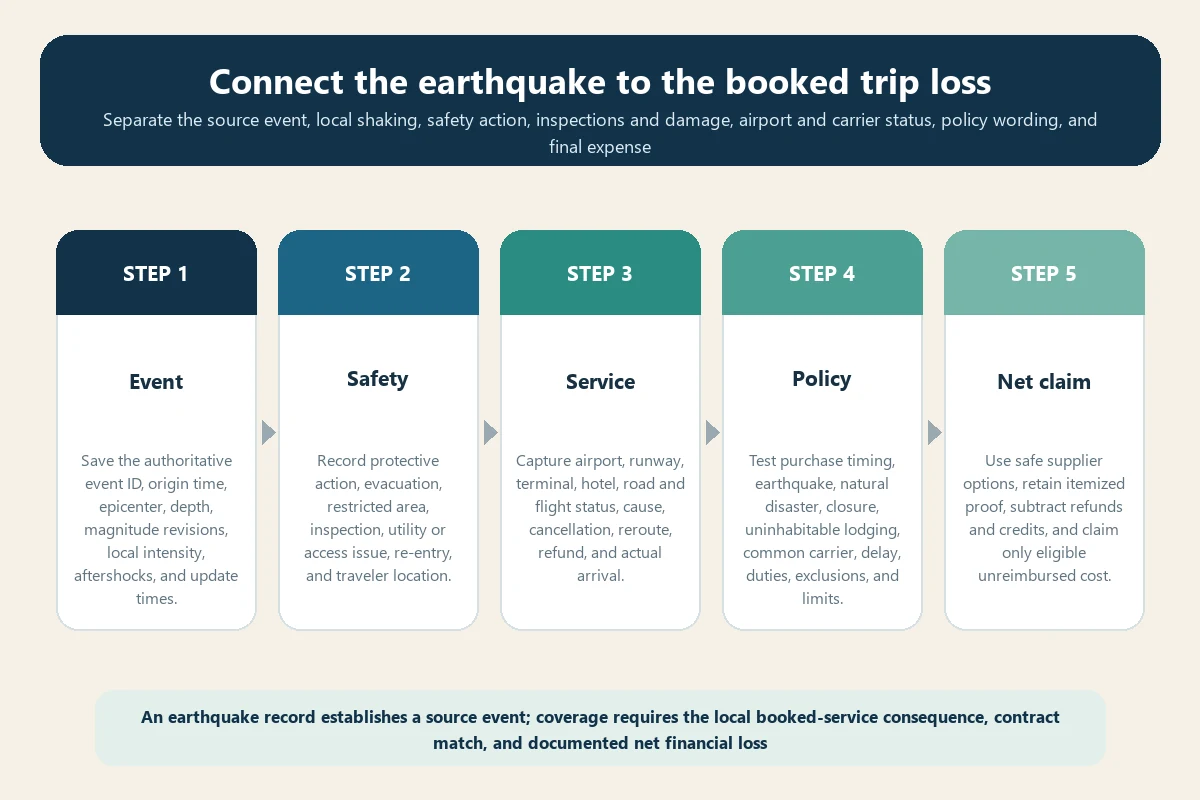
Save the authoritative event ID, origin time, epicenter, depth, preliminary and revised magnitude, and update timestamps. Then preserve local intensity or ShakeMap information for the airport, hotel, and route. Do not infer damage from magnitude alone.
Expect earthquake data to be revised
Initial automatic locations and magnitudes can change as agencies analyze more observations. Keep the first record used for decisions and the later reviewed record. Explain revisions instead of silently replacing the earlier evidence.
A news screenshot may omit the event ID, time zone, depth, and revision. Link the claim to the authoritative event page and match every booking in local time.
Drop, Cover, and Hold On before documenting
Ready.gov’s official earthquake safety guidance directs people indoors to Drop, Cover, and Hold On, then watch for hazards and aftershocks. Follow local responders, airport staff, hotel management, and engineers. Do not remain near glass or enter a restricted structure to obtain evidence.
After reaching safety, record traveler location, protective action, evacuation, injuries or immediate hazards, authority instructions, inspection status, and re-entry time. Preserve communications gaps caused by power or network failure.
An earthquake report is not a closure notice
An airport can continue operating after light shaking. It can also pause ramp, terminal, runway, navigation, baggage, rail, or utility systems for inspection without fully closing. A hotel may evacuate briefly and reopen after assessment.
Use facility records to prove the exact restriction, scope, cause, start, extensions, and reopening. Avoid converting a precautionary inspection into confirmed structural damage.
Build parallel event and service timelines
The event timeline should contain origin time, shaking reports, aftershocks, alerts, evacuation, inspection, and all-clear. The service timeline should contain airport access, airport operations, hotel status, booked flight, alternatives, cancellation, refunds, and actual arrival.
Align them by time and place. This reveals whether the service failed because of local damage, precautionary inspection, utility loss, staff displacement, an inbound aircraft, or a separate operational decision.
Map every itinerary point
List the origin airport, connection, destination airport, hotel, rail station, bridge, tunnel, rental depot, cruise port, attraction, and transfer route. Record local shaking and official status for each. A strong earthquake near one city does not establish closure across an entire country.
Country-level destination guides can help with planning, but the claim needs booking-level facts. Our Japan disaster travel insurance guide shows how route dependencies differ across cities and islands.
Prove airport inspections and restrictions
Preserve notices for terminal evacuation, runway or taxiway inspection, control-tower status, fuel system, jet bridges, baggage equipment, power, water, fire protection, access transit, and parking. Record whether operations were paused, reduced, relocated, or closed.
If a formal closure occurs, use the airport closure coverage guide. If a power failure is the direct cause, use the airport power outage guide. Do not substitute one label for another.
Access infrastructure may be the broken link
A bridge, tunnel, rail line, highway, parking structure, or airport train may close for inspection even when flights operate. Save the transportation authority’s exact segment, direction, reason, start, alternatives, and reopening.
Record the check-in cutoff and whether a safe practical alternative existed. Do not enter a damaged or restricted route to try to mitigate the loss. A personal access failure and a carrier cancellation can engage different policy wording.
Get the airline’s final disposition
Keep the itinerary, ticket number, flight number, scheduled times, boarding pass, app messages, emails, texts, gate information, and call notes. Ask whether the cause was airport inspection, closure, infrastructure damage, ATC restriction, inbound aircraft, crew displacement, or another event.
Save every rebooking, alternate airport, waiver, voucher, meal or hotel offer, refund choice, cancellation, and actual arrival. A precautionary delay can later become a cancellation or a completed flight.
Use the airline refund before insurance
The U.S. Department of Transportation’s airline refund guidance says a passenger is entitled to a refund when the airline cancels and the passenger declines alternative transportation or compensation. The earthquake being beyond the carrier’s control does not remove that refund right.
A refunded ticket is not an insurance loss. If safe rebooking is accepted, eligible meals, lodging, local transportation, missed connections, or unused prepaid land arrangements may remain.
Hotel habitability needs an inspection record
Obtain the hotel’s evacuation notice, assessment, confirmed damage or utility issue, affected dates, restricted areas, alternative property, expected reopening, and refund or credit decision. A visible crack in an image does not establish the building’s legal or structural status.
An operating hotel may still be inaccessible; an evacuated hotel may later reopen. If the trip has begun, the trip interruption insurance guide helps classify unused nights, additional transport, and replacement lodging.
Aftershocks need new consequences, not assumptions
Aftershocks can trigger new evacuations, inspections, damage, or service pauses. Preserve each material event and supplier response. Do not claim that the possibility of aftershocks automatically makes an operating destination unusable.
When authorities restrict an area or engineers delay re-entry, keep that record. When services resume, update the chronology and mitigate reasonably without compromising safety.
Tsunami risk is a separate evidence chain
A coastal earthquake can trigger a Tsunami Information Statement, Watch, Advisory, or Warning. Those products and actions are not interchangeable with the earthquake record. Preserve both.
Use the tsunami flight cancellation guide when coastal evacuation, port status, or tsunami-related access is the direct consequence. Do not label earthquake shaking damage as tsunami flooding without evidence.
Choose benefits by trip stage
Trip cancellation generally addresses an eligible pre-departure cancellation and forfeited prepaid costs. Trip delay may address reasonable additional expenses after a qualifying delay reaches its threshold. Trip interruption can address an eligible event after departure, unused arrangements, and additional transport under its wording.
A missed-connection benefit can impose a separate cause and minimum delay. Use the delay, interruption, and cancellation comparison
Test the exact issued policy
Search for earthquake, aftershock, natural disaster, common carrier, airport closure, inaccessible destination, uninhabitable accommodation, evacuation, trip delay, cancellation, interruption, and missed connection. Read definitions, duration thresholds, notice duties, exclusions, per-day caps, and total limits.
Do not assume the word “natural disaster” creates universal coverage. Some benefits require physical damage; others require common-carrier stoppage, a formal closure, or accommodation uninhabitability. The issued policy and endorsements for the purchaser’s U.S. state control.
Create the known-event chronology
Record first trip deposit, policy purchase, earthquake origin time, first public report, revisions, aftershocks, inspection, supplier decision, carrier action, and expense. A policy purchased after the earthquake is reported may not cover loss arising from it.
The when to buy travel insurance guide explains why early purchase and timestamped evidence matter. Avoid inventing one universal known-event cutoff.
Fear alone is different from a covered consequence
A traveler may reasonably feel uneasy after shaking or aftershocks. Standard named-peril cancellation generally still needs a listed covered reason. If flights, lodging, and destination remain available, fear alone may not qualify.
Cancel For Any Reason coverage, when purchased and used under its timing, insured-cost, and cancellation-deadline rules, can address some otherwise uncovered choices. It usually reimburses only a stated percentage. Read the actual endorsement before acting.
Build a chronological claim file
- Policy, declarations, endorsements, purchase receipt, and itinerary.
- Authoritative event ID, revisions, local intensity, and aftershocks.
- Evacuation, inspection, road, rail, airport, hotel, and utility notices.
- Carrier status, alternatives, waivers, refunds, and actual arrival.
- Supplier invoices, cancellation rules, itemized receipts, and payment proof.
- A timeline linking every claimed cost to the qualifying consequence.
Use the travel insurance claim guide to index the submission. Explain evidence gaps caused by evacuation or outages rather than reconstructing unsupported details.
Calculate only net eligible loss
Start with each forfeited prepaid cost or reasonable additional expense. Subtract airline and hotel refunds, replacement credits used, card recoveries, and other reimbursement. Then apply the correct benefit limit, daily cap, deductible, and documentation rules.
If the airline refunds airfare and the hotel refunds closed nights, those amounts leave the insurance claim. A documented replacement hotel after a qualifying delay may remain, subject to the policy.
Common earthquake claim mistakes
- Using magnitude as proof of local damage or airport closure.
- Calling an inspection pause confirmed structural damage.
- Using national news without matching the booked place and time.
- Treating fear of aftershocks as a listed covered reason.
- Ignoring safe alternatives, refunds, credits, and notice duties.
- Combining access, lodging, airport, and carrier failures into one line.
- Claiming gross trip cost rather than eligible net loss.
Frequently asked questions
Does an earthquake automatically cover flight cancellation?
No. The claim still needs a qualifying consequence for the booked trip, a matching policy trigger, eligible expense, and net loss.
What if the airport pauses for inspection?
Save the facility notice, affected systems, duration, reopening, carrier action, and actual arrival. A short inspection pause may be evaluated differently from a formal closure.
What if my hotel is evacuated?
Preserve the evacuation, inspection, confirmed condition, re-entry, alternatives, and refund. Then test evacuation, uninhabitable-accommodation, cancellation, delay, or interruption wording.
Are aftershocks covered?
They can matter when they cause a qualifying covered consequence. Their possibility alone does not prove a service failed or destination became unusable.
Can I cancel because I am afraid to travel?
Fear alone is commonly outside named-peril cancellation. Properly purchased CFAR coverage may provide partial reimbursement if every endorsement rule is met.
Bottom line: establish the source event, then prove the local consequence. The strongest earthquake flight claim connects measured shaking to a documented inspection, closure, damage, or carrier action, uses supplier remedies, matches policy language, and claims only remaining eligible cost.
