
Travel insurance tsunami flight cancellation coverage depends on the tsunami’s documented consequence for the booked trip—not simply on an earthquake or ocean alert. A distant event can produce an information statement with no U.S. impact. A warning can require immediate evacuation while an inland airport remains open. Waves can also close coastal roads, damage lodging, stop a port, or force an airline cancellation.
This U.S. guide connects the source event, official alert, life-safety action, evacuation boundary, facility and carrier status, policy wording, supplier remedies, and remaining expense. It is educational, not emergency, geological, oceanographic, aviation, engineering, legal, medical, or insurance advice.
Tsunami flight coverage at a glance
- Move inland or to high ground immediately when warned or natural signs appear.
- Save the exact alert level, affected coast, issue time, and updates.
- Separate evacuation from airport, hotel, port, and carrier status.
- Document each supplier’s action, alternative, refund, or credit.
- Test purchase timing and the issued policy’s exact covered reason.
- Claim only eligible expense remaining after all recoveries.
Reviewed August 17, 2026.
Know the four official message levels
The National Weather Service’s tsunami alert guidance distinguishes a Warning, Advisory, Watch, and Information Statement. A Warning calls for action where dangerous coastal flooding and powerful currents are possible. An Advisory indicates strong currents or waves dangerous to people in or near the water. A Watch means the danger level is not yet known. An Information Statement communicates that an earthquake occurred and can indicate no threat or undetermined impact.
Preserve the exact message rather than calling every product a warning. Save its source region, earthquake details, affected coast, forecast arrival information, issue time, recommended action, cancellation, and later updates.
Natural warning signs override claim paperwork
NWS tsunami safety guidance says strong or long ground shaking, a sudden rise or fall of the ocean, or a loud ocean roar can be natural warnings. Move quickly inland or to high ground and follow local instructions. Do not wait for a phone alert, hotel manager, airline, or insurer.
Do not approach the shore to photograph receding water. Do not return after the first wave. Once safe, record what was observed, where, when, the route taken, official instructions received, and when authorities permitted return.
An earthquake is not proof of a local tsunami
The U.S. Geological Survey’s tsunami science overview explains that undersea earthquakes can generate tsunamis, but other sources are possible and not every earthquake produces one. Preserve the source-event record, then preserve the tsunami center’s coastal product.
An earthquake magnitude, social-media video, or Pacific-wide headline does not establish the alert level at the booked destination. The claim needs geographic and chronological linkage.
Build separate safety and service timelines
The safety timeline should contain natural signs, official alert, evacuation, shelter, all-clear, and re-entry. The service timeline should contain road, airport, hotel, port, carrier, and booking status. Align the two by time without treating them as interchangeable.
A coastal evacuation may be entirely correct while the booked flight leaves from a safe inland airport. Conversely, an airport can close for inspection after the warning is downgraded. The policy analysis starts from the actual service failure and expense.
Map the traveler and every booking
List the traveler location, coastal evacuation zone, hotel, origin airport, connection, destination airport, port, rental depot, attraction, and transfer route. Record whether each point was inside the affected coast or evacuation boundary and at what time.
Keep the official map, legend, version, and URL. A destination-country alert does not prove every island, coast, or inland city faced the same action.
Document evacuation with precision
Save the issuing authority, mandatory or recommended status, zone, effective time, destination such as high ground or vertical evacuation, route, shelter, all-clear, and re-entry restriction. Record the lodging address and traveler position relative to the zone.
Leaving an unaffected inland location voluntarily can be evaluated differently from complying with a mandatory coastal order. If communication permits, notify the travel supplier and insurer from safety and retain case numbers.
Airport access can fail while flights operate
A coastal highway, bridge, rail line, tunnel, causeway, parking area, or shuttle route can close. Obtain the responsible authority’s exact segment, direction, reason, start, alternatives, and reopening. Record airline check-in cutoff and whether a safe practical route remained.
Do not cross a closed zone or floodwater to mitigate the loss. Our flash flood flight cancellation guide provides a detailed access-versus-carrier evidence method.
Airport operations need their own proof
A coastal airport may evacuate a terminal, move aircraft, suspend ramps, inspect runways and utilities, accept diversions, reduce operations, or close. Preserve the airport or FAA source, affected facility, cause, scope, start, extensions, and reopening.
An evacuation zone around the airport does not automatically prove an aviation closure. If a formal closure occurs, use the airport closure coverage guide. If air traffic flow restrictions dominate, use the air traffic control delay guide.
Get the airline’s final flight status
Keep the itinerary, ticket number, flight number, scheduled times, boarding pass, emails, texts, app alerts, gate display, and call notes. Ask whether the cause was evacuation, airport closure, runway inspection, tsunami risk, ATC restriction, inbound aircraft, crew displacement, or another event.
Save every same-airline or alternate-airport rebooking, waiver, voucher, meal or hotel offer, refund choice, cancellation, and actual arrival. The cause can change as inspection and recovery proceed.
Use the airline refund first
The U.S. Department of Transportation’s airline refund guidance states that passengers are entitled to a refund when an airline cancels and they decline alternative transportation or compensation. A natural disaster being beyond the airline’s control does not remove that right.
A refunded ticket is not an insurance loss. If safe rebooking is accepted, eligible delay expenses, a missed connection, or unused prepaid arrangements may remain. Preserve the offer, response, and final ticket status.
Hotel closure and habitability are separate
A hotel may evacuate temporarily, close for inspection, lose utilities, suffer water damage, reopen, or offer another property. Obtain its notice, affected dates, physical condition, alternative, expected reopening, and refund or credit decision.
An alert alone does not prove the room became uninhabitable. An operating hotel does not mean the coastal route was safely accessible. If the trip already began, the trip interruption insurance guide helps classify unused arrangements and added transport.
Ports, ferries, and cruises form another service chain
A tsunami advisory can keep people out of harbors because strong currents remain dangerous even without broad coastal flooding. A port can close while the airport operates. Save port authority and operator notices, sailing or embarkation status, relocation, alternatives, refund, future credit, and onward-connection effect.
The ferry travel insurance guide explains how to separate port action, carrier cancellation, access, and missed connections. Apply the method to the actual jurisdiction and ticket terms.
Choose benefits by trip stage and outcome
Trip cancellation generally addresses an eligible pre-departure cancellation and forfeited prepaid costs. Trip delay may address reasonable added expenses after a covered delay reaches its threshold. Trip interruption can address an eligible event after departure, unused arrangements, and additional transport under its wording.
A missed-connection benefit can have its own cause and time requirements. Use the delay, interruption, and cancellation comparison before assigning expenses.
Test the exact policy trigger
Search the issued contract for earthquake, tsunami, tidal wave, natural disaster, weather, common carrier, mandatory evacuation, airport closure, inaccessible destination, uninhabitable accommodation, cancellation, delay, interruption, and missed connection. Read definitions, duration thresholds, duties, exclusions, per-day caps, and total limits.
Do not assume every policy defines a tsunami identically or that earthquake wording automatically includes every resulting loss. The policy and endorsements issued for the purchaser’s U.S. state control.
Build the known-event timeline
Record trip deposit, policy purchase, source earthquake, first information statement, watch, advisory or warning, evacuation, supplier decision, carrier action, and expenses. A policy bought after the event or public alert may not cover resulting losses.
There is no safe universal cutoff that replaces the issued wording. The when to buy travel insurance guide explains how early purchase and timestamped evidence reduce ambiguity.
Do not confuse government evacuation with insurance transport
Local movement to high ground, transport from an evacuation zone, government-assisted departure, security evacuation, medical evacuation, and repatriation are different services. Record who ordered, arranged, and paid for each movement and its endpoint.
Do not self-book expensive transport on the assumption that an evacuation benefit applies. When safe and feasible, contact assistance and obtain written authorization or an explanation of available options.
Build a chronological claim file
- Policy, declarations, endorsements, purchase receipt, and full itinerary.
- Source-event record and every official tsunami message and map.
- Evacuation, all-clear, re-entry, road, airport, hotel, and port notices.
- Carrier cancellation, alternatives, waivers, refunds, and actual arrival.
- Supplier invoices, cancellation rules, itemized receipts, and payment proof.
- A timeline connecting each claimed expense to the qualifying consequence.
Use the travel insurance claim guide to index the submission. Explain communication gaps caused by evacuation or outages rather than reconstructing unsupported details.
Calculate eligible net loss
Begin with each forfeited prepaid cost or reasonable added expense. Subtract airline and hotel refunds, port or ferry payments, credits used, card recoveries, and other reimbursement. Then apply the correct benefit limit, daily cap, deductible, and proof rules.
If the airline refunds the canceled ticket and the hotel refunds evacuated nights, those amounts leave the claim. A documented replacement hotel after a qualifying delay may remain, subject to the policy.
Common tsunami claim mistakes
- Calling an Information Statement a Tsunami Warning.
- Using an earthquake headline as proof of local coastal impact.
- Treating evacuation as proof the airline canceled.
- Returning after the first wave or before the official all-clear.
- Ignoring safe alternatives, refunds, credits, and notice duties.
- Combining airport, hotel, port, and government actions into one claim line.
- Claiming gross trip value instead of eligible net loss.
Frequently asked questions
Does a Tsunami Warning automatically cover trip cancellation?
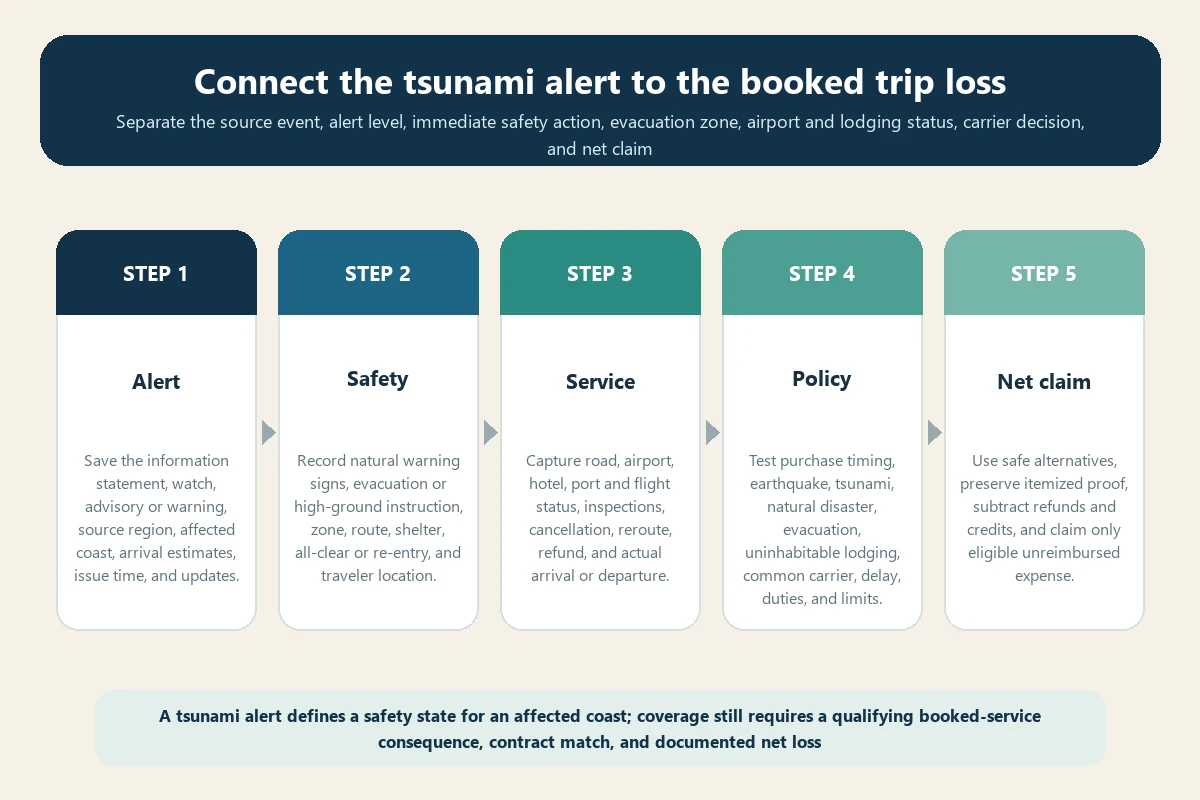
No. It establishes an urgent safety state for the affected coast. Coverage still requires a qualifying booked-service consequence, policy match, eligible expense, and net loss.
What if the coast evacuates but my flight operates?
Preserve the evacuation boundary, traveler and lodging locations, safe access options, flight status, and supplier decisions. Do not describe the operating flight as canceled.
Does earthquake coverage automatically include tsunami loss?
Not necessarily. Read definitions and covered reasons in the issued contract and document which event caused the specific service failure.
Are extra hotel and meal costs covered?
They may qualify under delay or interruption terms after the required trigger and threshold, subject to reasonableness, receipts, daily caps, limits, and recoveries.
When is it safe to return to the coast?
Only when responsible authorities issue the all-clear or re-entry instruction. Multiple waves and dangerous currents can continue for hours.
Bottom line: protect life first, then build distinct evidence chains. The strongest tsunami claim identifies the official alert and safety action, proves exactly which booked service failed, uses supplier remedies, matches the policy, and calculates only the remaining eligible loss.
Earthquake disruption needs separate source-event, local-shaking, inspection, facility, and carrier evidence. Use this earthquake flight cancellation travel insurance guide to preserve supplier remedies, test the issued policy, and calculate eligible net loss.
