
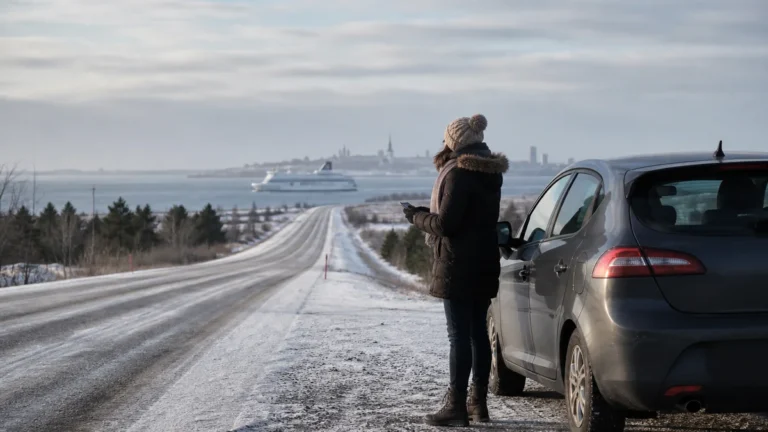
Travel insurance for Estonia from USA trips should be tested against winter roads, rural medical access and Baltic ferry connections. A summer Tallinn weekend is not the same risk as a February rental-car loop or a route joining Estonia, Latvia and Finland on separate bookings.
Key takeaways
- Prepare to pay overseas providers by cash or credit card and file with usable medical records.
- Confirm winter tires, roadside help, vehicle damage and liability with the rental company.
- Separate emergency medical care from rental-car and ferry-delay benefits.
- Include every Baltic country and sea crossing in policy dates and territory.
- Document road, weather, carrier, police and provider facts at the time of an event.
Planning information reviewed August 16, 2026. Road rules, weather, ferry schedules, entry procedures and policy terms can change; verify them for the actual travel dates.
Classify the Estonia trip before buying
Write a route ledger showing the U.S. departure, Tallinn arrival, every overnight location, rental-car day, ferry, neighboring country and return. Add the season, daylight window and booked activity. Mark whether tickets belong to one journey or several independent contracts.
A winter city stay may expose the traveler to slippery sidewalks and flight delays. A rural driving itinerary adds tire, collision, towing and distance-to-care questions. A ferry to Helsinki or Stockholm adds passenger-rights and missed-connection issues. The policy should be evaluated against those concrete events.
The multi-country Europe insurance guide helps align territory for a Baltic circuit.
Entry insurance and private coverage are not identical
Many U.S. citizens visit Estonia for short tourism without applying for a traditional Schengen visa, subject to current rules. Travelers with another passport, a longer stay or a different purpose can face a visa or residence process. Verify the current procedure with the responsible authority.
A traveler who needs a Schengen visa may need a certificate that proves dates, territory, amount and required medical functions. That document does not decide whether a winter collision, ferry delay or existing condition is covered. The full policy does.
Use the Schengen insurance requirements guide for formal proof and read the contract separately for claim protection.
Plan the medical payment path
The U.S. Department of State’s Estonia country information says care outside larger cities can fall short of the standards available in Tallinn, Tartu and Pärnu. It notes that most hospitals and doctors abroad do not accept U.S. health insurance directly and that providers may accept only cash or credit-card payments.
Ask the existing U.S. health insurer about overseas emergency and urgent care. Then ask the travel insurer whether its benefit is primary or secondary, whether assistance can arrange an appropriate provider and whether the traveler must pay first.
- What medical maximum, deductible and coinsurance apply?
- Are existing conditions subject to a lookback period or waiver?
- Which services need authorization?
- Can assistance issue a payment guarantee?
- Which reports, translations and proof of payment are required?
The primary medical coverage guide explains reimbursement order. Carry a realistic payment reserve because insurance status alone does not guarantee direct billing.
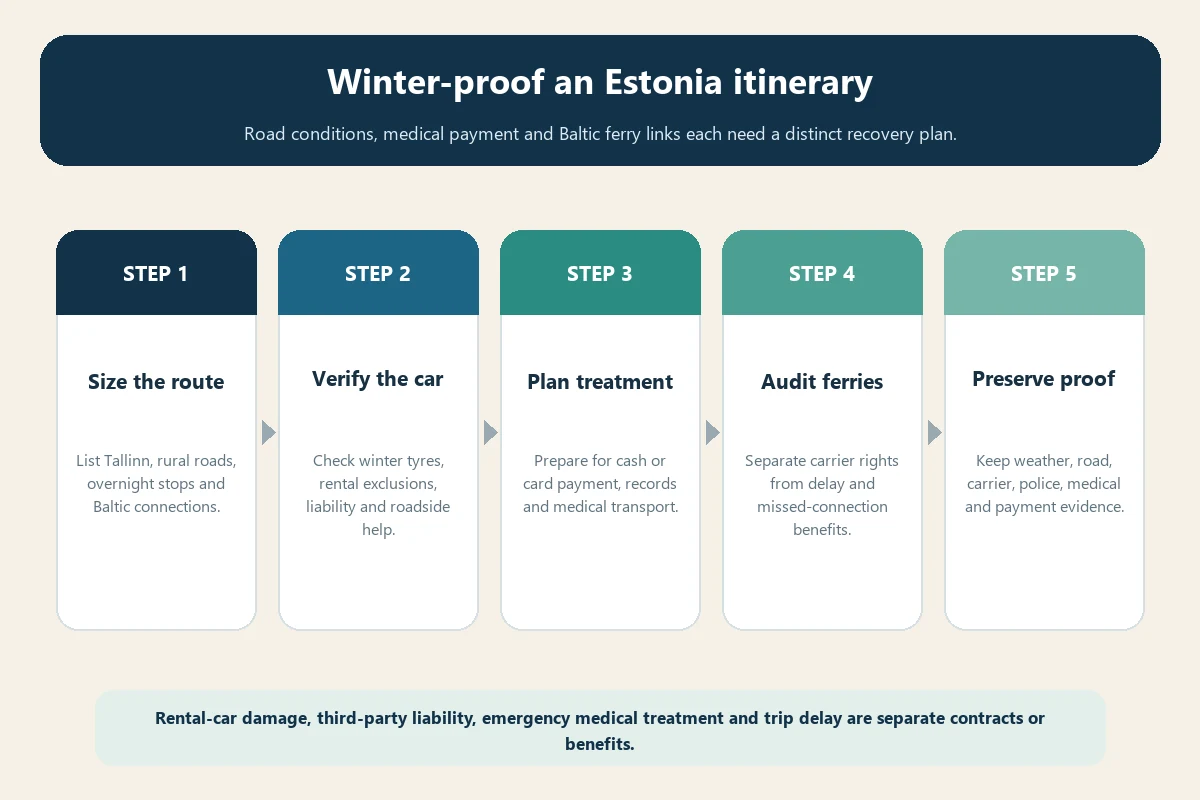
Winter-road conditions need their own plan
Estonia’s Transport Administration explains in its official winter road-maintenance guidance that national roads use several condition levels. Even a high-maintenance road may not provide summer conditions, while medium-level roads can retain snow and ice.
The State Department also warns that winter roads can be icy and dangerous and some rural roads are unpaved. It states that winter tires are required from December 1 to March 1, subject to current local rules. Confirm the rental vehicle’s actual equipment rather than accepting a generic “winter ready” description.
Before driving, record:
- tire type and visible condition;
- scraper, warning equipment and emergency supplies;
- roadside-assistance provider and territorial limit;
- fuel or charging stops and daylight window;
- weather and official road conditions;
- the last practical safe overnight alternative.
A cautious decision to stop driving can prevent a loss, but extra lodging is not automatically insured. The policy still needs a defined covered reason and eligible expense.
Rental-car protection has four layers
Separate damage to the rental vehicle, theft, third-party liability and injuries to occupants. A travel medical benefit addresses covered treatment, not the rental company’s repair bill. A credit-card collision benefit may require the full rental payment on that card and can exclude vehicle types or countries.
| Layer | Where to verify | Main evidence |
|---|---|---|
| Vehicle damage | Rental waiver or card benefit | Condition photos, agreement and repair invoice |
| Third-party liability | Rental contract and mandatory local cover | Police and liability reports |
| Roadside service | Rental assistance contract | Dispatch record and towing receipt |
| Traveler injury | Health and travel medical policy | Medical report and payment proof |
Read the Europe road-trip insurance guide before relying on one protection layer to fill every gap.
What to do after a winter collision
Protect people first. Estonia uses 112 for police, ambulance and fire. Follow responder instructions and do not move the vehicle when local rules or safety require waiting. Contact the rental company and insurer as soon as practical.
Photograph the vehicle positions, road surface, tire condition, surroundings and damage when safe. Record the location, time, weather, witnesses and other vehicle details. Obtain the police or incident record and preserve towing, medical and replacement-transport receipts.
Do not accept or promise liability beyond what is necessary at the scene. Send documents through the correct rental, card and insurance channels and disclose other possible recovery sources.
Baltic ferries and missed connections
A scheduled ferry from Tallinn is a carrier contract. A private excursion boat is not necessarily treated the same way. Record the carrier, departure, arrival, ticket relationship and onward flight or train.
The European Union’s official ship passenger-rights page describes qualifying assistance, rerouting, reimbursement and compensation. Use those remedies before calculating an insurance claim.
Trip delay can require a covered cause and minimum duration. Missed-connection coverage may require a common carrier and a recognized connection. Trip interruption addresses a defined event after departure. The Europe ferry insurance guide compares these paths.
Cancellation and known winter events
Insure the prepaid, nonrefundable amount for flights, lodging, rental cars, ferries and tours. Refundable reservations do not create the same loss. Standard cancellation applies only to reasons defined in the policy.
A winter storm that was already known when the policy was bought may be excluded as foreseeable. A general forecast does not necessarily satisfy a severe-weather trigger. Read the exact consequence required, such as common-carrier cessation, road closure, destination uninhabitability or another named event.
Contact the carrier or supplier for rerouting and refunds first. Save the official notice and timing. Private insurance normally addresses only eligible unrecovered costs.
Medical transport and rural distance
The State Department recommends supplemental medical evacuation insurance. Inspect ambulance, transfer, evacuation and repatriation separately. A plan may transport the traveler to the nearest suitable facility rather than directly to the United States.
Ask who decides suitability, whether assistance must approve the transport and what happens when emergency care begins before contact. The repatriation guide explains the distinctions.
Compare Estonia policies against the route
- complete dates, Baltic countries and ferry crossings;
- medical payment, deductible, existing conditions and assistance;
- ambulance, hospital transfer, evacuation and repatriation;
- rental damage, theft, liability and roadside assistance;
- winter-weather delay, cancellation and interruption triggers;
- ferry and separate-ticket missed connections;
- baggage, electronics and equipment sublimits;
- claim evidence, deadline and appeal procedure.
Check geographic and event exclusions with the Europe country-exclusions guide. The full policy issued for the buyer’s U.S. state controls.
Build the evidence file immediately
For care, collect the diagnosis, medical report, itemized invoice, prescription and proof of payment. For a road event, preserve police, rental, towing and condition records. For a ferry event, keep the original ticket, carrier notice, cause, actual timing and refund decision.
The claim-filing guide provides a chronological structure. Ask for translations only as the insurer directs and keep the original documents.
Create an offline contingency sheet for rural driving with the rental desk, roadside service, insurer, nearest planned lodging and emergency contact. Add the vehicle plate and fuel type after pickup. A working response plan reduces confusion when mobile coverage, battery life or language support is limited.
If several policies might respond, open each file on time and disclose the others. Coordination can affect payment order, but it should not erase the original evidence or the traveler’s duty to mitigate further loss safely.
Frequently asked questions
Is travel insurance mandatory for every U.S. tourist visiting Estonia?
Not as one universal private-policy rule for every short U.S. tourist. Travelers who require a Schengen visa can face formal proof requirements. Verify the current entry procedure for the specific passport and stay.
Will Estonian providers accept U.S. health insurance?
Do not assume direct acceptance. The State Department says providers may require cash or credit-card payment, so plan for reimbursement and document the care.
Does a rental-car waiver cover medical treatment?
Usually not. Vehicle damage, liability, roadside service and personal medical treatment are separate protection layers.
Are icy roads a covered reason to cancel?
Not automatically. The policy must define a qualifying event or consequence, and known or foreseeable conditions can be excluded.
Will ferry delay coverage pay for a missed separate flight?
Only if the cause, waiting period, connection definition and expense satisfy the policy. Carrier rights and refunds apply first.
This article is educational and is not legal, medical or insurance advice. Official authorities, responders, carriers, providers and the issued policy control.
