
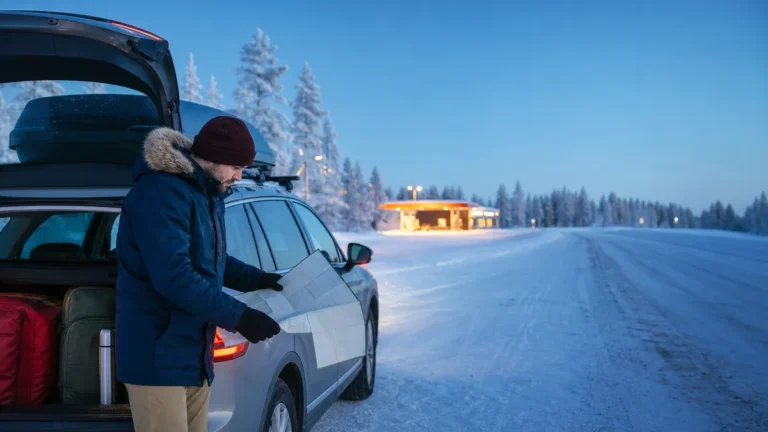
Travel insurance for Finland from USA trips should be matched to Lapland distance, winter driving, outdoor activities and medical transport. Helsinki offers dense services, while a remote resort, wilderness excursion or long rental-car route can be hundreds of miles from the facility an insurer considers suitable.
Key takeaways
- Map airports, hospitals, resorts and remote overnights before choosing medical transport limits.
- Verify the actual rental vehicle, winter tires, roadside assistance and collision protection.
- Declare skiing, snowmobiling, hiking and guided wilderness activities before purchase.
- Distinguish ambulance, helicopter response, medical evacuation and repatriation.
- Use carrier or supplier remedies first and claim only eligible unrecovered delay or interruption costs.
Planning information reviewed August 16, 2026. Weather, road rules, services, entry procedures and policy terms can change; verify them for the actual season and route.
Draw the Finland distance map
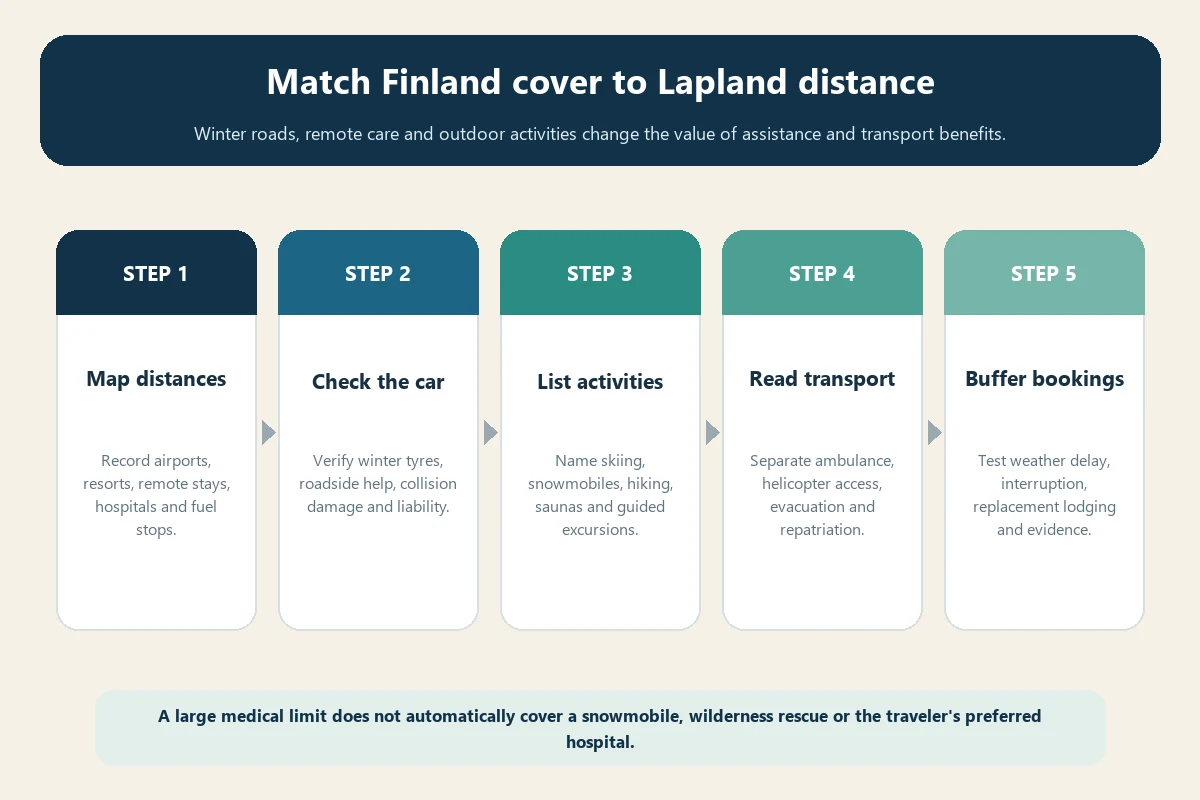
List the U.S. departure, Helsinki connection, northern airport, resort, rental-car legs, excursions and final return. Add the nearest clinic or hospital to each remote overnight and the distance to a larger facility. Record fuel or charging stops and the last safe accommodation alternative.
This map changes the insurance comparison. A high medical maximum is useful, but so are a reachable assistance service, clear transport definitions and a realistic plan for waiting through weather disruption. Include every side trip to Sweden, Norway or Estonia.
Use the multi-country Europe insurance guide when Lapland travel crosses a border.
Entry status and insurance protection
Many U.S. citizens visit Finland for short tourism without applying for a traditional Schengen visa, subject to current rules. Other travelers can require a visa, residence permit or formal insurance certificate. Passport, nationality, residence, purpose and duration determine the procedure.
A certificate used for an entry process does not describe every activity exclusion, vehicle rule or medical-transport condition. The full policy controls those claims. Travelers who need formal proof can review the Schengen insurance requirements guide.
Remote care changes the transport question
The U.S. Department of State’s Finland travel information says ambulance services are widely available in cities and most areas, but response can be longer in sparsely populated Lapland and the nearest hospital can be hundreds of miles away. It also describes medical-helicopter access to wilderness and hard-to-reach locations.
Do not translate those facts into an automatic insurance promise. Local emergency response is not the same as a policy’s medical evacuation benefit. Ask whether the contract covers ambulance, hospital transfer, air ambulance, emergency evacuation and repatriation under separate limits or one combined maximum.
Questions for the insurer include:
- Who decides that transport is medically necessary?
- Does the destination have to be the nearest suitable facility?
- Which services require assistance authorization?
- How does the plan handle an emergency before contact is possible?
- Is non-medical search and rescue included or excluded?
The medical repatriation guide separates local response, evacuation and return home.
Plan the medical payment path
Ask the existing U.S. health plan whether it covers emergency or urgent treatment in Finland, how out-of-network care is reimbursed and whether Medicare limitations apply. Ask the travel insurer whether its benefit is primary or secondary and whether assistance can locate a provider or issue a payment guarantee.
Carry the policy number, assistance contact and a practical payment method. Direct billing can depend on the provider and authorization. Request a diagnosis, medical report, itemized invoice, prescription and proof of payment before leaving a facility.
The primary medical coverage guide explains order of payment. It does not promise cashless access.
Winter tires and rental-vehicle readiness
Finland’s Transport and Communications Agency, Traficom, states in its official winter-tire guidance that winter tires should be used between November and March when conditions require them. It also explains tread depth and snow-grip markings.
Confirm the rental car’s actual tires at pickup, along with an ice scraper, snow brush, warning equipment and roadside contact. Photograph vehicle condition and tire markings. Ask whether the rental agreement restricts unpaved roads, border crossings or misuse in severe conditions.
Finland’s official tourism site publishes a practical winter-driving checklist. It recommends clearing the vehicle, carrying warm clothing, planning fuel or charging and checking live road conditions. Use those precautions for safety, but read the insurance contract to know which extra expenses are payable.
Separate four rental-car protections
| Exposure | Where it may be covered | Common gap |
|---|---|---|
| Damage to rental car | Rental waiver, travel plan or eligible card benefit | Tires, glass, undercarriage or excluded roads |
| Third-party liability | Rental contract and local mandatory cover | Low limits or excluded driver |
| Breakdown or towing | Rental roadside service | Driver error or remote recovery charge |
| Traveler injury | Health and travel medical policy | Activity, alcohol or authorization exclusion |
The Europe road-trip insurance guide provides a contract-by-contract review.
Snowmobiles and winter activities
List downhill and cross-country skiing, snowboarding, snowshoeing, snowmobiling, ice fishing, hiking and guided wilderness tours. Check the policy’s covered-activity list and definitions for recreational, organized, racing, off-piste, backcountry, motorized and guided use.
A snowmobile can be treated as a motor vehicle. Verify licensing, operator, passenger, helmet, route and liability rules. A sports rider may change medical coverage while leaving damage to the machine or third-party liability elsewhere.
For skiing, check marked-area, off-piste, guide and rescue conditions. The Austria Alpine-rescue guide provides a useful comparison between search, mountain rescue, medical evacuation and repatriation.
Weather delay is not automatic coverage
Short daylight, snow, ice and rapid condition changes are foreseeable characteristics of a Finnish winter. Insurance usually requires a defined event and consequence. A traveler choosing not to drive is not automatically the same as an official road closure or common-carrier cancellation.
Record the policy’s delay threshold, severe-weather trigger and required evidence. Save carrier notices, road authority information, actual timings and receipts. When safe and practical, contact assistance before booking a costly replacement.
A weather event known before purchase can fall under a foreseeable-event exclusion. Buying after an announcement normally cannot turn that event into an unexpected loss.
Cancellation, interruption and remote lodging
Calculate prepaid, nonrefundable flights, resort nights, rental car, transfers and activities. Flexible bookings should not inflate insured cost. Standard cancellation pays only for covered reasons defined in the contract.
Trip interruption applies after departure and can address eligible unused arrangements plus additional transport for a covered event. Delay covers shorter qualifying waiting-period costs. A supplier refund or credit reduces the unrecovered amount.
If weather strands the traveler, ask whether replacement lodging is a delay expense, interruption expense or not covered. Preserve the official cause and proof that the original booking could not be used.
Country, sanctions and border exclusions
A northern route can cross Sweden or Norway, while a ferry can connect to Estonia. Verify each country and transit. Also read government-advisory, sanctions, war and civil-disorder wording rather than assuming a worldwide label is unconditional.
The Europe country-exclusions guide shows how geographic and event exclusions interact.
Compare Finland plans against the route
- complete dates, transit countries and remote overnights;
- medical maximum, deductible, provider payment and assistance;
- ambulance, helicopter access, evacuation and repatriation;
- search-and-rescue wording and sublimit;
- rental damage, liability, roadside service and winter conditions;
- skiing, snowmobile and guided-activity definitions;
- weather delay, cancellation and interruption triggers;
- claim deadline, evidence and appeal route.
Use the complete policy issued for the purchaser’s U.S. state. A summary page cannot show every exclusion, definition or authorization rule.
Document incidents in real time
Finland uses 112 for emergencies, and the State Department identifies the official 112 Suomi application. In a serious event, protect the traveler first. Then open an assistance case and save the instructions.
For a road incident, keep photos, police or wildlife report, rental records and towing receipts. For an activity incident, keep the operator report and booking. For medical care, collect the complete provider file. The claim-filing guide organizes the evidence.
Carry an offline route, warm clothing, power bank and the assistance number on paper. Those are safety preparations, not insured benefits. If a breakdown or closure forces an overnight stop, record the official condition, why continuing was unsafe, the roadside contact and the available alternatives before claiming lodging or transport.
For cold-related equipment loss, read the baggage definition carefully. Rental winter clothing, skis, camera batteries and vehicle equipment can have different ownership, custody and sublimit rules. Keep rental agreements and receipts beside the incident record.
Frequently asked questions
Is travel insurance mandatory for every U.S. tourist visiting Finland?
Not as one universal private-policy rule for every short U.S. tourist. Travelers who require a Schengen visa can face formal proof requirements. Verify the current procedure for the specific passport and stay.
Does medical evacuation include a wilderness rescue?
Not automatically. Search, rescue, local emergency response, hospital transfer, evacuation and repatriation can be separately defined and limited.
Will a rental company guarantee correct winter tires?
Confirm the vehicle and conditions directly at booking and pickup. Photograph the tires and read the rental agreement rather than relying on an assumption.
Does a winter-sports rider cover snowmobiles?
Only if the exact motorized activity and all licensing, route, helmet and operator conditions are included. Liability and machine damage can remain separate.
Is a voluntary stop because of snow covered?
Not necessarily. The policy must contain a qualifying trigger and eligible expense. Official closures or carrier cancellations can be treated differently from a personal decision.
This article is educational and is not legal, medical or insurance advice. Official authorities, responders, providers and the issued policy control.
