

Travel insurance for Hungary from USA trips should be selected around the actual route, not just a destination label. A Budapest weekend, a Danube cruise, a thermal-bath visit and a rail journey to Vienna create different medical, interruption and evidence questions. Build the comparison from the bookings and activities that could produce a real loss.
Key takeaways
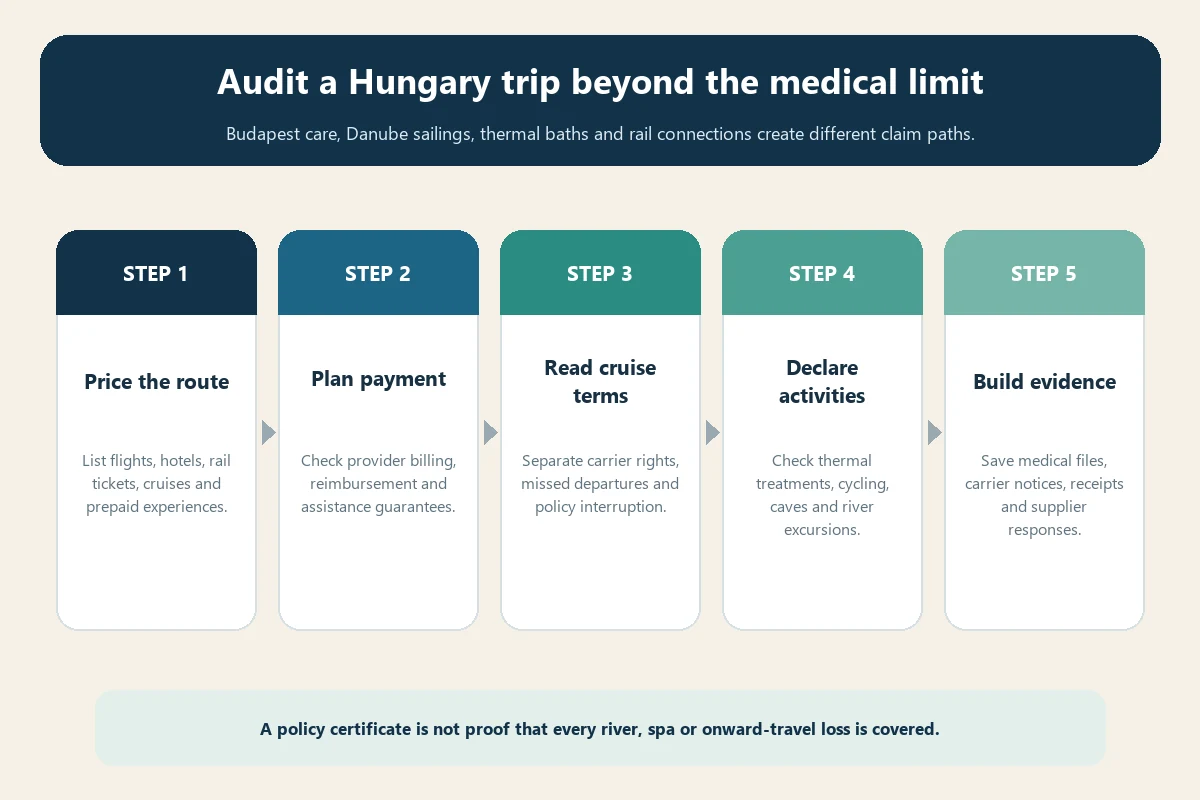
- Check how Hungarian providers bill visitors and whether the plan can arrange or guarantee payment.
- Separate river-carrier remedies from insurance for unused bookings and additional transport.
- Read exclusions for thermal treatments, cycling, caves and other planned activities.
- Include every neighboring country and transit point in a multi-country itinerary.
- Save contemporaneous medical, carrier, supplier and payment records for a claim.
Planning information reviewed August 16, 2026. Entry procedures, transport schedules, provider practices and insurance wording can change. Verify current facts for the travel dates.
Start with a Hungary loss map
Write the trip as a sequence: U.S. departure, connecting airport, Budapest hotel, prepaid tours, cruise embarkation, rail segments, rural nights and return. Beside each item, record its cancellation terms and the cost that would remain after a supplier refund. This produces a defensible insured-trip-cost figure.
Next, add the events that could break the sequence. Examples include an illness before departure, hospital treatment in Budapest, a delayed flight that misses a sailing, a river itinerary change or a rail disruption on a separate ticket. The policy must contain both a covered event and an eligible expense; an inconvenient change alone is not enough.
If the route also enters Austria, Slovakia, Croatia or another country, use the multi-country Europe insurance guide to check dates, territories and transit.
Entry paperwork is not the complete policy
Many U.S. citizens take short tourism trips to Hungary under current Schengen rules without applying for a conventional visa. Other passports, purposes or durations can require a visa or residence permission. Verify the procedure for the traveler’s nationality, residence, purpose and full itinerary.
A visa insurance certificate, when required, addresses an entry standard. It does not prove that cancellation, baggage, river cruising, private treatment or a preferred hospital is insured. Read the certificate, schedule, definitions and exclusions together. The Schengen insurance requirements guide explains that distinction.
Plan how medical care will be paid
The U.S. Department of State’s official Hungary travel information says emergency care may be billed later, while non-emergency care generally requires payment by the traveler or private insurance. It also warns that credit cards are not universally accepted and recommends medical-evacuation protection.
Ask the existing U.S. health plan whether care abroad is covered, whether the provider is treated as out of network and which documents are required. Medicare usually has limited coverage outside the United States, subject to narrow exceptions. Confirm the travel plan’s deductible, benefit order and treatment of pre-existing conditions rather than assuming one policy automatically pays first.
Ask the insurer’s assistance service whether it can identify an appropriate clinic, communicate with a hospital or issue a payment guarantee. Direct billing is never certain merely because assistance is available. Carry a usable payment method and a backup. The primary medical coverage guide shows how payment order affects reimbursement.
Separate ambulance, evacuation and repatriation
Calling local emergency services, taking an ambulance to a Budapest hospital, transferring to another facility and returning medically to the United States are distinct events. A plan can define and limit them differently. Review who decides medical necessity, which destination is permitted and when advance authorization applies.
Do not assume “evacuation” means transport to a hospital of personal choice. Many contracts refer to the nearest suitable facility. A later return home can require separate approval and medical coordination. The evacuation and repatriation guide provides a clause-by-clause checklist.
Audit a Danube cruise as two contracts
A river itinerary usually combines a carrier contract with land arrangements such as hotels, flights and transfers. Read the cruise terms for water-level changes, substituted transport, itinerary alteration, boarding deadlines and passenger responsibilities. Then compare those terms with the insurance definitions for delay, missed connection, cancellation and interruption.
The European Union’s official ship passenger-rights guidance describes assistance and compensation rules for covered services, with exceptions. A carrier remedy and an insurance benefit are not cumulative windfalls. A refund, reimbursement or credit can reduce the loss submitted to the insurer.
A changed port or shortened sightseeing program is not automatically an insured interruption. The policy may require a named cause, a minimum delay or complete cessation of the trip. Ask how a missed sailing is handled when the inbound flight and cruise were purchased separately.
Use the Europe ferry and passenger-vessel guide to compare the carrier response with the policy response.
Budapest public transport can protect the evidence trail
Keep the tickets and service information used to reach an appointment, replacement hotel or departure point. Budapest’s official transport authority publishes current information about boat services. A sightseeing boat, public boat, river cruise and private transfer may have different operators and contractual remedies.
When disruption occurs, save the operator name, route, scheduled and actual times, cancellation notice and alternative offered. A screenshot without the date or service number may not connect the loss to the claimed booking. Keep receipts for replacement transport and an explanation of why it was reasonable.
Thermal baths require an activity check
Budapest’s baths are a major reason to visit, but “spa” can describe ordinary bathing, wellness services, a prescribed treatment or an elective medical procedure. Insurance may distinguish accidental injury, sudden illness, routine care, rehabilitation, preventive services and planned treatment.
Travelers with heart, blood-pressure, mobility or other health concerns should seek appropriate medical advice before using hot pools or saunas. That safety decision is separate from coverage. Check whether a medical condition was stable, disclosed when required and subject to a waiver or look-back period.
If treatment is the purpose of travel, ordinary leisure-trip insurance may exclude related losses. Request the relevant definition in writing. Do not describe a planned procedure as an unexpected illness.
Check cycling, caves and countryside activities
List every planned activity rather than asking whether “adventure” is covered. Hungary itineraries can include city cycling, e-bikes, horseback riding, cave tours, hiking, kayaking or organized events. Look for conditions concerning helmets, guides, depth, altitude, racing, professional participation and alcohol.
Also separate medical benefits from third-party liability and equipment damage. Coverage for an injured cyclist does not necessarily pay for damage to a rented e-bike or another person’s property. The rental agreement can place those costs on the traveler.
Rail connections depend on the ticket structure
A Budapest-to-Vienna or Budapest-to-Bratislava train can be part of a larger itinerary. Determine whether the journey is sold as one through ticket or as separate contracts. A missed connection on one continuous ticket may receive a carrier response that is unavailable when the traveler created a tight self-transfer.
The EU’s official rail passenger-rights overview explains rerouting, assistance and compensation for covered rail journeys. Eligibility and exceptions matter. Insurance may address eligible costs left after the railway fulfills its obligation.
Do not insure a flexible or refundable fare as if it were fully nonrefundable. Keep each ticket, the conditions of carriage and proof of any carrier refund. The Europe train travel insurance guide explains through-ticket and self-transfer risk.
Use the right benefit for the time of loss
| Situation | First place to look | Evidence to preserve |
|---|---|---|
| Illness before U.S. departure | Trip cancellation covered reasons | Diagnosis, physician advice, booking terms |
| Overnight wait after departure | Carrier remedy and trip delay | Official cause, times, hotel and meal receipts |
| Trip ends early after a covered event | Trip interruption | Unused bookings and added return transport |
| Danube schedule changes but trip continues | Carrier contract, then policy wording | Original and revised itinerary, refund response |
| Hospital treatment | Health plan and travel medical benefit | Medical report, itemized bill, proof of payment |
Benefit names are not interchangeable. Delay usually requires a waiting period; cancellation operates before departure; interruption operates after the trip begins. Read the covered reasons and maximums for each.
Compare plans with a Hungary worksheet
- all countries, transit airports, dates and travelers;
- nonrefundable trip cost after supplier remedies;
- medical maximum, deductible, benefit order and direct-payment process;
- ambulance, facility transfer, evacuation and repatriation definitions;
- river cruise, missed connection and itinerary-change wording;
- thermal, cycling, cave and water-activity exclusions;
- rail ticket structure, delay thresholds and replacement transport;
- claim notice, documentation and appeal deadlines.
Compare the full contract issued for the purchaser’s U.S. state. A marketing summary can omit exclusions, sublimits and authorization conditions.
Build a claim file while the event is happening
For medical care, request the diagnosis, clinician notes, itemized invoice, prescription and payment receipt before leaving the provider. For transport, obtain the official reason, scheduled time, actual time and the remedy offered. For a prepaid tour or cruise, keep the supplier’s written refund decision.
Open an assistance case promptly when it is safe to do so. Record the case number, instructions and contact time. Avoid discarding original tickets or replacing a booking without documenting the available options. The travel insurance claim guide provides an evidence index.
Finally, disclose the complete geography. A Danube trip may enter countries with different advisories or exclusions. Check the Europe country-exclusions guide before purchase and again before departure.
Frequently asked questions
Is travel insurance mandatory for every U.S. visitor to Hungary?
There is no single private-policy requirement that applies identically to every U.S. tourist. Visa status, passport, purpose and duration can change the documentation required. Verify current official entry rules.
Will a travel policy pay a Hungarian hospital directly?
Not necessarily. Direct payment depends on the provider, insurer, assistance authorization and situation. Prepare for reimbursement and collect complete medical and payment records.
Does cruise coverage pay whenever the Danube itinerary changes?
No. The carrier’s contract and the policy’s covered-event definitions control. A port change without an eligible financial loss may not produce an insurance benefit.
Are thermal baths treated as an excluded medical treatment?
Ordinary bathing, wellness services and planned treatment can be treated differently. Check the precise activity and medical-treatment definitions in the issued contract.
Does insurance cover a missed train to Austria?
It depends on the cause, ticket structure, connection time, carrier remedy and policy trigger. A self-created connection on separate tickets can leave a larger gap.
This article is educational and is not legal, medical or insurance advice. Official authorities, providers, carriers and the issued policy control.