
Travel insurance flight cancellation due to war usually involves two different answers. The airline may owe a refund or rebooking because it canceled the flight, while the policy may exclude losses caused directly or indirectly by war, hostilities, military action, or a related government order.
This U.S. guide explains how to protect the supplier remedy, read conflict exclusions, handle known-event timing, plan safe alternatives, and claim the remaining eligible loss. It is educational, not legal, security, aviation, financial, or insurance advice.
Start with the airline, not the insurer
The U.S. Department of Transportation’s Refunds guide says a passenger is entitled to a refund when the airline cancels, regardless of reason, if the passenger chooses not to travel or accept alternative compensation.
Request the fare and eligible ancillary fees in the original payment form when due. Insurance generally measures unrecovered loss, so the refundable airfare should not be claimed twice.
Refund, reroute, and voucher are different choices
A refund ends the carrier’s obligation to transport on the canceled ticket. A confirmed reroute continues the journey. A voucher converts money into future carrier value and can carry expiration, route, transfer, capacity, or blackout restrictions.
Compare final arrival, transit countries, airspace, baggage, documentation, accessibility, and onward protection before accepting. Preserve the exact offer and response deadline; the decision changes both safety and the insurance ledger.
War is broader than a formally declared war
Policies can exclude war, invasion, hostilities, warlike operations, military action, civil war, rebellion, insurrection, or related consequences whether war is declared or not. Causation language may extend to losses arising directly or indirectly from those events.
Copy the entire clause and definitions. Do not decide coverage from a headline, destination advisory, or use of the word “conflict” in an airline email.
Identify why the airline actually canceled
A carrier may cancel because airspace closed, an airport shut, security risk increased, insurance or crew permissions changed, fuel became unavailable, sanctions restricted service, an aircraft could not reposition, or commercial demand collapsed.
Ask the operating carrier for a written flight-specific reason. Build the causal chain from event to operational decision rather than assuming every cancellation near a war was caused by combat.
Airspace closure may carry government-action issues
A state or aviation authority may close airspace or issue routing restrictions. Even without physical damage, a policy’s government regulation, government action, prohibition, or war exclusion may affect the claim.
Preserve the issuing authority, geographic scope, effective time, routes affected, airline response, and available alternatives. If traffic management rather than conflict caused the delay, compare our air traffic control delay guide.
Terrorism and war are not interchangeable
A policy may provide a narrow terrorism cancellation benefit while excluding war or military action. Terrorism can have its own actor, intent, designation, distance, timing, city, itinerary, and advisory requirements.
Find whether an express terrorism provision overrides any exclusion and for which benefits. Do not use “terrorism covered” to infer that state military action, missiles, invasion, or generalized hostilities qualify.
Civil unrest may form a third category
Demonstrations, riot, civil disorder, rebellion, and insurrection can appear in different definitions or exclusions. A carrier’s security cancellation does not establish which legal or policy category applies.
Save official notices and objective facts, then ask the insurer for the exact clause used. Avoid making political or legal classifications in the claim narrative.
Known-event timing is crucial
Insurance covers uncertain future events. A conflict, escalation, advisory, airspace closure, route suspension, or insurer notice may make later losses known or foreseeable under the policy.
Record first trip deposit, quote, policy purchase and effective date, conflict event, government advisory, carrier schedule action, and cancellation. The State Department’s current Worldwide Caution illustrates why travelers should preserve dated alerts and confirm airline operations. There is no universal known-event date across all products and routes.
Buying before the conflict does not guarantee payment
An earlier purchase may defeat one known-event objection but cannot erase an applicable war exclusion. The policy still needs a coverage grant that reaches the event, destination, dates, expense, and traveler.
Ask for a written coverage decision citing the clause, causal link, and evidence. Preserve the certificate version and endorsements issued at purchase.
Fear of travel is usually not a standard covered reason
A traveler may reasonably feel unsafe even when the airline still operates. Standard named-reason cancellation generally does not pay merely because the traveler changes plans or fears escalation, unless specific wording applies.
Follow official safety advice. For contractual flexibility, our Cancel For Any Reason guide explains purchase deadlines, insured trip cost, cancellation cutoff, and partial reimbursement.
CFAR has strict timing and percentage rules
CFAR is optional and typically must be purchased soon after the initial deposit, insure the required trip cost, and be used before a stated predeparture deadline. It normally pays only a stated percentage of eligible prepaid nonrefundable cost.
It is not emergency evacuation, does not reimburse airline-refunded fare, and may not help after the traveler has already departed. Read the issued endorsement, not a generic product description.
Trip delay can apply to a pre-cancellation wait
A flight may first be delayed for hours and later canceled. Reasonable meals, lodging, or local transport during the waiting phase may fall under trip delay only if the policy’s cause and threshold are satisfied and no exclusion controls.
Record scheduled departure, every status update, cancellation time, carrier amenities, and itemized expenses. Use our flight-delay coverage guide to test the separate clock.
Interruption matters after the trip begins
A traveler already abroad may lose the return flight, need a safe reroute, or abandon unused arrangements. Trip interruption can address unused prepaid cost and additional transport only under its covered reasons, limits, exclusions, and authorization terms.
Use our delay, interruption, and cancellation comparison to assign each expense to the correct stage. Do not call an in-trip departure an ordinary predeparture cancellation.
Government departure assistance is not insurance
The State Department’s Crisis Response and Evacuations guidance recommends leaving while commercial transportation is safely available. When commercial options are unavailable and conditions permit, the government may coordinate movement to a nearby safe location.
Such transportation may be reimbursable to the government, may not go to the United States, and generally does not include in-country pickup, lodging, or onward travel. It neither proves nor replaces an insurance benefit.
Prioritize safety over claim optimization
Follow local authorities, embassy alerts, airport instructions, and legitimate carrier communications. Do not enter a closed airport, cross an unsafe route, or delay a safe departure solely to preserve a receipt or wait for insurer authorization.
When safe, contact assistance, record the case number and instruction, and explain any emergency decision that made prior approval impossible.
Check transit points and airspace, not only destination
A reroute can avoid the destination airport but cross affected airspace or require transit through another country. Verify flight operation, entry and transit documents, advisories, airport status, baggage, connection protection, and lawful payment.
Save availability and price at the decision time. A costly alternative is easier to defend when the traveler can show why cheaper routes were closed, unsafe, unavailable, or unconfirmed.
Fuel and crew consequences need separate classification
Conflict can disrupt fuel supply or strand airline crews. The immediate carrier code may say fuel shortage or crew unavailable even when the upstream event is war-related.
Use our fuel shortage coverage guide or crew shortage coverage guide to document those operational branches without hiding the conflict connection.
Protect downstream supplier refunds
Contact hotels, tours, cruises, rentals, event organizers, and transfer providers before no-show deadlines. Ask for refund, date change, credit, waiver, or late-arrival protection and preserve each response.
The airline refund covers transportation, not every booking. Insurance evaluates only eligible nonrefundable cost after supplier recovery and exclusions.
Build a charge-by-charge ledger
List airfare, ancillary fees, replacement travel, lodging, meals, ground transport, unused hotel, tours, cruise, and onward travel. For each line record payer, supplier, policy section, refund, voucher, card benefit, government charge, and balance.
Use our supplier-refund and subrogation guide to prevent duplicate recovery. Disclose restricted credits and ask the insurer how it valued them.
Assemble the evidence packet
Include the issued policy, purchase proof, original itinerary, carrier cancellation and stated reason, refund or reroute offers, official alerts and airspace notices, traveler location, revised route, final arrival, unused bookings, supplier responses, receipts, recoveries, and assistance communications.
File through our travel-insurance claim guide. If denied, request the exact exclusion, causation wording, known-event date, and appeal deadline rather than arguing only that the airline canceled.
War-related flight cancellation checklist
- Get the airline’s cancellation and exact reason in writing.
- Choose deliberately among refund, safe reroute, and voucher.
- Separate war, terrorism, unrest, airspace, sanctions, fuel, and crew.
- Record policy purchase, advisories, event, and carrier-action dates.
- Read causation, exclusions, exceptions, and CFAR terms together.
- Follow official safety instructions and preserve assistance contacts.
- Check every transit country and route, not only the destination.
- Request refunds or changes from downstream suppliers promptly.
- Keep itemized expenses and evidence of reasonable alternatives.
- Subtract all refunds and benefits before claiming net loss.
Bottom line
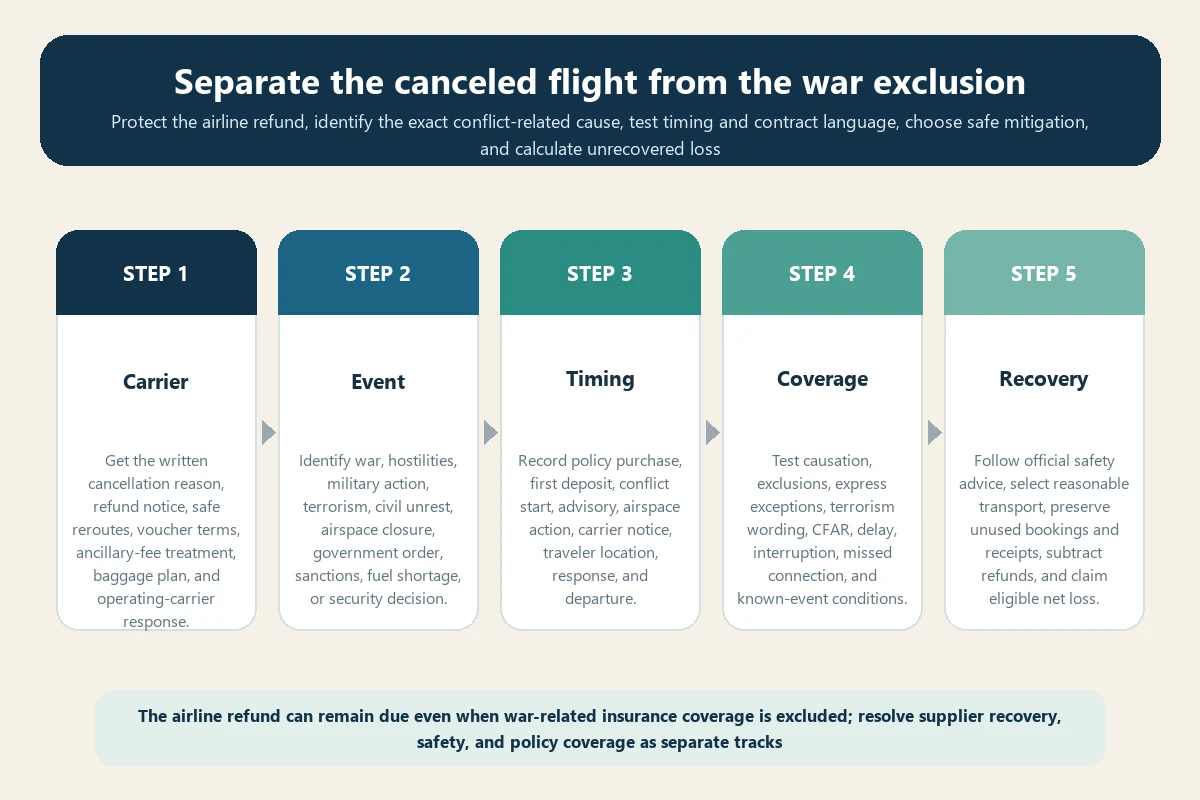
Travel insurance flight cancellation due to war begins with the carrier’s refund or safe rebooking obligation, but insurance depends on the exact event, causation language, exclusions, exceptions, and purchase timeline.
Handle safety, supplier recovery, and policy coverage as separate tracks. Their documented intersection—not the canceled-flight label—determines whether an eligible loss remains.
Closed or restricted airspace needs its own order, scope, cause, and reroute analysis. Use this travel insurance airspace closure coverage guide to preserve airline refunds, verify the aviation restriction, test exclusions and timing, and calculate net loss.
