

Travel insurance for Hong Kong from USA trips should be built around hospital deposits, official storm signals and supplier-level proof. A Signal No. 8 can change transport and venue operations, but it does not automatically reimburse every hotel night, ferry ticket or side trip.
Key takeaways
- Prepare for hospital deposits and non-resident public hospital charges.
- Save the Hong Kong Observatory signal and each operator response.
- Test flights, ferries, rail and timed venues as separate contracts.
- Check policy territory before adding Macau or mainland China.
- Claim only eligible costs left after refunds, credits and rebooking.
Planning information reviewed August 16, 2026. Advisories, Hospital Authority charges, storm systems, supplier operations and policy terms can change. Recheck official and supplier information for the travel dates.
Build a Hong Kong cost and booking ledger
List U.S. flights, airport transport, hotel nights, attraction tickets, tours, ferries and any rail or flight to a side destination. Record the refund deadline, change option and prepaid amount for each.
Add the traveler’s medical payment capacity and U.S. health-plan rules. This ledger exposes the two main financial risks: paying for care locally and losing a booking after an operational shutdown.
Use the delay, interruption and cancellation guide to separate extra lodging, replacement transport and unused arrangements.
Prepare for a hospital admission deposit
Current U.S. Department of State Hong Kong destination information says good medical facilities and ambulance services are widely available. It also says travelers can be asked for a deposit before hospital admission and that hospitals and clinics generally accept credit cards.
Ask the travel insurer whether it can issue a payment guarantee to a named facility. Confirm whether that guarantee is accepted, how long authorization takes and what the traveler must fund first.
The health insurance abroad guide structures the call to the U.S. plan. Local payment, insurer coordination and later reimbursement are separate steps.
Use current public hospital charges as planning evidence
The Hong Kong Hospital Authority publishes official fees and charges. Its rates effective January 1, 2026 distinguish eligible from non-eligible persons. A typical U.S. visitor without Hong Kong resident status is generally in the non-eligible category.
The published non-eligible rates include HK$2,100 for an Accident and Emergency attendance, HK$7,400 per general inpatient day and HK$35,600 per intensive-care day. These figures are planning examples, not a prediction of a final bill. Procedures, medicines and other services can add costs.
Recheck the official schedule before travel. Avoid converting one public tariff into a universal policy-limit recommendation. Age, private care, length of stay, transfer and evacuation can materially change exposure.
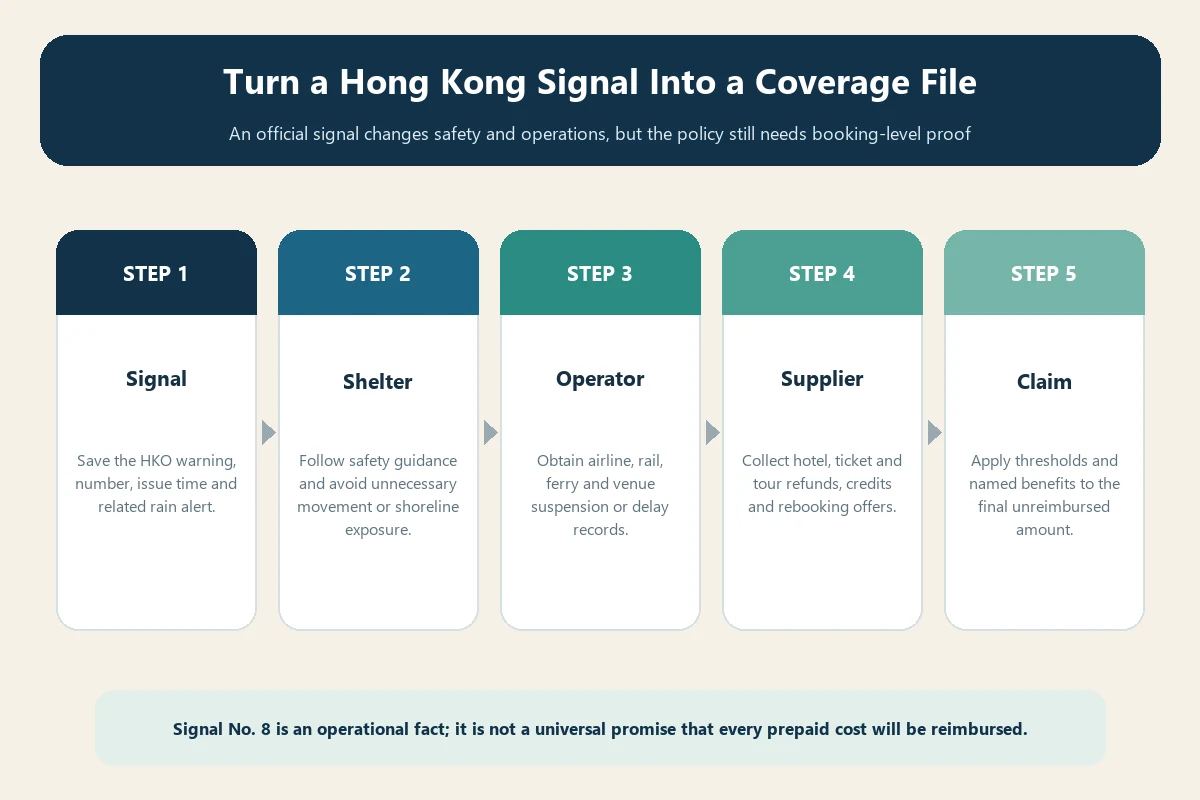
Understand the official tropical cyclone system
The Hong Kong Observatory explains precautions for tropical cyclone warning signals. It says tropical cyclones normally occur from May through November and are particularly prevalent in September.
The Observatory issues bulletins and warnings when a cyclone within 800 kilometers poses a threat. Its instructions escalate from monitoring and securing objects to avoiding streets, coastlines and exposed windows during higher signals.
Save the signal number, issue time, related rain warning and safety instruction. Follow the warning before handling bookings or calling the insurer.
Do not treat Signal No. 8 as a universal benefit
The State Department notes that its consulate closes when Hong Kong announces Signal No. 8 or above or a Black Rainstorm Warning. Other operators make their own safety and service decisions under applicable rules.
Obtain the airline, MTR, ferry, venue and tour notice that affected the booking. Ask whether the policy requires a common-carrier delay, minimum number of hours, mandatory evacuation or accommodation closure.
The weather-delay guide explains why an official signal, supplier cancellation and named policy trigger must be documented separately.
Track known-event timing
A tropical cyclone develops over time. Build a chronology showing first trip payment, policy purchase, storm formation, Observatory signal, carrier action, hotel response and traveler expense.
If insurance is purchased after the storm is known or foreseeable under the policy, losses from that storm may be excluded. Record the exact purchase time and effective date rather than relying on a general booking email.
Ask how the policy defines a known event and when coverage begins. The answer can differ for cancellation, delay and optional cancel-for-any-reason benefits.
Audit the airport and airline decision
A public warning does not state whether a particular flight is delayed, canceled or operating. Save the airline notice, scheduled departure, new departure, alternate offer and refund or credit.
Ask whether airport transport disruption is treated differently from flight delay. If the airline operates but the traveler chooses not to move during dangerous conditions, document the official instruction and ask how the policy evaluates that decision.
Keep boarding passes, rebooking receipts and added hotel bills. Claim only the amount left after airline recovery.
Separate ferry cancellation from port access
List each ferry operator, terminal, sailing and onward booking. A sailing may be canceled because of sea conditions, while a terminal can also become hard to reach because of local transport suspension.
Obtain the operator’s cancellation and refund record. Then document the hotel, tour or flight missed afterward. The ferry travel insurance guide provides a contract-by-contract audit method.
Do not assume a missed Macau hotel is reimbursed merely because a Hong Kong ferry stopped. The policy must connect the covered event to the prepaid, nonrefundable loss.
Check rail and cross-boundary tickets
MTR, airport rail and cross-boundary rail tickets can have different supplier terms. Record each operator and ticket separately. Ask whether the service qualifies as a common carrier and how a missed connection is measured.
If a train is suspended, obtain the official record and alternate option. Keep the original itinerary and any replacement fare. Disclose ticket refunds and credits.
The route must have been feasible before the disruption. A tight self-created connection may not meet the policy’s reasonable-connection rule.
Verify territory for Macau and mainland China
A side trip can cross into a different jurisdiction with separate entry rules, advisories and medical systems. Confirm that Hong Kong, Macau and mainland China all fall within the policy’s territorial definition for the planned dates.
Review each destination’s official guidance. Ask whether an advisory, regional exclusion or border disruption affects benefits. Insurance cannot grant entry or override local law.
The country exclusions and advisories guide provides a framework for checking geography, advisory timing and excluded events.
Test medical evacuation realistically
Hong Kong has strong medical facilities, so an insurer may view transfer to an appropriate local hospital differently from transport to the United States. Ask who determines medical necessity and destination.
Confirm whether prior authorization is required when reasonably possible, how a companion is treated and whether onward movement across a border requires separate approval. A headline limit does not guarantee a chosen destination.
The medical evacuation limits guide helps compare authority, sublimits and transport stages.
Plan assistance and documentation
Store 999 for local emergency services, the insurer’s international assistance number, policy number and hospital details offline. Give a companion authority to speak with the insurer.
Ask whether assistance can locate an appropriate facility, coordinate payment and arrange a transfer. Record the representative, time, instruction and case number. A referral does not guarantee reimbursement.
The assistance line versus claims guide explains the difference between urgent coordination and later adjudication.
Compare policies with one Hong Kong scenario
Use the same traveler ages, dates and prepaid costs. Include five hotel nights, attraction tickets, a Macau ferry, a separately booked onward flight, Signal No. 8 and an emergency admission requiring a deposit.
- How does the facility deposit get funded?
- Which public or private medical costs are eligible?
- What supplier action and delay threshold trigger weather benefits?
- How are ferry, rail and separately ticketed flight connections treated?
- Does the policy territory include every side destination?
- Who authorizes transfer or medical evacuation?
Read the certificate and endorsements. Generic Google prices and fixed medical limits do not answer these operational questions. Compare the same scenario across every plan.
Protect timed tickets and nonrefundable events
Record attraction, restaurant, meeting, conference and tour cancellation terms. A transport shutdown does not automatically make every missed timed reservation a covered loss.
Ask the supplier for a refund, credit or reschedule. Keep its written decision. The trip cancellation guide explains why named reasons and supplier recovery come first.
If the value remains usable, disclose it. The insurer generally evaluates the final eligible loss after recoveries.
Build the claim file chronologically
Keep Observatory warnings, airline notices, ferry records, hotel decisions, original tickets, replacement receipts and refunds. For medical care, preserve diagnosis, itemized charges, deposit receipt, payment proof and discharge instructions.
The travel insurance claim guide explains coordination among suppliers, the U.S. health plan and travel insurer. Record Hong Kong dollars and the actual card conversion.
Label each cost by date, traveler, booking and reason. A clean chronology shows how the official event changed a specific contract and what remained unpaid.
Rehearse a Signal No. 8 hotel day
Ask the hotel where guests should shelter, how late checkout or added nights are handled and which services stop at higher signals. Store food, medicine and charging needs before conditions deteriorate, following official advice.
Then identify who will monitor the airline, ferry and next hotel. Keep safety decisions separate from reimbursement work. This rehearsal shows which bookings require direct supplier confirmation and which expenses may need a receipt if the disruption crosses a policy threshold.
Bottom line
A strong Hong Kong plan replaces broad storm assumptions with verified processes. Prepare for medical deposits, understand official signals, audit each operator and check every side-trip territory. Then preserve the records that connect the real event to an eligible, unreimbursed loss.
