
Travel insurance tornado flight cancellation coverage depends on the tornado’s documented consequence for the booked trip—not merely on a watch, warning, or dramatic image. A tornado threat can send passengers and workers to shelter, stop ramp activity, close an airport, damage facilities, disrupt utilities, or leave flights operating after the warning expires. Each outcome requires different proof.
This U.S. guide explains how to connect the official alert, safety action, operational response, carrier decision, policy wording, supplier recovery, and net expense. It is educational, not meteorological, emergency, aviation, structural, legal, medical, or insurance advice.
Tornado cancellation coverage at a glance
- Save the watch or warning, polygon, storm location, motion, and exact time.
- Follow shelter instructions and document the terminal or ramp safety pause.
- Separate operational stoppage from confirmed physical damage.
- Get the airline’s final flight-specific reason and every remedy.
- Compare purchase timing and test the correct policy trigger and threshold.
- Subtract refunds and credits before claiming documented net loss.
Reviewed August 17, 2026.
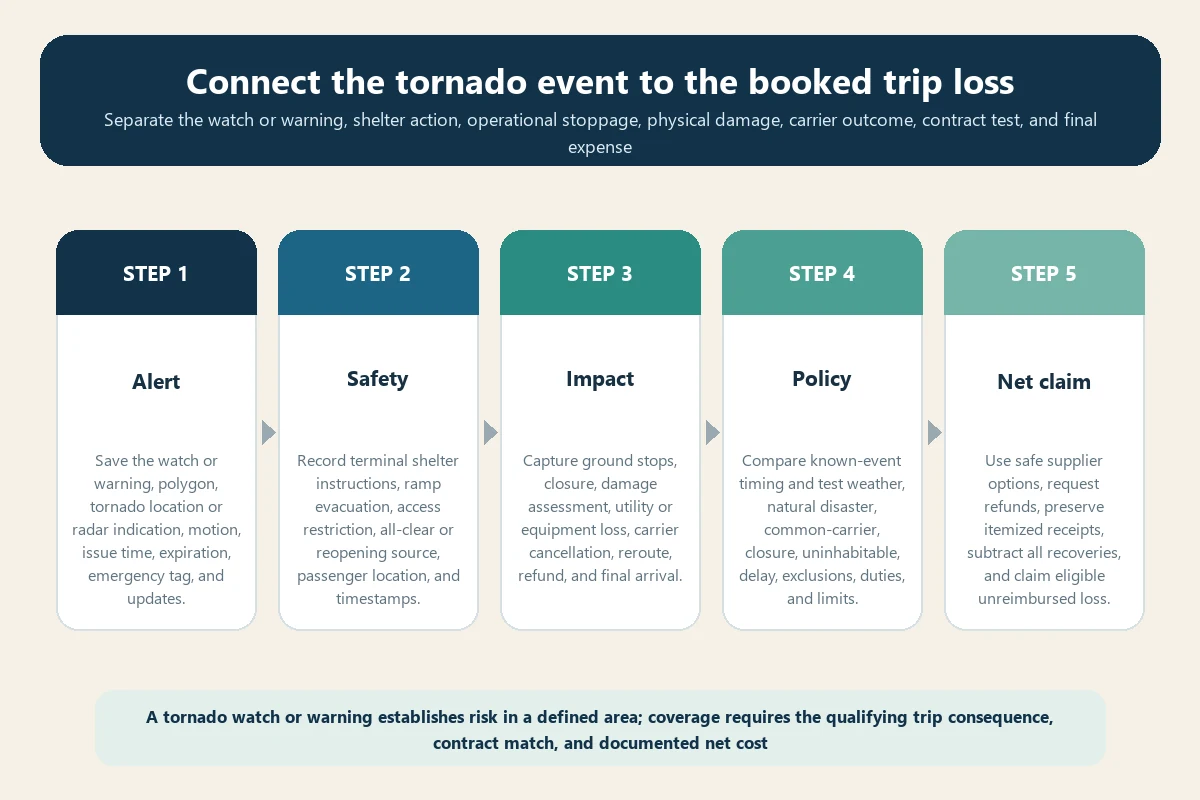
A Tornado Watch and Warning are not interchangeable
A Tornado Watch means tornadoes are possible across a broad watch area and people should prepare. A Tornado Warning means a tornado has been observed or indicated and people in the warned area should act immediately. The National Weather Service’s tornado safety resources emphasize that warnings can leave only seconds to take shelter.
A watch can support foreseeability and planning evidence but does not prove that a tornado reached the airport. A warning provides a narrower place and time but still does not prove airport closure, flight cancellation, or physical damage.
Preserve the complete official alert
Save the issuing office, watch or warning number, affected polygon, counties, storm location, radar or spotter basis, motion, issue time, expiration, tornado-emergency or damage-threat tag if present, and every update. Keep the URL and an uncropped image with timestamp and legend.
Later survey data can confirm a tornado path and damage rating, but it does not replace contemporaneous evidence. A final track may pass several miles from the airport while the warning polygon included it. Preserve both records and explain the difference.
Shelter first; the claim can wait
NWS guidance on what to do during a tornado instructs people in workplaces and public settings to proceed quickly and calmly to designated shelter areas, away from windows and large open rooms. Follow airport and emergency instructions.
Do not remain at a window, cross an exposed terminal, enter a vehicle, or leave shelter to photograph the storm. Evidence can come from official alerts, carrier messages, terminal announcements, and later records.
A terminal shelter order is not an airport closure
An airport may direct passengers into interior areas and evacuate ramp workers while airfield status is still being assessed. Boarding, screening, baggage, fueling, pushback, and gate operations can stop. Air traffic may hold or divert independently.
Record the shelter announcement, passenger location, work stopped, start time, source of reopening or release, and backlog. Do not label it a full airport closure unless an authoritative notice says the airport or relevant operation closed.
Map the alert to origin, connection, and destination
A tornado can affect the origin, connection, destination, alternate airport, inbound aircraft, or road access. Record which facility was inside the warning and when. A destination warning may clear before the flight departs, while an origin warning can delay the same itinerary hours later.
Use local airport, FAA, carrier, emergency-management, and transportation records. General FAA traffic information describes system conditions, but the FAA advises passengers to confirm flight-specific impact with the carrier.
Document the aviation response
Possible responses include ramp suspension, ground stop, ground delay program, airspace reroute, holding, diversion, airport closure, runway inspection, equipment shutdown, and damage assessment. Preserve the facility, stated cause, scope, start, expected end, extensions, and cancellation.
Our air traffic control delay guide explains flow restrictions. If a formal facility closure occurs, use the evidence method in the airport closure coverage guide.
Physical damage is a separate trigger
A tornado warning does not prove that a terminal, runway, radar, hotel, rental, or destination attraction was damaged. If damage occurred, preserve the supplier’s inspection, closure notice, cancellation, refund position, and expected reopening.
Policy wording may distinguish weather disruption from a natural disaster that makes lodging uninhabitable or the destination inaccessible. Photographs can support a file, but supplier and authority records are stronger for showing whether the booked service could be delivered.
Utilities and access can fail after the storm
Even if the tornado misses the airport, downed power, communications loss, blocked roads, fuel interruption, debris, or damaged navigation equipment can delay recovery. Record the utility or transportation authority, affected area, start, restoration estimate, and connection to the booked service.
Do not assume a regional outage establishes airport shutdown. Match the affected facility and time. If the airport loses power, see our airport power outage coverage guide.
Get the airline’s final reason
Keep the itinerary, ticket number, flight number, scheduled times, boarding pass, app alerts, emails, text messages, and gate display. Ask whether the cause was tornado warning, thunderstorms, ramp evacuation, ATC restriction, airport closure, damage assessment, utility failure, inbound aircraft, or crew displacement.
The cause can change during recovery. Preserve each stage, the final carrier code, every rebooking option, waiver, voucher, refund, hotel or meal offer, baggage instruction, and final arrival.
Use the airline remedy before insurance
The U.S. Department of Transportation’s current airline refund guidance says a passenger is entitled to a refund when the airline cancels and the passenger declines alternative transportation or compensation. A tornado being outside the airline’s control does not remove that right.
If airfare is refunded, it is not an insurance loss. If safe rebooking is accepted, eligible delay costs, a missed connection, or unused prepaid land arrangements may remain. Save the offer, deadline, response, and final ticket status.
Build the known-event timeline
List the trip deposit, later nonrefundable payments, policy purchase, coverage effective time, first severe-weather outlook, Tornado Watch, Tornado Warning, shelter order, operational restriction, damage notice, airline decision, and final arrival. Keep original timezones.
A policy purchased after the tornado threat or disruption became known may not cover that event. Tornadoes are not named like hurricanes, so “before the storm was named” is not a useful universal rule. Apply the policy’s foreseeability language. See when to buy travel insurance.
Test weather, disaster, closure, and damage wording
Search the certificate for weather, inclement weather, natural disaster, catastrophe, common carrier, airport closure, cessation of service, destination inaccessible, evacuation, uninhabitable accommodation, delay, and missed connection. Read definitions, exclusions, thresholds, duties, and benefit limits.
Answer these questions:
- Does a carrier cancellation qualify, or must service stop for a stated period?
- How many hours trigger trip delay?
- Must the airport formally close?
- Does uninhabitable require physical damage to booked lodging?
- Can road closure or evacuation make the destination inaccessible?
- Which replacement costs require authorization?
The weather delay coverage guide explains general contract rules.
Choose the benefit by sequence
Trip cancellation usually concerns abandoning the trip before departure for a covered reason. Trip delay can reimburse necessary expenses after a qualifying wait. Missed connection addresses a late arrival breaking an onward segment. Trip interruption may apply after departure.
A shelter order followed by normal departure may create no covered loss. An overnight operational stoppage can create delay costs. Confirmed damage to prepaid lodging can create a different cancellation or interruption question. Use the benefit comparison guide.
Reroute only after safety and access checks
Do not drive through a warned area, flooded road, debris field, damaged utility corridor, or emergency perimeter to reach another airport. Follow NWS, emergency-management, transportation, airport, and carrier instructions.
If an alternate airport is offered, verify that the warning has cleared, roads and transit operate, the terminal is accessible, baggage can follow, and the carrier accepts the change. Contact the insurer’s assistance service before a major replacement purchase when safe and practical.
Build the evidence file by layer
- Alert: outlook, watch or warning, polygon, tornado basis, motion, issue time, expiration, and updates.
- Safety: shelter order, terminal or ramp action, passenger location, release, and reopening source.
- Operations and damage: traffic program, closure, inspection, utility or access loss, and recovery.
- Flight and policy: itinerary, carrier reason, outcome, purchase time, trigger, threshold, and exclusion.
- Money: supplier terms, refund request, response, receipt, credit, and remaining amount.
Write a short chronology citing each exhibit. Show how the official event reached the relevant operation or property, how that affected the booked trip, what remedy was used, and what cost remained.
Calculate documented net loss
Create a ledger listing supplier, original charge, service date, currency, refund eligibility, refund requested, refund received, voucher, card credit, replacement expense, and amount claimed. Separate airfare, lodging, meals, transport, and unused activities.
Update the insurer when a pending recovery posts. The supplier refunds and insurance recovery guide explains how to avoid duplicate reimbursement.
Common tornado claim mistakes
- Treating a broad Tornado Watch as proof the airport was struck.
- Using a warning polygon without location and timestamp.
- Calling a shelter order a complete airport closure.
- Claiming physical damage without supplier or authority confirmation.
- Ignoring a later utility, access, aircraft, crew, or network cause.
- Buying coverage after the relevant threat became known.
- Using cancellation benefits for a short delay below the threshold.
- Claiming expenses already refunded, credited, or supplied.
File and follow the claim
Notify the insurer within the deadline. Submit the policy, purchase proof, chronology, itinerary, watch and warning records, shelter and operational evidence, damage confirmation if relevant, carrier explanation, supplier correspondence, receipts, and net-loss ledger.
If more evidence is requested, answer the exact question. If coverage is denied, request the cited clause and factual basis, then compare them with the timed records. The claim filing guide can organize the package.
Bottom line
A tornado can support travel insurance benefits when it causes the qualifying trip consequence described by the policy. The strongest file separates the watch or warning from shelter, operational stoppage, physical damage, and flight outcome, then applies purchase timing, airline remedies, policy thresholds, and documented net loss.
Flash-flood disruption needs separate warning, access, airport-operation, and carrier evidence. Use this flash flood flight cancellation travel insurance guide to connect the hazard to the booked trip, preserve remedies, test policy terms, and calculate net loss.
Storm surge disruption needs separate coastal-warning, evacuation, access, facility, and carrier evidence. Use this storm surge flight cancellation travel insurance guide to trace the booked-trip consequence, supplier remedies, policy trigger, and remaining net loss.
