

Pregnancy is not automatically a pre-existing condition for travel insurance, but a US policy rarely treats it as one thing: normal pregnancy, childbirth, an unexpected complication, and any pregnancy-related diagnosis, test, or treatment inside the look-back window each fall under a different clause. Trip cancellation and emergency medical expense are then tested separately again. This guide separates those clauses from the medical decision to travel. It is educational information, not medical, legal, or coverage advice; a pregnant traveler should get individualized guidance from an obstetric healthcare professional.
Key facts
- Normal pregnancy, childbirth, and pregnancy complications are separate contract terms; a benefit can cover one and exclude another.
- A pregnancy-related diagnosis, test, treatment, or medication event inside the look-back window can trigger the pre-existing definition.
- CDC: many health policies do not cover pregnancy or neonatal complications that occur outside the United States.
- CDC: most airlines allow flying until 36 weeks and most cruise lines restrict travel beyond 24 weeks; those are carrier rules, not insurance.
- A pre-existing waiver removes only the named exclusion; it does not pay routine prenatal care or normal childbirth.
- NAIC lists pre-existing health conditions among the most common travel insurance exclusions; check what is excluded, not only what is included.
This U.S.-focused guide separates those clauses and the medical decision to travel. It is educational information, not medical, legal, or coverage advice. A pregnant traveler should obtain individualized guidance from an obstetric healthcare professional.
Key takeaways
- Do not treat pregnancy, normal childbirth, and pregnancy complications as the same contract term.
- Check the pre-existing definition for prior symptoms, testing, treatment, advice, and medication events.
- Read trip-cancellation and emergency-medical benefits separately.
- Keep medical fitness, airline or cruise rules, and insurance coverage in separate files.
- Confirm pregnancy and neonatal coverage, exclusions, limits, and evacuation terms in writing.
Reviewed August 16, 2026. Pregnancy provisions differ substantially by product and state. The issued certificate and endorsements control.
Is pregnancy a pre-existing condition? Four lanes, not one answer
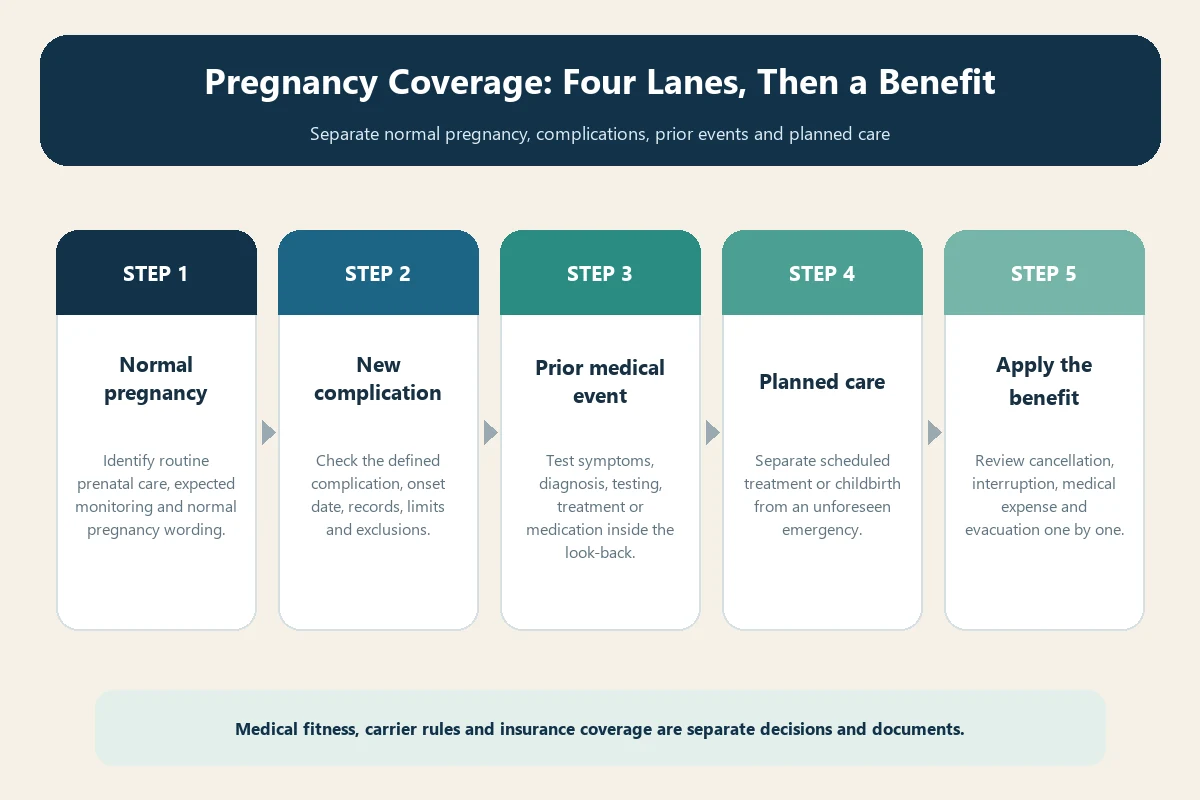
Lane one is normal pregnancy and routine prenatal care. Lane two is an unexpected complication first arising after coverage begins. Lane three is a complication, symptom, test, or treatment that existed inside the policy’s look-back window. Lane four is normal childbirth or scheduled care during the trip.
Write the facts into one lane before reading the benefit. If more than one lane applies, analyze each one. A traveler may have a normal pregnancy and a separate chronic condition, or a prior complication followed by a new event.
Lane one: normal pregnancy and routine care
Routine prenatal visits, expected monitoring, vitamins, and normal pregnancy expenses are not automatically emergency medical losses. Some certificates expressly exclude normal pregnancy or childbirth under particular benefits. Others may list a pregnancy-related cancellation reason with narrow timing and record requirements.
Do not infer medical-expense coverage from a cancellation clause, or cancellation coverage from a medical benefit. Use the travel medical benefits guide to identify the exact benefit being tested.
Lane two: an unexpected complication
A policy may define Complications Related to Pregnancy separately from pregnancy itself. The definition can name conditions and exclude ordinary discomforts or prescribed rest unless tied to a defined complication. Medical records must support the diagnosis and onset date.
A current Travel Guard Missouri sample policy illustrates this structure. It defines complications and separately lists normal pregnancy or childbirth exclusions under some benefits. It is an example only; another state form may differ.
Even when a complication is potentially eligible, deductibles, limits, prior authorization, emergency definitions, and evacuation approval can still affect payment.
Lane three: a condition or event inside the look-back period
Pregnancy itself may not be labeled pre-existing by a marketing page, yet a related diagnosis, symptom, test, treatment recommendation, or medication event can still require review under the issued definition. The decisive question is what the contract lists and when the event occurred.
Use the pre-existing look-back guide to copy the anchor date and count the exact days. Record obstetric visits, urgent evaluations, tests, diagnoses, restrictions, and prescribed medications without drawing a coverage conclusion from the timeline alone.
If a prescription changed, the medication-change guide helps separate a new drug, dose adjustment, substitution, and refill. Never delay medically necessary treatment for insurance reasons.
Lane four: normal childbirth or planned care
A scheduled delivery, planned procedure, routine prenatal appointment, or travel undertaken to obtain care is different from an unforeseen emergency. Policies may exclude normal childbirth, expenses for a child born during the trip, routine care, or travel for medical treatment.
Read the five-layer medical exclusions guide across general exclusions, benefit exclusions, defined terms, conditions, and endorsements. A pre-existing waiver does not automatically remove a normal-pregnancy or planned-treatment exclusion.
Sample forms show why answers conflict
A current Travel Guard Pennsylvania sample policy includes a trip-cancellation provision involving complications, normal pregnancy, or childbirth when stated onset and medical-record requirements are met. The same form also contains exclusions for normal pregnancy or childbirth under other benefits.
The Missouri sample uses its own benefit and exclusion structure. These examples explain why two search results can sound contradictory while describing different products, benefits, dates, or states.
Do not copy a sample form’s language into an application answer. Obtain the issued certificate for the traveler’s state and read the schedule and endorsements together.
Pregnancy coverage and medical fitness are separate
An insurer’s contract does not decide whether a person should travel. The CDC Yellow Book’s pregnant travelers chapter recommends a pre-travel assessment, pregnancy-specific insurance review, prenatal records, professional contact information, and planning for obstetric and neonatal care at the destination.
ACOG’s Travel During Pregnancy FAQ provides medical guidance for healthy pregnancy and situations requiring individualized advice. Use the treating professional’s guidance for medical decisions, not an insurance article.
A fitness-to-travel letter can document due date, medical assessment, and restrictions. It does not guarantee that a claim satisfies a covered reason or remove exclusions.
Airline and cruise rules create a third file
Transportation providers can impose their own pregnancy rules, documentation requirements, or boarding limits. Those rules are not insurance benefits. A denied boarding or voluntary decision not to travel must still match the policy’s covered-event language.
Keep current carrier rules, a physician letter if required, and communications with the airline or cruise line. Recheck the rules before departure because operational policies can change.
Test cancellation, interruption, waiver, and evacuation one benefit at a time
For cancellation, identify the exact listed reason. Does the certificate require a complication, physician-imposed restriction, hospitalization, or another event? When must onset occur? Which medical records must verify it? Does the reason apply to the insured, a companion, or a family member?
The trip cancellation guide separates the covered reason from financial loss. Keep cancellation notices, supplier refunds, credits, payment receipts, and physician records.
Learning about a pregnancy after booking is not automatically a covered cancellation reason. The certificate must list an applicable event and all conditions must be met.
Test trip interruption after departure
If a complication occurs during travel, medical expense and trip interruption may both be relevant. They remain separate benefits. Medical expense addresses eligible treatment; interruption may address unused insured trip costs or eligible additional transportation after a covered event.
Use the trip interruption guide to document when the trip stopped, physician advice, revised transportation, unused bookings, and refunds.
Review a waiver without overestimating it
A pre-existing-condition exclusion waiver can matter when prior pregnancy-related medical events fall within the definition. Requirements can include purchase during a time-sensitive period, medical ability to travel, insuring required trip costs, and timely updates after later payments.
The waiver eligibility checklist tests those conditions. A valid waiver removes only the named exclusion where the certificate says it applies. It does not automatically pay routine prenatal care, normal childbirth, a known scheduled event, or travel against medical advice.
Ask about the newborn and evacuation explicitly
Pregnancy-related care can involve two patients and facilities with different capabilities. Ask whether the plan covers pregnancy complications, neonatal care, expenses for a child born during the trip, medical evacuation, an accompanying person, and return travel after treatment.
CDC notes that many health policies may not cover pregnancy or neonatal complications outside the United States and advises reviewing supplemental health and evacuation coverage. Do not assume a high emergency-medical limit includes every neonatal expense.
The National Association of Insurance Commissioners’ travel insurance overview recommends comparing covered events, exclusions, limits, and conditions. Ask for written responses tied to the exact plan.
Build a date-and-document worksheet
Record the first trip payment, policy purchase, coverage effective date, estimated due date, departure and return, symptom onset, test or diagnosis date, treatment recommendation, physician restriction, and claim event. Do not use conception estimates as an insurance conclusion unless the certificate specifically requires a relevant date and the record supports it.
Keep prenatal records needed for travel, a medication list, physician contact details, insurer communications, assistance authorizations, itemized bills, proof of payment, and supplier refund records. Protect medical information and use secure claim channels.
The claim documentation guide provides an evidence ledger. Submit complete records without changing medical language or omitting earlier events.
Work through four limited examples
Normal pregnancy discovered after purchase
The traveler feels well and wants to cancel. Discovery alone may not be a listed reason. Check the cancellation section, onset wording, physician requirements, and refund options. Do not assume pregnancy automatically activates cancellation.
Unexpected complication during the trip
The traveler receives urgent treatment for a defined complication. Test the complication definition, pre-existing facts, emergency medical benefit, exclusions, assistance requirements, and itemized expenses. Medical necessity does not remove contract conditions.
Related diagnosis before purchase
A pregnancy-related condition was diagnosed during the look-back window. Review the pre-existing definition and waiver. Then separately test whether the later loss fits a covered benefit.
Scheduled prenatal care abroad
The traveler plans a routine appointment at the destination. That expected care is not the same as an unforeseen complication. Read routine-care, normal-pregnancy, planned-treatment, and travel-for-treatment provisions.
Ask twelve written questions
Ask how the plan defines normal pregnancy, childbirth, and complications; whether pregnancy-related medical events enter the pre-existing definition; which look-back dates apply; whether a waiver is available; which cancellation reasons apply; whether routine prenatal care is excluded; how childbirth is treated; whether neonatal care is covered; what emergency and evacuation limits apply; whether preauthorization is required; what records prove onset; and how carrier restrictions interact with covered reasons.
Provide the state, plan, trip dates, purchase dates, and general scenario. Do not disclose unnecessary medical details to a sales channel. Request the complete certificate and a written answer.
Bottom line
Pregnancy is not a single insurance category. Separate normal pregnancy, a new complication, prior look-back events, and planned care. Then test cancellation, interruption, medical expense, evacuation, and exclusions one benefit at a time.
The safest purchase decision combines individualized medical advice, current carrier rules, and the issued insurance certificate—without letting any one of those documents stand in for the others.
Sources and further reading
- Pregnant Travelers | CDC Yellow Book — Many health insurance policies do not cover the cost of medical treatment for pregnancy or neonatal complications that occur outside the United States; pregnant travelers should strongly consider travel health insurance covering pregnancy-related problems and care of the neonate, and medical evacuation coverage is also advised; most commercial airlines allow flying until 36 weeks' gestation and most cruise lines restrict travel beyond 24 weeks' gestation.
- Travel Insurance | NAIC — Pre-existing health conditions are listed first among the most common travel policy exclusions; it is good practice to check not only what is included but what conditions are excluded from the policy.