

Travel medical insurance exclusions decide which otherwise eligible medical bills will not be paid. The difficult part is that exclusions are rarely contained in one neat list. A claim can be limited by a general exclusion, a medical-benefit exclusion, a definition, a medical-necessity test or an assistance requirement.
This guide gives U.S. travelers a repeatable way to read an issued certificate. It does not interpret a specific contract, decide a claim or replace medical advice.
Key takeaways
- Read general exclusions and medical-benefit exclusions together.
- Separate emergency treatment from routine, preventive, maintenance and elective care.
- Test pre-existing-condition wording independently from every other exclusion.
- Check definitions of medically necessary, unforeseen, physician and trip.
- Confirm authorization rules before assuming an eligible service will be reimbursed.
Reviewed August 16, 2026. Coverage varies by plan, state, benefit and the facts documented in the medical record.
Start with the five-layer exclusion map
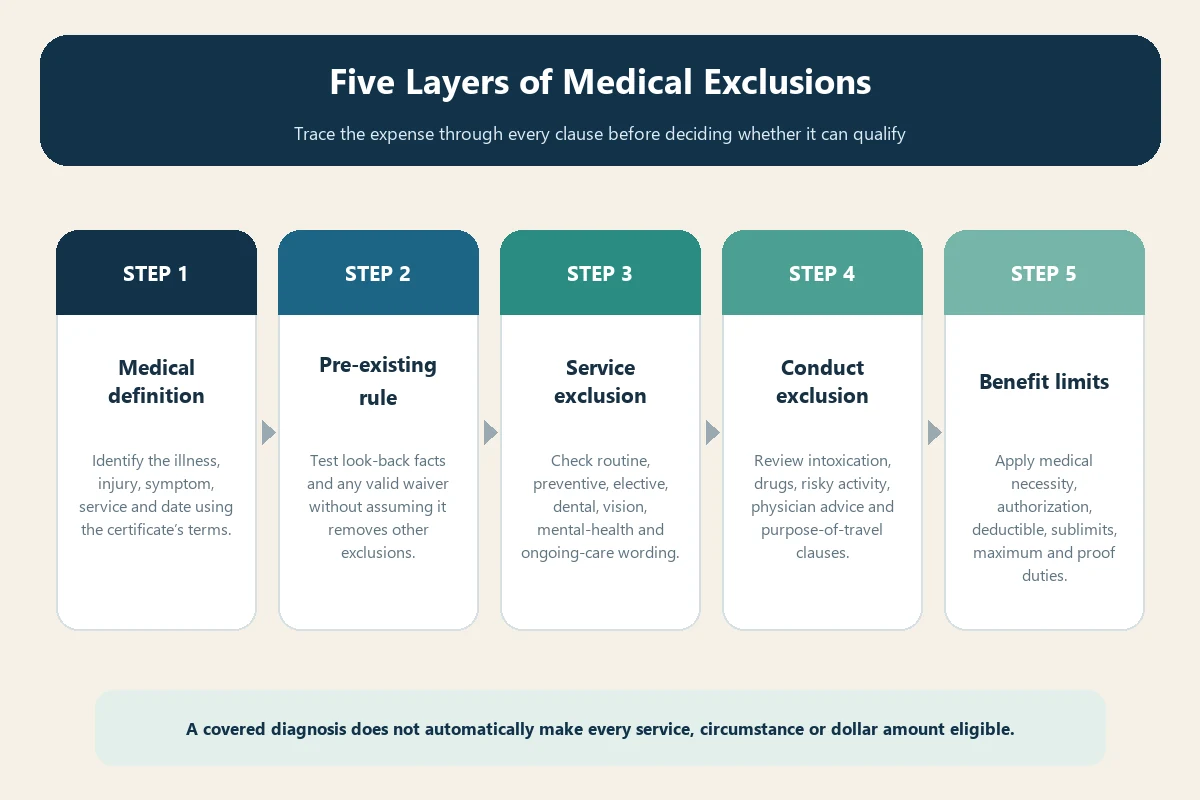
Read the certificate in this order: general exclusions, exclusions attached to emergency medical expense, defined terms, benefit conditions and assistance or authorization rules. A service must survive every applicable layer.
The travel medical insurance benefits guide explains what a benefit promises before exclusions and limits are applied.
General exclusions can reach every benefit
A general exclusion can apply to trip cancellation, medical expense, evacuation and other benefits. Common examples involve intentional acts, illegal conduct, war, intoxication, travel against medical advice or events known before coverage began.
Do not stop when the medical section looks favorable. Search the table of contents and every rider for “general exclusions,” “limitations” and “not covered.”
Medical-benefit exclusions are narrower but decisive
The emergency medical section can add rules for routine care, elective treatment, pre-existing conditions, pregnancy, mental health, dental care, rehabilitation or treatment that is not medically necessary.
A clause attached only to one benefit should not automatically be treated as a site-wide rule. Record the exact benefit to which the clause applies.
Routine and preventive care serve a different purpose
Annual physicals, screening tests, vaccinations, wellness visits and stable-condition monitoring are planned care. Short-term travel medical coverage is usually built for an unexpected eligible illness or injury during the covered trip.
A current CDC travel-insurance checklist tells travelers to ask exactly which services are covered and which exclusions apply. Read the CDC Yellow Book travel-insurance chapter before departure.
Elective and planned treatment are not emergencies
A procedure selected in advance, a treatment booked before departure or travel undertaken to obtain care can fall outside an emergency benefit. The procedure may be clinically important while still being planned for insurance purposes.
The continuation-of-treatment guide separates scheduled care, recurrence, complications and follow-up after a new event.
Medical necessity is a contract test
Certificates often define medically necessary by reference to accepted practice, physician orders, the diagnosis and whether the service is primarily for convenience. A doctor’s recommendation is important evidence but does not by itself override every contract term.
Check whether the plan can review level of care, length of stay, transportation method, facility choice or the need for a particular service.
Pre-existing conditions require their own analysis
A pre-existing-condition definition can turn on symptoms, examinations, advice, treatment, testing or medication changes during a stated window. A formal diagnosis might not be required.
Use the look-back-period guide to map dated medical facts to the issued definition.
A waiver removes one exclusion, not all exclusions
If every stated condition is met, a waiver can remove the pre-existing medical condition exclusion from specified benefits. It does not automatically cover preventive care, planned treatment, travel against medical advice or an otherwise excluded activity.
The pre-existing-condition waiver guide explains purchase windows and continuing obligations.
Intoxication and drug wording varies
Some certificates use a legal alcohol limit, some refer to being under the influence and others require a causal connection between substance use and the loss. Prescribed medication taken as directed can be treated differently from misuse or illegal drugs.
A current Travel Guard Washington sample policy excludes losses resulting from drugs or narcotics unless prescribed and intoxication above the local legal limit. That is a plan-and-state example, not a universal definition. Review the sample policy and compare it with the document offered to you.
Do not assume any alcohol use voids coverage
A restaurant drink and an injury caused by intoxication are not automatically the same fact pattern. Preserve emergency records, toxicology results when collected, police reports and witness information.
Never change or omit facts in a claim. Ask the insurer which clause applies and what evidence supports its decision.
Adventure activities can require an upgrade
Scuba diving, mountaineering, organized competition, motorized racing and other activities may be excluded, limited by depth or altitude, or covered only with an optional sports rider.
Before booking, compare the itinerary with the adventure and winter-sports exclusion guide. Confirm rescue and evacuation separately from treatment.
Travel against medical advice creates a separate risk
Some policies exclude a trip taken against a physician’s advice or when the traveler is not medically able to travel. The timing and substance of clinical advice matter more than a generic “fit to fly” note.
Give the clinician the actual itinerary, activities, treatment schedule and access-to-care constraints. Keep the resulting record.
Foreseeable events can fail before an exclusion is reached
Coverage is generally designed around events that occur after the relevant benefit becomes effective. A known storm, announced strike, existing symptoms or already-required treatment can be tested under an “unforeseen” definition or effective-date rule.
Identify the date the fact became known, the benefit effective date and the loss date. Do not rely only on the date a formal diagnosis or cancellation occurred.
Normal pregnancy and complications can be separated
A certificate may treat routine prenatal care, normal childbirth and unexpected pregnancy complications differently. It can also apply travel-date, gestational-age, pre-existing-condition or newborn-care rules.
Ask the insurer to identify the exact covered benefit and exclusion. Confirm destination provider capability and newborn coverage before travel.
Mental health language needs a current certificate
Some plans exclude mental or psychological disorders; others cover specified emergencies or use definitions that distinguish psychiatric conditions from neurological disease. Marketing summaries are not enough.
The travel medical insurance mental-health guide shows how to check crisis care, inpatient treatment, medication and evacuation clauses.
Emergency dental is usually a narrow benefit
Routine cleaning, replacement appliances and delayed restorative work are different from urgent pain relief or treatment of accidental dental injury. Sublimits, tooth limits and exclusions can apply.
Read the emergency dental coverage guide before assuming the main medical maximum applies.
Prescription exclusions depend on why the drug is needed
A refill of regular medication, replacement of lost tablets and medicine prescribed for a newly covered illness are three separate events. The plan may also exclude over-the-counter products or drugs not approved at the destination.
The prescription medication guide provides a service-by-service check.
Noncompliance can affect necessity and causation
Ignoring medical advice, leaving care against advice or failing to follow an assistance-center instruction can complicate a claim. The certificate may require reasonable efforts to reduce the loss or cooperate with medical review.
Urgent safety comes first. When possible, document why an instruction could not be followed and notify the assistance center promptly.
Authorization rules are not always exclusions
Evacuation, transfer, major procedures and continued inpatient care may require advance coordination. A failure to call can reduce benefits even when the diagnosis itself is eligible.
Store the assistance number offline. Record calls, case numbers, names, instructions and authorization decisions.
Limits and sublimits can look like exclusions
A covered service can still leave a balance because of a deductible, coinsurance percentage, daily cap, visit limit or benefit maximum. A low payment does not necessarily mean the claim was excluded.
Compare the medical sublimits guide with the schedule of benefits and claim explanation.
Read one current contract example correctly
The NAIC’s 2025 market-conduct standard calls for pre-existing-condition exclusions, waiver circumstances and definitions to be disclosed in policy or fulfillment materials. The NAIC examination standard supports a certificate-first comparison, not a promise that every state or plan uses identical language.
Use examples to learn where clauses appear. Use only your issued certificate to evaluate your trip.
Build an exclusion worksheet
| Layer | Question | Evidence to save |
|---|---|---|
| Benefit | Is this service listed as a covered expense? | Schedule and benefit text |
| General exclusions | Does a site-wide clause apply? | Exact exclusion and facts |
| Medical exclusions | Is this routine, planned or otherwise excluded? | Medical section and records |
| Definitions | Do defined terms change the result? | Definitions and dates |
| Conditions | Was authorization or notice required? | Call log and approvals |
Questions to ask before purchase
- Which general exclusions apply to the medical and evacuation benefits?
- How are routine, preventive, maintenance and elective care defined?
- What look-back period and medication-change rules apply?
- Does any waiver remove only the pre-existing-condition exclusion?
- Which activities require an upgrade?
- How does the plan define intoxication and causation?
- Which services require advance authorization?
- What limits, sublimits, deductible and coinsurance remain?
If a claim is denied
Request the written decision, exact clause, medical facts relied on and appeal instructions. Compare the denial with the correct policy version, state-specific endorsements and benefit section.
Submit a concise timeline, itemized bills, records and any missing authorization evidence. A disagreement about facts is different from a clear contractual exclusion.
Bottom line
Travel medical insurance exclusions are a layered contract analysis, not a single blacklist. First confirm the benefit, then check general and medical exclusions, definitions, limits and authorization rules.
Choose coverage by matching the issued certificate to your health, itinerary and activities. If wording is unclear, obtain written clarification before purchase and preserve it with the policy.
Pregnancy coverage needs four separate lanes. Use the travel insurance pregnancy and pre existing condition guide to distinguish normal pregnancy, complications, prior medical events, cancellation and emergency care.