
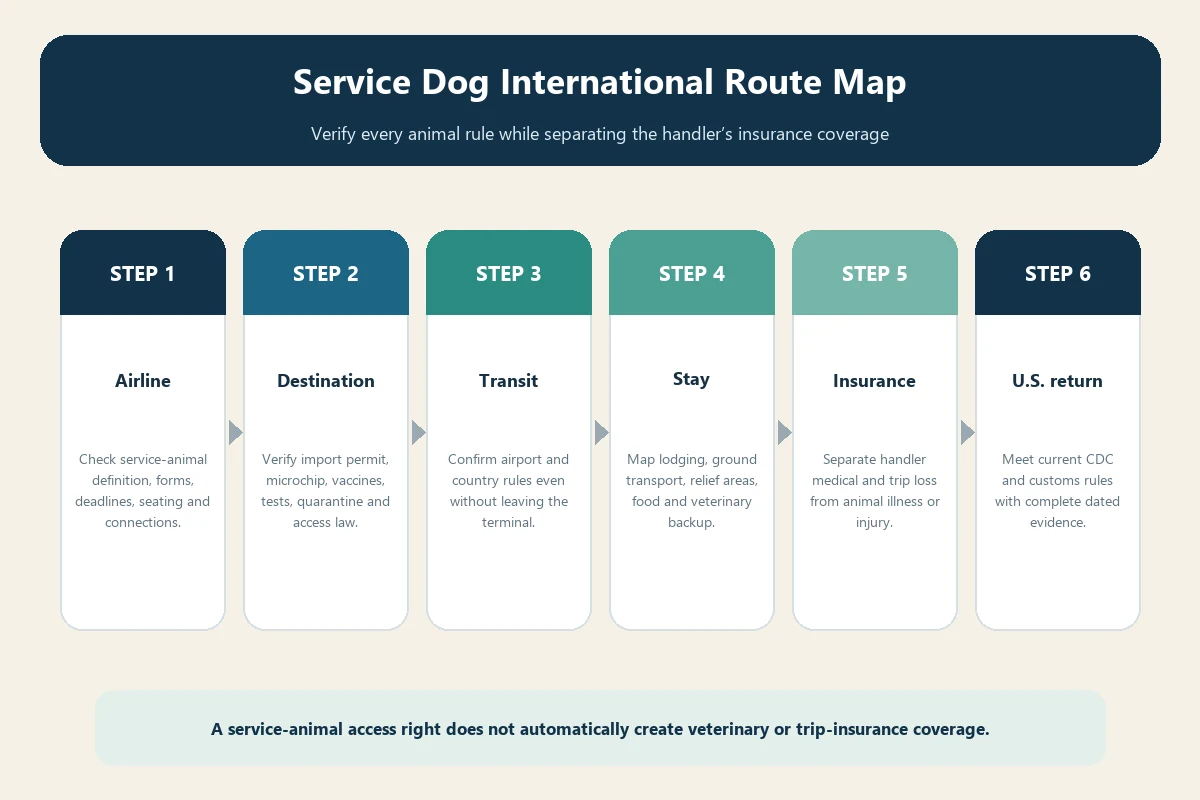
Standard travel insurance primarily protects the human traveler and should not be assumed to cover a service dog’s illness, veterinary care, quarantine, denied entry, animal transport, or return. Before international travel, verify the operating airline’s service-animal procedure, every destination and transit-country import rule, USDA export documents, current CDC requirements for returning to the United States, public-access rules, veterinary support, relief, food, and backup assistance. Then test the policy for handler medical care, trip cancellation, interruption, delay, baggage, and companion costs.
This article is educational, not disability-rights, veterinary, import, legal, aviation, or insurance advice. Rules change and vary by route. Verify current requirements with DOT, CDC, USDA APHIS, destination authorities, the operating carrier, a USDA-accredited veterinarian, and the insurer before every trip.
Key takeaways
- U.S. airline service-animal rules, foreign entry rules, public-access laws, and travel insurance are separate systems.
- DOT’s air-travel definition recognizes a dog individually trained to perform tasks for a qualified person with a disability; emotional support animals are not included.
- All dogs entering or returning to the United States require the current CDC documentation, including a Dog Import Form receipt.
- A service dog is not automatically an insured traveler.
- Rehearse handler hospitalization, dog illness, denied boarding, quarantine, delay, and medical evacuation.
Reviewed: August 16, 2026.
Service dog, emotional support animal, and pet are different
Under U.S. Department of Transportation air-travel rules, a service animal is a dog individually trained to do work or perform tasks for a qualified person with a disability. Emotional support, comfort, companionship animals, other species, and dogs in training are not service animals for this rule.
A destination country can use another definition for entry or public access. A dog accepted in a U.S. aircraft cabin may still face animal-health documentation, quarantine, breed rules, or limited access after arrival.
Start with a route matrix
List the departure country, every connection, destination, cruise port, side trip, and return entry point. For each, record airline, import authority, required forms, vaccination, microchip, veterinary endorsement, parasite treatment, quarantine, advance permit, public access, and relief.
A connection can count even when the traveler plans to remain airside. Verify the actual airport and whether bags or the dog clear customs.
Operating-airline forms
U.S. airlines may require the DOT Service Animal Air Transportation Form attesting to health, behavior, and training. For a flight scheduled to last eight hours or more, an airline may also require the DOT relief attestation. The updated forms are submitted to the airline, not DOT.
Airlines can have an advance submission process within federal limits. Check the current form, deadline, accessible submission channel, and approval for each operating carrier and codeshare segment. Keep electronic and paper copies.
Cabin space, control, and behavior
The handler is responsible for supervising, feeding, toileting, and controlling the service dog. Airlines can deny transport in circumstances permitted by DOT rules, including safety, direct threat, significant disruption, health requirements, or missing required forms.
Discuss the dog’s size, harness, tether, floor space, seating, relief needs, food, water, and long-flight readiness with the airline and veterinarian. A purchased extra seat may not change where the dog is permitted to occupy space.
Destination import requirements
Use USDA APHIS’s country-specific pet travel pages and the destination’s official veterinary authority. The dog may need a microchip, rabies vaccination, health certificate, laboratory test, parasite treatment, import permit, or endorsement within precise time windows.
Service status does not erase animal-health rules. Begin months ahead for routes with laboratory or quarantine requirements. Do not rely on a commercial pet-shipping checklist alone.
Transit and side-trip rules
A brief layover, land border crossing, ferry, cruise port, or day trip can trigger another jurisdiction’s requirements. A country may treat a dog remaining airside differently from one clearing customs. Airlines can also require transit approval.
Map the entire six-month travel history because U.S. return rules consider where the dog has been, not only the final departure country.
Returning to the United States
CDC’s current dog-import rules apply to all dogs, including service dogs and U.S. dogs returning home. As of the reviewed date, every dog requires a CDC Dog Import Form receipt. Other requirements depend on where the dog was vaccinated and whether it has been in a high-risk country for dog rabies during the previous six months.
Dogs from high-risk routes can require additional endorsed vaccination forms, approved laboratory testing, specified ports, and a reservation at a CDC-registered animal care facility. Service-dog accommodations exist in limited circumstances but do not waive the core requirements. Use CDC’s current Dog Importation Navigator before departure and again before return.
USDA export preparation
A USDA-accredited veterinarian may need to complete a country-specific health certificate, followed by USDA endorsement. Timing can be strict. High-risk rabies travel may also require U.S.-issued vaccination certification before leaving.
Keep the microchip number consistent across records. A clerical mismatch can become a boarding or border problem. Review every field before the endorsement deadline.
Public access abroad
The Americans with Disabilities Act and Air Carrier Access Act do not control every foreign hotel, restaurant, taxi, attraction, or beach. Research the destination’s service-dog law and common practice. Carry translated documentation, while understanding that a U.S. registry or vest does not create foreign legal access.
Choose backup restaurants, transport, and activities. An access refusal may be discriminatory under local law but still not be a covered travel-insurance event.
Lodging and relief
Confirm service-dog acceptance, room access, relief location, waste disposal, nearby green space, food storage, and emergency evacuation. Ask about cleaning charges and local pest or wildlife risks.
For cruises, verify the ship’s relief box, ports where the dog may disembark, documentation held by the ship, and what happens when a port denies entry.
Veterinary care and medication
Obtain a pretravel veterinary exam and a plan for food, routine medicine, emergency medicine, heat, parasites, motion, and destination disease. Carry labels, prescription, veterinary summary, microchip record, vaccination, and emergency contacts.
Human travel medical insurance does not pay veterinary bills unless the policy explicitly provides an animal benefit. Pet insurance can also exclude foreign care or require its own network and claims.
What standard travel insurance may cover
The human traveler’s policy can cover eligible medical emergencies, cancellation, interruption, delay, baggage, and evacuation. Some policies or optional pet bundles may add narrow animal-related benefits, but never infer them from the word “service.”
Ask whether service-dog illness or death is a covered cancellation reason, whether veterinary care is reimbursed, whether quarantine costs qualify, and whether animal return transport is covered.
Handler pre-existing-condition rules
The disability or health condition for which the dog performs tasks can be a pre-existing condition. The look-back, waiver, medical-ability, and disclosure rules apply to human claims. The dog’s training does not waive them.
Use the senior pre-existing-condition questions for the handler’s medical timeline.
Dog illness before departure
If the dog becomes ill and cannot travel, the human trip is not automatically covered. The policy must list the animal’s illness, death, or another applicable event as a covered reason, and veterinary documentation may be required. A handler choosing not to go without the dog can be excluded when no animal benefit exists.
Flexible bookings or a specific pet/service-animal add-on can address this gap more clearly.
Handler illness before departure
If the senior becomes medically unable to travel, cancellation follows the human medical and pre-existing-condition provisions. The dog’s boarding, caretaker, or veterinary expenses may remain personal costs.
Identify who can legally and practically care for the dog if the handler is hospitalized or dies.
Delay and missed connections
A delay can create food, water, relief, hotel, veterinary-document expiration, and border timing problems. Standard delay coverage may reimburse the traveler’s eligible expenses after a trigger but exclude animal costs.
Carry a delay supply, locate relief areas, and ask the insurer whether dog food, kennel, veterinarian, or new certificate fees qualify. Save the carrier notice and receipts.
Baggage and equipment
Harnesses, leashes, bowls, boots, food, medicine, and mobility-related gear can be lost or damaged. Review property exclusions, per-item limits, medical-equipment rules, and documentation. Keep essential control equipment with the handler.
The baggage delay guide explains carrier reports and sublimits.
Handler medical emergency abroad
A foreign hospital may not admit the dog or provide care for it. Name a local or traveling backup handler, boarding option, veterinarian, and authority to make decisions. The travel insurer’s assistance line may help but does not automatically assume the animal’s custody.
Use the direct-billing guide for the human hospital and separately plan dog care.
Medical evacuation with a service dog
A human evacuation benefit may not guarantee space or transport for the dog. Aircraft type, medical crew, animal entry at the receiving country, quarantine, hospital access, and alternate handler all matter.
The medical evacuation insurance pets guide explains animal transport gaps, and the travel companion guide covers human companion provisions.
Six-scenario rehearsal
- Airline form rejected: correct the record and contact the airline’s disability resolution staff.
- Transit rule changes: reroute or obtain the required document before departure.
- Dog becomes ill: use the veterinarian and confirm whether cancellation is covered.
- Handler hospitalized: activate the backup handler and dog-care authority.
- Return document expires: contact the official authority, not an informal broker.
- Medical evacuation: coordinate the human route and the dog’s lawful transport separately.
Document packet
- DOT forms and operating-airline approval
- Microchip, vaccination, health, laboratory, and import records
- USDA endorsement and destination permits
- CDC Dog Import Form receipt and return-route documents
- Service-dog task and handler information required by law
- Veterinary summary, medicine, food, and emergency contacts
- Backup handler and decision authority
- Travel policy, pet policy, and animal-benefit certificate
- Accessible lodging, relief, and transport confirmations
- Trip payments, refunds, and claim evidence
Questions for the insurer
- Is the service dog an insured person, covered animal, or excluded?
- Is dog illness or death a covered cancellation reason?
- Are veterinary, quarantine, kennel, or new-document costs covered?
- What happens if entry or boarding is denied?
- Does delay cover animal necessities?
- How are harnesses and equipment classified?
- Who cares for the dog if the handler is hospitalized?
- Can the dog travel during medical evacuation?
- What companion or bedside benefits apply?
- Which documents and deadlines control each claim?
FAQ
Does travel insurance cover a service dog?
Not automatically. Standard policies focus on people. Animal benefits require explicit language or a separate product.
Does a service dog need CDC paperwork to return to the U.S.?
Yes. Current CDC dog-import rules apply to service dogs, including returning U.S. dogs. Requirements depend on vaccination and recent country history.
Can an airline require DOT forms?
Yes, within DOT rules. Airlines may require the air-transportation form and, for flights scheduled eight hours or more, a relief attestation.
Will medical evacuation take the service dog?
Do not assume so. Verify aircraft, animal entry, quarantine, hospital access, and insurer provisions before travel.
Bottom line
International service-dog travel is a two-direction regulatory project plus an insurance gap analysis. Verify airline forms, export, transit, destination access, veterinary care, and current U.S. return rules. Then identify which human and animal costs are covered, excluded, or require a separate plan.
