

A medical evacuation insurance limit is not self-explanatory. Before comparing two headline numbers, identify whether the maximum applies per person, booking, trip, occurrence, related cause, or policy term—and which rescue, escort, repatriation, equipment, or transport expenses share it.
This worksheet does not recommend one universal amount. It is educational, not medical, insurance, actuarial, financial, or legal advice. Limits, definitions, and state forms vary; use the issued policy, schedule, declarations, and endorsements.
Key takeaways
- Copy the unit attached to the maximum.
- Find every expense included in or separate from that maximum.
- Do not treat a rescue sublimit as the evacuation limit.
- Test related-cause and aggregate wording for multiple events.
- Stress the limit against an itinerary-specific route without calling the result a guarantee.
Reviewed August 16, 2026. This page complements the site’s general evacuation-limit pillar by auditing limit mechanics rather than prescribing a headline amount.
Start with the schedule and then keep reading
The schedule might show “Emergency Evacuation and Repatriation of Remains: $250,000.” That line does not reveal who receives the limit, how often it resets, whether services share it, or which conditions activate it.
Use the general evacuation-limit guide for the medical-necessity, authorization, and coverage gates. This worksheet begins after the number is found.
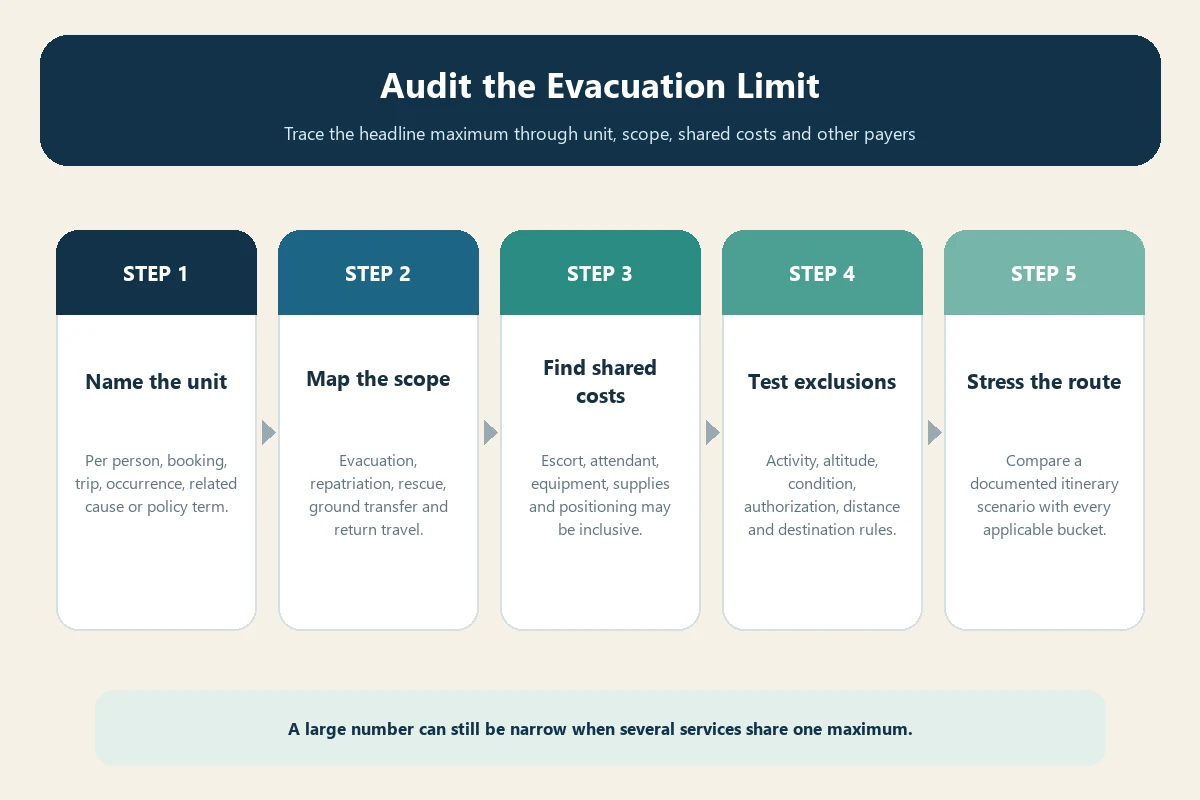
Check 1: Is the limit per person or per booking?
A per-person maximum may apply separately to each insured traveler. A per-booking or family maximum can be shared. Group policies can use still other structures.
Ask how the limit works if two travelers are injured in one vehicle accident or several insureds become ill from the same event. Do not multiply a displayed amount by the party size unless the contract supports that calculation.
Check 2: Is it per trip, occurrence, or policy term?
Single-trip language may cap all evacuation expenses during one trip. Annual coverage may state a per-trip maximum, annual aggregate, or both. Occurrence wording can group several injured travelers or related services.
Copy the reset trigger. Renewal, a new itinerary, or a second event does not automatically restore a fully used limit. The annual-policy review method shows why the term and each eligible trip must be separated.
Check 3: How are related causes grouped?
A form can apply the maximum to all injuries from the same accident or all sicknesses from the same or related causes. A stabilization transfer and later transport home might therefore draw from one shared bucket.
Create a timeline with incident, local ambulance, hospital, interfacility transfer, later transport, and return travel. Ask the insurer which items it considers one evacuation or related series.
Check 4: Does repatriation of remains share the maximum?
Some schedules combine emergency evacuation and repatriation of remains under one line. Others state separate benefits. A combined label does not prove two independent maximums.
The repatriation-of-remains guide explains the different service and evidence. For limit auditing, mark whether the two benefits share, stack, or exclude one another after payment.
Check 5: Is search and rescue separate?
Field search, hoist extraction, and movement to an accessible point can precede medical evacuation. A policy can assign search and rescue a much smaller sublimit.
A state-specific Travel Guard policy example shows a $250,000 evacuation-and-repatriation maximum and a separate $10,000 search-and-rescue maximum. Those figures illustrate structure only; the traveler must use the issued schedule.
Check 6: Are escort and attendant costs inclusive?
A physician may recommend a medical escort, contracted attendant, or companion. The policy can cover that person’s services, transportation, and accommodations inside the main evacuation maximum.
A current state-specific Travel Guard form example says recommended escort or attendant expenses are inclusive of the evacuation maximum. Do not add them on top unless the actual contract permits it.
Check 7: Which medical supplies share the bucket?
Evacuation wording often includes related medical services and supplies. Oxygen, ventilator, monitor, stretcher, medication pump, isolation equipment, and specialty crew can consume the same maximum.
The approval-chain guide explains how medical configuration is determined. For the limit worksheet, ask for an estimate that itemizes equipment and care level.
Check 8: Are ground and positioning legs included?
The aircraft patient leg is only part of a mission. Origin ambulance, destination ambulance, empty positioning flight, fuel stop, handling, and permits can fall inside the benefit.
Use the destination ladder to define the covered endpoint. A longer preferred destination is not automatically covered merely because unused limit remains.
Check 9: Does “return home” use the same limit?
After an authorized evacuation, a policy may reimburse later economy airfare home, provide a medically necessary transfer, or cover no additional return. These are different benefits.
Mark whether the later trip is inside the evacuation maximum, a trip-interruption benefit, an additional benefit, or excluded. Deduct unused-ticket refunds if the form requires it.
Check 10: Is the displayed amount a maximum or a service promise?
Insurance generally pays eligible expenses up to a maximum. A membership may arrange a defined service under membership rules rather than present the same indemnity structure.
The membership comparison helps identify the legal and operational model. Do not add a membership and insurance number as though both are cash benefits.
Check 11: Does other insurance pay first?
Evacuation coverage may be primary or excess, and it may coordinate with health insurance, employer coverage, credit-card benefits, a tour operator, or a membership. The contract can require submission to another payer.
List each payer, its territorial scope, authorization rules, and explanation-of-benefits process. Avoid duplicate recovery. A $250,000 maximum does not mean the policy pays $250,000 when another source covers part of the eligible expense.
Check 12: Which eligibility conditions can reduce the usable limit?
Distance-from-home thresholds, overnight-trip definitions, excluded destinations, adventure activities, altitude, licensing, intoxication, pre-existing conditions, and travel against medical advice can block a benefit before the maximum matters.
The CDC adventure-travel chapter warns that insurance can depend on deductibles, maximum expenditures, medical-control approval, and pre-existing conditions. It also says wilderness rescue and certain adventure sports may be excluded.
Convert the itinerary into scenarios
Build three nonnumeric scenarios: a local ground transfer, a regional fixed-wing transfer, and a remote rescue plus international air ambulance. For each, identify the likely destination, mode, crew, equipment, rescue stage, and possible later return.
The CDC insurance chapter says medevac costs vary by location and rise for critical illness or complex infection control. Use that fact to widen the stress test, not to manufacture a precise quote.
The worksheet
| Clause | Policy page | Result |
|---|---|---|
| Per-person or shared unit | ____ | ____ |
| Per-trip, occurrence, or aggregate | ____ | ____ |
| Related-cause grouping | ____ | ____ |
| Rescue sublimit | ____ | ____ |
| Escort and supplies inclusive | ____ | ____ |
| Repatriation shared | ____ | ____ |
| Ground and return legs | ____ | ____ |
| Other-insurance order | ____ | ____ |
A nonnumeric stress test
Imagine a traveler injured on a remote island. A local boat reaches a clinic, a helicopter transfers the patient to a regional hospital, and a fixed-wing aircraft later moves the patient to a specialty center. A medical escort accompanies the last leg.
Run the worksheet without assigning prices. Does the boat count as rescue, ambulance, or evacuation? Does the helicopter use a rescue sublimit? Are both aircraft transfers related to one accident and one maximum? Is the escort inclusive? Does later airfare home sit inside or outside the bucket?
If the form cannot answer those questions clearly, ask the insurer in writing. The exercise reveals scope uncertainty before a misleading dollar comparison is made.
Red flag 1: “Up to” is omitted in the comparison
A schedule maximum is not a prepaid account. A comparison table should say “up to” and keep the coverage conditions beside the number. Removing that phrase can make a conditional benefit look like guaranteed cash.
Red flag 2: Combined and separate limits are added
Do not add evacuation, repatriation, rescue, escort, and interruption figures unless the contract says they stack. A combined schedule line or inclusive expense can make arithmetic double-count the same capacity.
Red flag 3: The route exceeds the covered destination
A large unused balance does not authorize extra distance to a preferred hospital. Stress-test the policy’s nearest-adequate-facility and later-transfer language before modeling transport home.
Red flag 4: An annual aggregate is mistaken for each trip
Frequent travelers should ask whether one paid evacuation reduces what remains for later trips during the policy term. Record benefit exhaustion and renewal rather than assuming the display resets with every boarding pass.
Record the answer, not just the sales reply
Place each answer beside the exact policy page, definition, and endorsement that supports it. If a representative explains an ambiguity, save the dated written response and case reference. A worksheet should reveal unresolved contract questions; it should never turn an informal assurance into policy language.
Recheck the worksheet after any endorsement or renewal.
For a family or group policy, test whether each insured traveler has an independent limit or everyone draws from one booking maximum. Then model simultaneous injuries, one escort accompanying two patients, and transport arising from the same event. The policy’s unit and related-cause language determine whether apparently separate needs compete for the same capacity.
Bottom line
Audit a medical evacuation insurance limit as a contract structure, not a marketing score. Identify its unit, reset, related-cause rule, shared rescue and repatriation benefits, inclusive escort and equipment costs, route boundaries, exclusions, and other payers. Only then can an itinerary scenario reveal what the headline maximum might actually need to absorb.
