

The Medigap foreign travel emergency limit is generally a $50,000 lifetime maximum—not a fresh limit for every trip or every year. According to Medicare’s April 2026 guidance, eligible standardized plans pay 80% of certain medically necessary emergency care outside the United States after a $250 calendar-year deductible, provided the emergency begins during the first 60 days of the trip and Medicare does not otherwise cover the care. The precise policy, remaining lifetime balance, medical necessity, and claim documents still decide the result.
This article is educational, not insurance, legal, medical, or financial advice. Medicare rules, state-standardized policies, legacy contracts, and carrier procedures can differ. Verify the current policy and written carrier guidance before travel.
Key takeaways
- The commonly cited $50,000 amount is a lifetime benefit for foreign travel emergencies under eligible Medigap coverage.
- Medicare lists Plans C, D, F, G, M, and N, plus certain legacy E, H, I, and J policies, as providing this benefit.
- The benefit generally pays 80% after a $250 deductible for the year; that leaves deductible, coinsurance, excess charges, and uncovered services with the traveler.
- The emergency must begin during the first 60 days of the trip, so a long stay requires a separate plan.
- Medical evacuation, repatriation, routine care, planned treatment, and assistance logistics should never be assumed from the phrase “foreign travel emergency.”
Reviewed: August 16, 2026.
What the Medigap foreign travel emergency benefit actually is
Original Medicare usually provides very limited coverage outside the United States. A Medigap policy is private supplemental insurance designed to help with gaps in Original Medicare. Some standardized Medigap plans include a foreign travel emergency benefit, but that benefit has its own definition, timing rule, cost sharing, and lifetime ceiling.
It is not the same as comprehensive travel medical insurance. It does not automatically create trip cancellation, interruption, delay, baggage, political evacuation, search-and-rescue, or return-home benefits. The policy pays only according to its certificate, and it generally coordinates around care that Original Medicare does not cover.
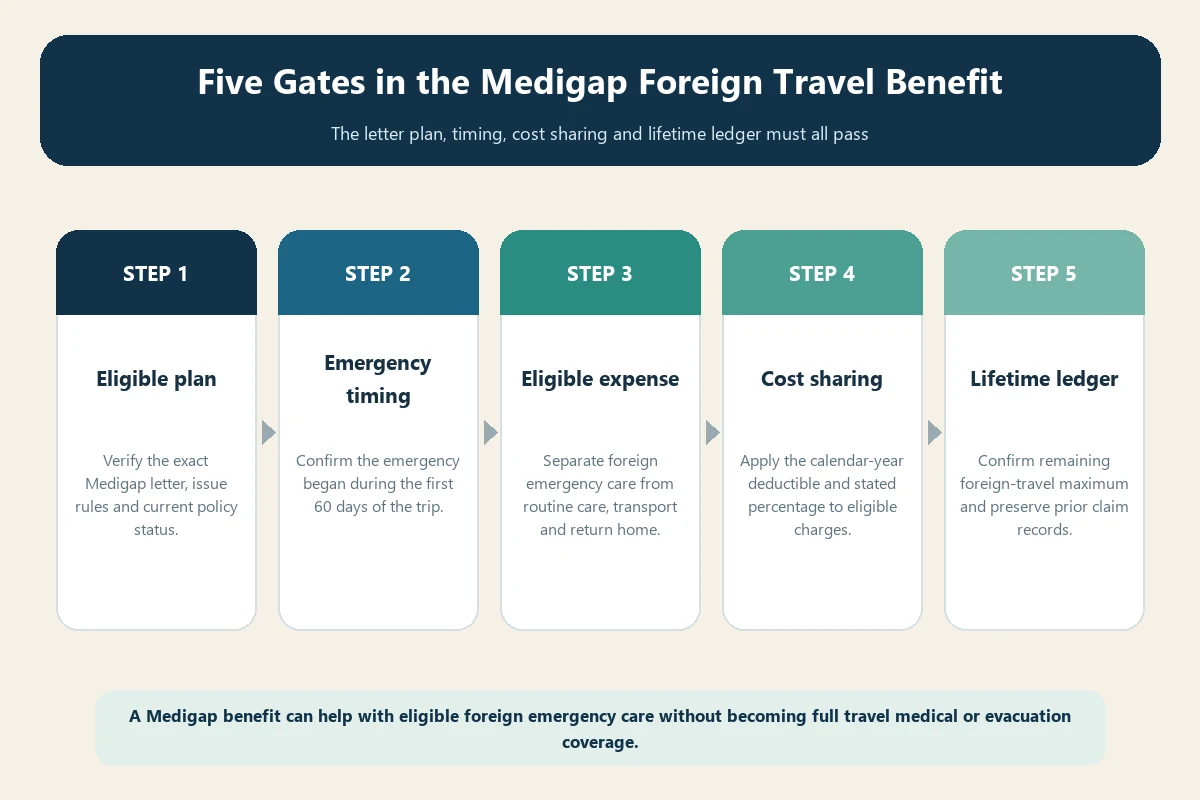
The five coverage gates
- Eligible plan gate: confirm the exact letter plan and policy version.
- Geography gate: confirm that Medicare treats the service as outside the United States and does not cover it under a limited exception.
- Timing gate: the emergency care must begin during the first 60 days of the trip.
- care gate: the service must qualify as medically necessary emergency care under the policy.
- money gate: the annual deductible, 20% share, exclusions, and remaining lifetime maximum determine payment.
A traveler should not stop at “Plan G covers foreign travel.” That statement addresses only the first gate. Ask the carrier to explain all five against a dated itinerary and a hypothetical claim.
Which Medigap plans include foreign travel emergency coverage?
Medicare’s 2026 foreign-coverage publication identifies standardized Plans C, D, F, G, M, and N. It also identifies older Plans E, H, I, and J, which are no longer sold but may remain in force for people who already hold them. Plan availability and eligibility rules matter. For example, people newly eligible for Medicare after January 1, 2020 generally cannot purchase a plan that covers the Part B deductible, which affects Plans C and F.
Massachusetts, Minnesota, and Wisconsin standardize Medigap policies differently. A letter-plan shortcut may therefore be insufficient. Ask for the outline of coverage, the foreign benefit language, and the carrier’s current claim procedure. A marketing comparison chart is useful for orientation, not proof of a particular contract.
How the $50,000 lifetime maximum works
“Lifetime” is the essential word. The maximum does not normally reset on January 1, at renewal, or when a new trip starts. Paid foreign emergency benefits can reduce the amount available for future travel. A person who has submitted prior foreign claims should ask the carrier for the remaining balance in writing.
The lifetime figure is also not the same as the largest foreign hospital bill the traveler can withstand. Before the plan pays, the traveler may owe the calendar-year deductible. After that, the benefit generally pays 80% of eligible billed charges, leaving 20%. The policy can also exclude amounts outside its definition, care after the timing window, non-emergency services, and charges above the remaining lifetime balance.
A simple benefit illustration
Suppose an eligible emergency produces $20,250 in charges accepted under the benefit and the $250 deductible has not been met. After the deductible, $20,000 remains. At 80%, the illustrative benefit would be $16,000 and the traveler’s share would be $4,250, before considering any excluded service or currency issue. This is only arithmetic, not a coverage prediction. The carrier decides which charges qualify and how the contract applies.
Now imagine the traveler had only $10,000 of the lifetime maximum remaining. The lower remaining balance could control. That is why a percentage and a headline maximum must be reviewed together.
The first 60 days rule
Medicare states that the foreign emergency care must begin during the first 60 days of the trip. This is not a 60-day waiting period and not necessarily 60 days of paid care. It is a start-of-emergency condition tied to the trip. Departure date, return date, border crossings, cruise itinerary, and the first date of symptoms or treatment can become important evidence.
A 90-day visit, seasonal residence, long cruise, or extended family stay needs special attention. The benefit should not be projected across the full journey merely because the policy remains active. Travelers planning longer absences can use the timeline method in our senior long-trip insurance guide and compare travel medical coverage for the days beyond the Medigap window.
What counts as outside the United States?
For Medicare purposes, the United States includes all 50 states, the District of Columbia, Puerto Rico, the U.S. Virgin Islands, Guam, American Samoa, and the Northern Mariana Islands. Medicare also describes narrow situations in which it may cover foreign hospital care: when a foreign hospital is closer than a U.S. hospital in a qualifying U.S. emergency, during certain direct travel between Alaska and another state through Canada, or when a person living in the United States has a foreign hospital closer than a U.S. hospital.
Those exceptions matter because the Medigap foreign benefit is designed for care Medicare does not otherwise cover. Do not assign the claim to a payer from geography alone; verify whether Medicare has a limited primary role first.
Emergency care does not automatically mean evacuation
A hospital benefit and a transportation benefit answer different questions. Medigap’s foreign emergency wording should not be assumed to pay an air ambulance across countries, a medically escorted commercial flight, transport to a hospital of choice, or return to the United States. A local ambulance necessary for the emergency may be treated differently from a later transfer selected for convenience or continuity.
Build a separate transport plan. Our medical evacuation limit guide shows how route, aircraft, medical crew, bed availability, and endpoint affect exposure. If a commercial return becomes possible, review the documentation in the fit-to-fly clearance guide and the commercial-flight repatriation guide.
What the benefit usually does not solve
- Routine checkups, elective or planned treatment abroad
- Prescription refills or ongoing maintenance care outside an emergency
- Trip cancellation, interruption, delay, missed connection, or baggage loss
- Search and rescue before the traveler reaches medical care
- Non-medical security or political evacuation
- Guaranteed direct billing by a foreign hospital
- Transport home or to a preferred hospital merely because it is desired
- Costs after the lifetime maximum is exhausted
A senior traveler can layer coverage, but duplicate insurance does not create duplicate recovery. Ask how a travel medical policy coordinates with Medigap and which insurer receives the claim first.
Direct billing and cash-flow risk
Foreign providers are not required to bill Medicare, and a Medigap carrier may not have a direct-billing relationship with the hospital. The traveler might need to pay a deposit or the full invoice, obtain records, and seek reimbursement. A $50,000 lifetime benefit therefore does not guarantee $50,000 of immediate payment at the bedside.
Before departure, ask the carrier whether it offers 24-hour assistance, payment guarantees, direct settlement, translation, or only later reimbursement. Record the correct international telephone number and the method for securing authorization. Carry an accessible payment and communication plan without assuming a credit-card limit replaces coverage.
Build the claim file while care is happening
Save admission and discharge records, diagnoses, physician notes, itemized invoices, proof of payment, dates, currency, translations if requested, travel dates, and correspondence with the carrier. If Original Medicare could cover the foreign service under an exception, the beneficiary may need to submit a claim because the foreign provider is not required to do so.
Our medical evacuation claim-document checklist is useful when transport is involved. Keep medical and transport invoices separated; they may be reviewed under different provisions.
A pre-trip verification script
Call the number on the policy—not a general sales line—and ask:
- What is my exact plan and policy form?
- Does it include foreign travel emergency coverage for this destination?
- How do you calculate the 60-day period for these travel dates?
- What deductible applies this calendar year?
- What percentage applies to eligible billed charges?
- How much of my $50,000 lifetime maximum remains?
- What is your definition of emergency and medically necessary care?
- Are ambulance, interfacility transfer, evacuation, or repatriation included?
- Must I contact assistance before treatment or transfer when reasonably possible?
- Will you arrange direct payment, or should I expect reimbursement?
- What claim form, deadline, records, translations, and proof of travel are required?
Ask for the answers or the controlling policy sections in writing. Keep them with the itinerary and emergency contacts.
When separate travel medical insurance deserves review
A separate plan may be relevant when the trip exceeds 60 days, prior lifetime benefits have reduced the remaining maximum, the destination has expensive private care, the itinerary is remote, or the traveler wants defined evacuation or repatriation assistance. Compare the plan’s age rules with our travel insurance age-limits guide. Then compare exclusions, pre-existing-condition provisions, networks, preauthorization, transport endpoints, and coordination—not just the medical limit.
Someone with several international trips can also compare a single-trip design with the annual approach in our annual senior travel insurance guide. The maximum trip length under an annual policy must still fit every itinerary.
FAQ
Does every Medigap plan cover foreign travel emergencies?
No. Medicare identifies specific standardized plans, and three states use different standardization systems. Verify the actual policy.
Does the $50,000 renew every year?
No. Medicare describes it as a lifetime limit. Ask the carrier for the remaining balance after any past claim.
Does the benefit pay 100% after the deductible?
No. The standard description is 80% of certain eligible billed charges after a $250 deductible for the year, subject to the lifetime maximum and policy terms.
Does it cover an emergency on day 75 of a trip?
The standard benefit requires emergency care to begin during the first 60 days of the trip. A day-75 event should not be assumed covered.
Will a foreign hospital bill Medigap directly?
Not necessarily. Confirm assistance and direct-payment procedures; be prepared to preserve records and submit a reimbursement claim.
Bottom line
The Medigap foreign travel emergency limit is a valuable but narrow supplement. Confirm the exact plan, remaining lifetime balance, first-60-days rule, deductible, 80% calculation, and emergency definition. Then solve evacuation, trip protection, long-stay care, and cash-flow risks separately. The best pre-trip decision is based on the actual policy and itinerary, not the letter on the card alone.
