

A medical evacuation membership hospital of choice benefit may arrange transport toward a selected hospital, but the word “choice” does not erase the membership agreement. Inpatient status, distance from home, enrollment timing, medical stability, a receiving bed, home-country geography, operational access, provider control, and service limitations can decide whether transport happens.
This guide audits the promise without ranking providers or assuming one company’s rules apply to another. It is educational, not medical, insurance, membership, legal, or transport advice. Read the agreement in force for the named member, effective date, residence, age, trip, and destination.
Key takeaways
- Medical transport memberships can be service agreements rather than insurance.
- “Hospital of choice” usually operates inside a geographic boundary.
- Inpatient admission and continued inpatient need can be essential.
- The receiving hospital may need to accept the member into an available bed.
- The membership provider normally controls timing, route, and transport mode.
Reviewed August 16, 2026. Membership, traveling, residence address, home country, hospital, inpatient, medical assessment, stability, acceptance, and hospital of choice are agreement-specific terms.
First separate membership from insurance
A medical transport membership may promise to arrange and pay for services when its criteria are met. It may state expressly that it is not an insurance plan and will not reimburse expenses a member arranges independently. Travel medical insurance, by contrast, can contain medical expense and emergency evacuation benefits subject to a policy maximum and claims rules.
The existing membership-versus-policy guide compares those product structures. This article addresses the narrower question: after choosing to evaluate a membership, what must surround the phrase “hospital of choice” before it becomes an operational benefit?
What hospital of choice can mean
The destination may be a hospital selected by the member or family within the member’s home country. It need not mean any hospital in the world, an outpatient clinic, a rehabilitation center, a preferred physician’s office, the member’s city, or the facility that offers the most advanced treatment.
The current MedjetAssist product page, for example, describes transport for an eligible hospitalized member to a home-country hospital of choice. That statement must be read with the complete rules, not as a stand-alone guarantee.
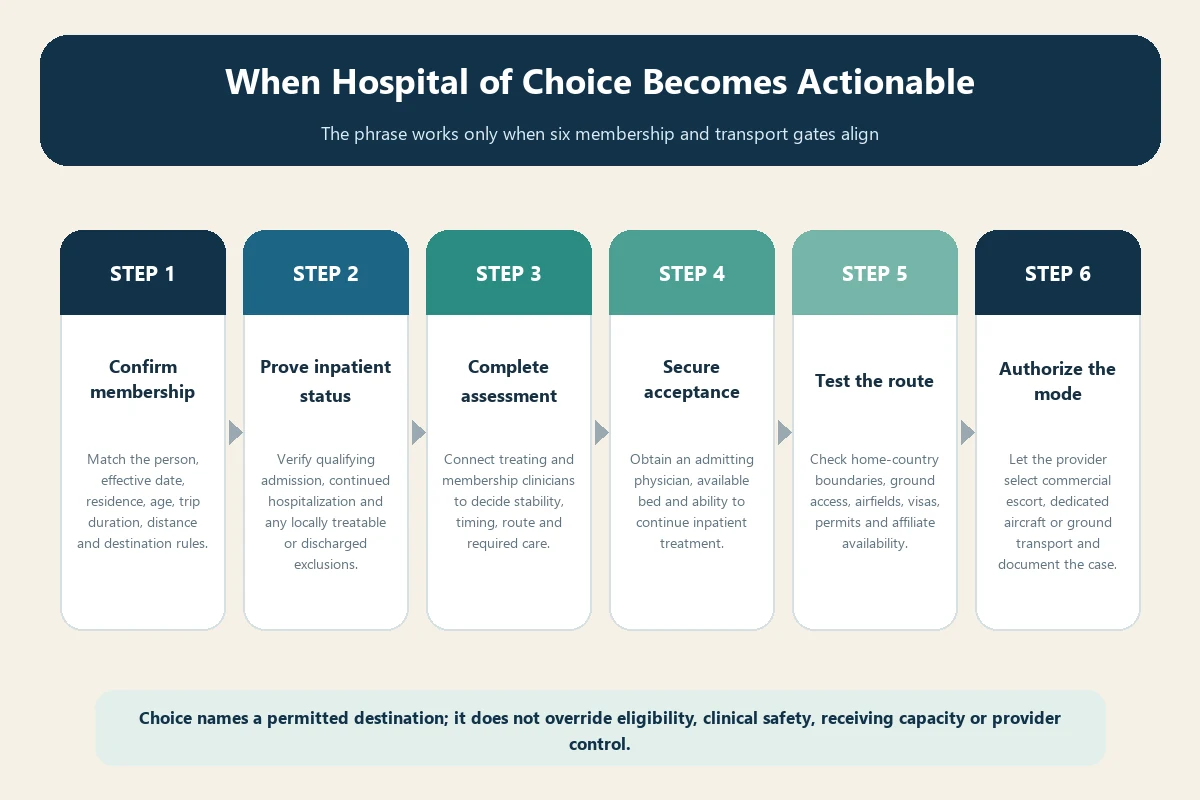
Build a six-gate contract audit
| Gate | Question to resolve | Evidence |
|---|---|---|
| Membership | Was this person eligible and active before the event? | Enrollment, effective date, residence |
| Travel | Does distance, trip duration, and geography qualify? | Itinerary, location, agreement |
| Hospital | Is the member admitted and still needing inpatient care? | Admission and physician records |
| Medical | Is transport safe, warranted, and clinically supportable? | Treating report and assessment |
| Receiving | Will the chosen hospital admit the patient to a bed? | Named physician and acceptance |
| Operations | Can the provider arrange a safe, lawful route? | Access, permits, mode, availability |
The evacuation approval guide is useful here because preference, clinical safety, membership eligibility, receiving acceptance, and aircraft operations belong to different decision makers.
Membership must exist before the emergency
Check when enrollment may be completed, where the applicant must be at enrollment, when the effective date starts, and whether renewal rules differ from new enrollment. An agreement can exclude a hospitalization already underway or travel begun before the effective date.
The July 2026 MedjetAssist annual rules are one current example. They describe an under-75 annual membership, require new enrollment while the person is at the residence address, and make successful fee collection part of validity. Other programs can use different ages, residence rules, waiting rules, or products.
Distance and trip-duration tests can stop eligibility
A membership may operate only when the person is a stated distance from a residence address. International trip duration can have a cap even when domestic travel is unlimited. A change of residence may need to be reported under prescribed conditions.
Record the member’s exact home address on file, event location, straight-line or agreement-defined distance method, departure date, international days, and itinerary. Do not rely on the marketing phrase “worldwide” to answer a distance or duration clause.
Hospitalized can mean formal inpatient admission
Emergency-department treatment, observation, outpatient surgery, a clinic visit, hotel recovery, or being medically unable to fly may not satisfy a defined hospital or inpatient trigger. Obtain the admission order, status, date, current unit, treating physician, and expected remaining inpatient course.
A membership can also decline minor conditions treatable locally or a patient who has already been medically discharged. The international hospital-transfer guide explains why the sending and receiving phases should be documented before discharge closes a transport pathway.
Continued inpatient need can be part of the destination test
Hospital of choice does not necessarily mean transport home for convenience or outpatient recovery. Current rules can require that the remaining inpatient hospitalization be completed at the receiving hospital. Ask both clinicians to state what care remains, why inpatient admission continues, and whether the chosen facility can provide it.
If the patient can safely travel without medical assistance or no longer needs inpatient care, ordinary return transportation, trip interruption, or a commercial change may be the relevant route instead of a membership transport.
Medical stability is not a self-assessment
The treating physician provides clinical facts, while the membership medical team can determine stability and transport requirements under the agreement. A patient can be too unstable for a long journey even when the family strongly prefers transfer.
One rules example permits initial movement to the nearest appropriate facility for stabilization, followed by home-country transport if the member later meets the criteria. The evacuation destination guide separates that first adequate-care movement from a later transfer.
The receiving hospital must say yes
A chosen hospital may need an admitting physician, an available appropriate bed, clinical records, payment or insurance information, and confirmation that it can continue the required inpatient treatment. Brand reputation or a relationship with a physician is not acceptance.
Some agreements place responsibility for obtaining acceptance on the member. Ask who must call, which records are needed, how long the bed can be held, whether a specialty unit is required, and what happens if capacity disappears before departure.
Home country defines the choice boundary
Copy the agreement’s definition of home country and residence address. The permissible hospital can be tied to the country of residence, not citizenship, passport, vacation home, family location, place of employment, or the country with the preferred specialist.
The home-country evacuation guide shows the same vocabulary problem in insurance forms. Point of origin, primary residence, country of residence, home country, and hospital of choice are not interchangeable.
Operational access can defeat an accepted route
Both hospitals may need ground-ambulance access to suitable airfields. The route may require landing permissions, overflight clearances, visas, medical records, entry documents, ground slots, weather, safe access, and an available affiliate. A cruise passenger may first need to reach a land-based hospital.
Hospital acceptance therefore does not equal departure clearance. Record the sending bedside, ground legs, departure airport, aircraft or commercial itinerary, arrival airport, receiving ambulance, admitting desk, and responsible coordinator.
The provider chooses the transport mode
A dedicated air ambulance is not automatically the benefit. Depending on clinical need, the provider may arrange a commercial airline seat with an authorized medical escort, a medically dedicated aircraft, or ground transport. The patient and family should not self-book a private aircraft and expect reimbursement unless the agreement expressly authorizes that process.
The evacuation route-cost guide explains why bed-to-bed transport includes more than flight time. Membership language may fund arranged services rather than reimburse a dollar invoice, but operational components still matter.
A second membership agreement shows why labels are insufficient
A Global Rescue consumer member-services agreement is another provider-specific example. It separates medical transport, local field rescue, transport of remains, and an optional security upgrade. It also reserves provider decisions about seriousness, access, safety, mode, and service limitations.
The lesson is not that two memberships are equivalent. It is the opposite: compare operative definitions and service sections rather than assuming the words medical evacuation membership produce a standardized benefit.
Hospital bills need a different funding source
A transport membership may not pay the foreign hospital, receiving hospital, physician, surgery, medication, intensive care, deductible, coinsurance, or ongoing treatment. Some current membership rules require the member to maintain home-country health insurance that can support inpatient admission.
The U.S. Department of State travel-insurance guidance recommends reviewing travel health and medical evacuation coverage separately. Do not buy a transport service and assume it funds treatment.
Medical planning still starts with qualified care
The CDC Yellow Book travel-insurance chapter recommends understanding the medical and evacuation resources available during travel. In an emergency, call local emergency services and stabilize the patient before treating a long-distance transfer as the first task.
Give the membership number and 24-hour contact to companions. Keep the agreement, medication list, diagnoses, insurer contacts, passport, visas, and advance directives accessible offline.
Ask these questions before enrollment
- Is this a service membership, insurance, or a combination?
- Who qualifies by age, residence, effective date, distance, and trip duration?
- What exactly counts as a hospital and inpatient admission?
- Must the patient continue inpatient care after transfer?
- Who decides stability, timing, route, and mode?
- Where may the chosen hospital be located?
- Who obtains the receiving physician and bed?
- What access, advisory, cruise, medical, and geographic limits apply?
- Does the member need separate health and travel medical insurance?
- What happens if the patient or family arranges transport independently?
The practical conclusion
Hospital of choice can be a meaningful difference between a medical transport membership and a standard nearest-adequate-facility evacuation benefit. It is still a destination permission inside a controlled service process, not an unconditional right to select any facility and demand any aircraft.
Release the route only after membership, travel, inpatient need, medical stability, receiving acceptance, home-country geography, ground access, documentation, provider authorization, and treatment funding align. That is when the phrase becomes an executable bed-to-bed plan rather than a marketing headline.