
Travel insurance does not pay for routine prescription refills or prevent medication interactions, so seniors taking multiple medicines need a reconciled list, adequate U.S.-dispensed supply, written time-zone schedule, storage plan, and licensed emergency replacement path before departure. The policy can then be tested for unexpected medical events, lost property, delay, cancellation, interruption, and pre-existing conditions connected to each diagnosis or recent medication change.
This article is educational, not medical, pharmacy, legal, or insurance advice. “Polypharmacy” can describe several medicines or medicine complexity, but the clinical appropriateness of any regimen belongs to the prescribers and pharmacist. Never start, stop, combine, substitute, or change a dose based on general travel content.
Key takeaways
- Reconcile prescription drugs, over-the-counter products, supplements, patches, injections, drops, and devices before travel.
- Use generic name, strength, purpose, schedule, prescriber, pharmacy, storage, and monitoring for every item.
- Medication changes can affect both medical stability and travel policy pre-existing-condition analysis.
- Medicare Part D generally does not cover retail prescriptions bought outside the United States.
- Separate routine supply, lost property, and an unexpected medication-related emergency into different claim lanes.
Reviewed: August 16, 2026.
Create one authoritative medication list
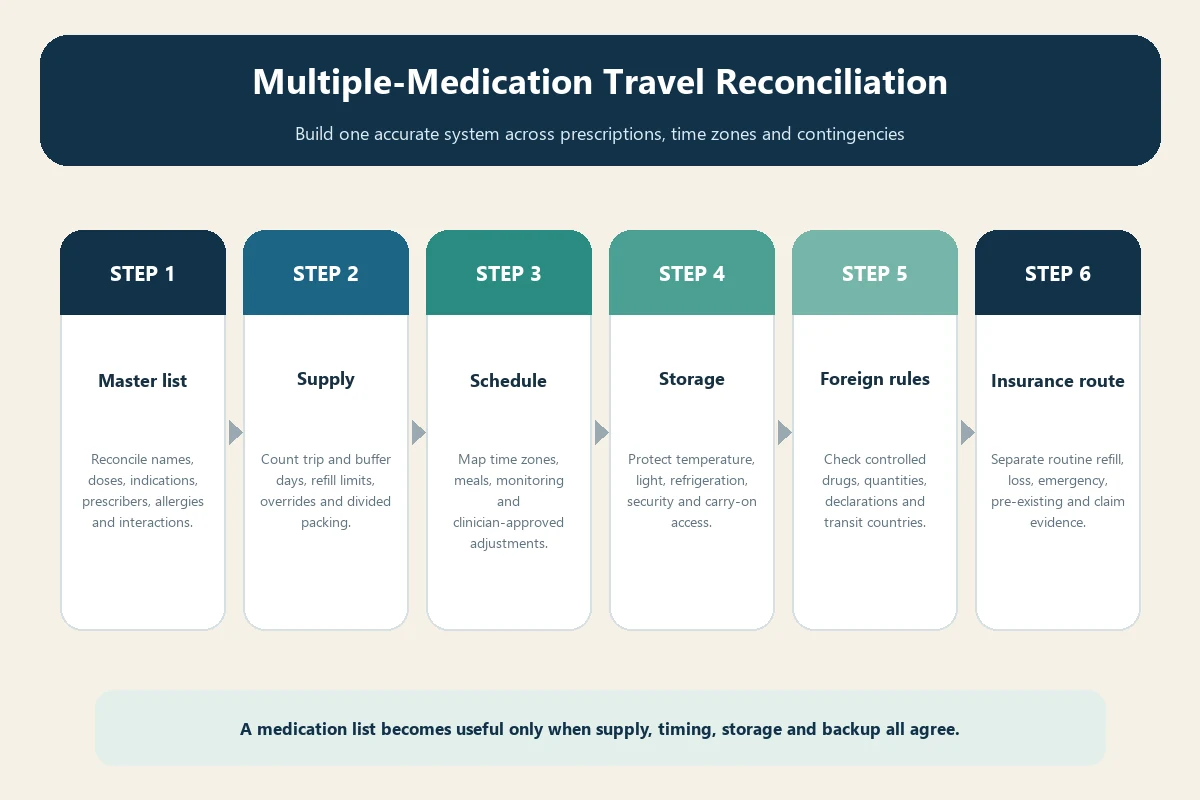
Combine every prescription, nonprescription drug, vitamin, supplement, inhaler, injection, patch, cream, eye drop, and as-needed medicine. Record generic and brand names, strength, form, schedule, indication, prescriber, dispensing pharmacy, start date, storage, and monitoring.
Give the list a revision date. A printed list without a date can be mistaken for a current regimen after a change.
Reconcile with the pharmacist and clinicians
Ask a pharmacist and the relevant prescribers to review duplicates, interactions, side effects, dosing times, refill dates, monitoring, and travel restrictions. More than one specialist may not see the complete record automatically.
The goal is not to reduce medicines for travel. It is to confirm the prescribed system and create safe instructions for time zones, delays, meals, illness, and missed doses.
Map each medicine to a condition
Travel insurers can ask about diagnoses, treatment, symptoms, and prescriptions. Connecting each medicine to its reason helps answer accurately and prevents a drug from being treated as the only condition.
Create a medical timeline for recent starts, stops, dose changes, side effects, emergency visits, and testing. The medication change and pre-existing-condition guide explains how a change can affect a claim.
Pre-existing-condition rules
Each underlying condition and treatment can be relevant during the look-back period. A waiver may remove a pre-existing-condition exclusion for otherwise covered losses when purchase timing and other eligibility conditions are met. It does not cover routine medicine or create benefits absent from the plan.
Use the senior pre-existing-condition questions and ask whether the waiver protects nontraveling family members or traveling companions when relevant.
Count the full door-to-door supply
Count doses from the first departure until reliable return to the U.S. pharmacy. Add a permitted disruption buffer for delays or an extended stay. A 30-day bottle may not cover a 30-day trip when airport and return days are included.
Check refill-too-soon, quantity, prior authorization, specialty pharmacy, controlled substance, and mail-order rules early. The chronic medication travel guide provides a refill timeline.
Vacation overrides
A Part D or other plan may allow an early fill or vacation override, but it is not automatic. The plan, pharmacy benefit manager, prescriber, and pharmacy can have separate steps. Request it weeks ahead and record the authorization.
Some medicines cannot be dispensed early or in large quantities under law or clinical rules. Do not build the trip around an unconfirmed supply.
Part D abroad
Medicare states that drug plans generally do not cover prescriptions purchased outside the United States. A foreign pharmacy receipt should be treated as a likely personal expense unless the exact plan gives written guidance otherwise.
Foreign brand names, formulations, and strengths can differ. Use a licensed clinician and pharmacy and provide the generic list. Do not accept informal substitutions.
Original labels and organization
Keep original pharmacy labels and destination-required documents. Pill organizers can help routine use but may not satisfy border or emergency identification. Carry labeled containers or a pharmacist-prepared system as advised.
Use an accessible method that prevents look-alike or sound-alike confusion. A caregiver should verify changes rather than refilling an organizer from memory.
Time-zone schedule
Ask the pharmacist or prescriber for a written transition schedule. Medicines taken once daily, multiple times, with food, on an empty stomach, at bedtime, or by injection can require different handling. Flights, cruise time, daylight-saving changes, and automatic phone clocks add complexity.
Do not shift every medicine by the same number of hours. Follow item-specific guidance.
Storage categories
Group medicines into room temperature, refrigerated, protected from light, protected from moisture, controlled substance, fragile device, and medically necessary liquid. Follow manufacturer and pharmacist instructions for the exact product.
A hotel minibar, frozen gel pack, car trunk, cargo hold, or bathroom can be unsuitable. Record temperature when required and obtain qualified advice after an excursion.
Carry-on and screening
Keep treatment-critical medicines accessible. TSA has procedures for medical liquids, injections, and devices, but return and transit airports follow their own rules. Declare items as requested and allow extra time.
Split a lawful supply only when both portions remain labeled and usable. Do not place every medicine in one checked bag.
Controlled medicines
Pain medicine, stimulants, anxiety medicine, sleep medicine, seizure rescue drugs, and other controlled substances can face strict destination and transit limits. A U.S. prescription does not guarantee import permission.
Check embassy or official health authority requirements, permits, quantity, and documentation. Choose a different itinerary if the necessary medicine cannot lawfully travel.
Supplements and over-the-counter products
Supplements, sleep aids, cold medicine, anti-diarrheal products, and pain relievers can interact with prescriptions. A familiar U.S. brand may contain different ingredients abroad.
Ask the pharmacist which nonprescription products are safe. Do not add a product because a tour guide or foreign seller recommends it.
Monitoring and devices
Some regimens depend on blood pressure, glucose, anticoagulation, laboratory tests, weight, oxygen, or another measurement. Decide which monitoring continues, what equipment travels, how results are shared, and what thresholds require care.
Routine monitoring is planned care and may not be covered by travel medical insurance. Price it and identify a qualified destination service.
Medication loss or delay
If medicine is lost, stolen, delayed, or damaged, contact the prescriber or pharmacist and follow the clinical backup. Obtain a carrier or police report when relevant. Use a licensed provider for replacement.
Baggage coverage can exclude medicines or apply limits. The baggage delay guide explains waiting periods and reports.
Travel medical coverage
A travel medical policy may cover eligible emergency evaluation and treatment for an unexpected adverse reaction, interaction, overdose, underdose, or interruption, subject to pre-existing-condition rules and all other terms. Routine refills and planned reviews are different.
Keep the medication list, event timeline, device logs, clinical records, itemized bills, and proof of payment. The insurer decides coverage; clinicians decide care.
Direct billing and foreign pharmacy payment
A foreign hospital may request a deposit. Assistance may guarantee payment for an eligible emergency or provide only a referral. A pharmacy purchase is often immediate out of pocket.
The direct-billing guide explains payment models.
Trip cancellation
Cancellation may apply when an unexpected covered medical change makes the traveler unable to depart. A medicine change, adverse effect, hospitalization, or unstable condition can be evaluated under the pre-existing-condition, waiver, and medical-ability rules.
Keep the clinical record, initial deposit, policy purchase, supplier refund, and nonrefundable balance.
Trip delay and interruption
A delay can exhaust supply or disrupt timing. Delay benefits may reimburse eligible expenses after a trigger, but the medication plan must work immediately. Interruption can address unused arrangements and additional return travel after a covered event.
Ask who arranges the return and whether a companion or medical escort is covered.
Medication emergency rehearsal
- Bag delayed: use the accessible carried supply and obtain the carrier report.
- Time-zone confusion: follow the written schedule and contact the pharmacist.
- Temperature excursion: isolate the medicine and obtain qualified usability advice.
- Foreign clinician prescribes a new drug: provide the complete list and check interactions.
- Unexpected adverse event: seek emergency care and document every medicine and dose timing.
Document packet
- Dated reconciled medication list
- Diagnosis-to-medicine map
- Prescriber and pharmacy contacts
- Prescriptions and original labels
- Time-zone and missed-dose instructions
- Storage, monitoring, and device requirements
- Destination permits and translations
- Medicare, MA, and travel policy documents
- Emergency hospital and assistance contacts
- Claim, receipt, and incident forms
Questions for the insurer
- How do the diagnoses, medicines, and recent changes fit the pre-existing-condition definition?
- Is a waiver available and valid?
- Would an interaction or adverse reaction be eligible?
- Are routine refills and monitoring excluded?
- Are medicines covered under baggage delay or loss?
- Can assistance locate a licensed pharmacy?
- Can an emergency receive direct payment?
- What cancellation and interruption documentation is required?
- Which payer is primary?
- What records and deadlines control a claim?
FAQ
Does taking many medicines prevent travel insurance?
Not automatically. The insurer evaluates the underlying conditions, treatment, recent changes, age, destination, and policy.
Does insurance cover routine foreign refills?
Do not assume so. Medicare Part D generally does not cover prescriptions purchased outside the United States, and travel medical benefits focus on unexpected events.
Should medicines stay in original bottles?
Original pharmacy labels support screening, border, and emergency identification. Ask the pharmacist how to combine safe organization with legal documentation.
What if a medicine schedule crosses time zones?
Obtain a written item-specific schedule from the prescriber or pharmacist. Do not shift every medicine by intuition.
Bottom line
Multiple-medication travel succeeds through reconciliation and redundancy. Verify every medicine, condition, refill, time, storage rule, interaction, monitoring need, and backup before departure. Then test pre-existing-condition, baggage, delay, medical, cancellation, and interruption provisions against the real system.
